Choosing a technology for a mobile application is not just a developer’s decision.
It affects the project budget, launch timeline, user experience, maintenance cost, app performance, and future growth.
For a startup founder or business owner, the real question is not:
“Which programming language is popular?”
The better question is:
“Which technology can help us build the right application without creating unnecessary cost and complexity?”
At Protriden Technologies, Flutter is one of the technologies we use for mobile application development because it offers a practical balance between speed, quality, consistency, and long-term maintainability.
But we do not choose Flutter simply because it is popular.
We choose it when it genuinely matches the business requirements of the project.
What Is Flutter?
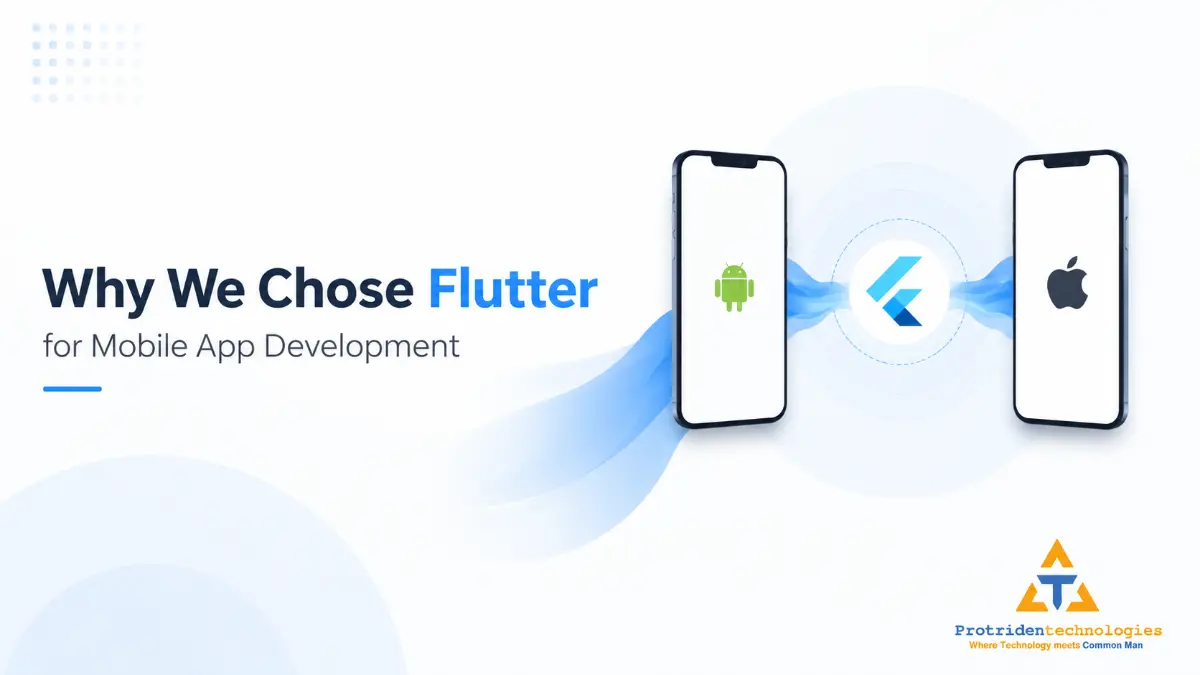
Flutter is a cross-platform application development framework created by Google.
It allows developers to build applications for Android and iOS using a shared codebase.
In traditional native development, businesses may need separate development efforts for:
- Android
- iOS
- Testing
- Bug fixing
- Feature updates
- Ongoing maintenance
Flutter can reduce this duplication by allowing many application features to be developed and maintained from one shared codebase.
For businesses, this may mean a more organized development process and a more consistent experience across platforms.
The Real Challenge Businesses Face Before Building an App
Most founders do not begin with a technology problem.
They begin with a business problem.
They may need to:
- Launch an MVP quickly
- Offer services through a mobile app
- Digitize bookings or orders
- Build a customer and service-provider application
- Create an internal business workflow app
- Connect users with an admin dashboard
- Support both Android and iOS users
- Keep development and maintenance manageable
The technology should support these goals.
It should not make the project more complicated than necessary.
That is one of the main reasons we often consider Flutter during project planning.
1. One Codebase for Android and iOS
One of Flutter’s biggest advantages is the ability to build Android and iOS applications from a shared codebase.
This does not mean every line of code will always be identical.
Some platform-specific work may still be required.
However, a large portion of the application can usually be developed and maintained together.
For businesses, this can simplify:
- Feature development
- Bug fixing
- UI updates
- Testing
- Version management
- Long-term maintenance
Instead of managing two completely separate applications, the development team can work with a more unified structure.
2. Faster MVP Development
Startups often need to test an idea before investing in a large, feature-heavy product.
They may need to launch a working MVP, collect feedback, understand user behaviour, and improve the application gradually.
Flutter is useful in such cases because the team can build core features for both major mobile platforms without starting two independent development processes.
This can help startups focus on important early-stage features such as:
- User registration
- Login and verification
- Booking
- Payments
- Notifications
- Profile management
- Location services
- Basic admin controls
- Reports and activity tracking
A faster launch does not mean skipping planning or quality checks.
It means reducing avoidable duplication.
3. Consistent Design Across Platforms
A business application should feel like the same product whether the user opens it on Android or iOS.
With separate native applications, maintaining design consistency may require additional coordination.
Flutter gives developers strong control over the user interface.
This helps create a consistent visual experience across devices.
Businesses can maintain the same:
- Brand identity
- Navigation structure
- Typography
- Buttons
- Forms
- User flows
- Visual components
- Interaction patterns
This is especially useful for customer-facing applications where trust and usability matter.
A user should not feel that the Android version is complete while the iOS version feels like a different product.
4. Better Development Efficiency
During application development, requirements change.
A startup may revise a feature.
A business may add a new workflow.
A payment provider may need to be updated.
A form may need extra fields.
A dashboard may need new reports.
When an application uses a shared codebase, the development team can often implement and maintain many changes more efficiently.
This is valuable during both initial development and long-term support.
The benefit is not only faster coding.
It also creates a cleaner process for:
- Feature updates
- Bug resolution
- Quality assurance
- Version control
- Release planning
- Maintenance
5. Useful for Feature-Rich Business Applications
Flutter is not limited to simple applications.
It can support many real-world business use cases, including:
- Booking applications
- Ecommerce applications
- Service-provider applications
- ERP and workflow applications
- Internal business tools
- Delivery applications
- Transport applications
- Customer portals
- Subscription-based applications
- Marketplace applications
At Protriden Technologies, mobile application development with Flutter forms part of our wider ability to build mobile apps, web applications, custom software, admin panels, cloud infrastructure, and business systems.
The mobile app is often only one part of the complete solution.
A successful product may also require:
- Backend APIs
- Admin panel
- Database
- Cloud hosting
- Notifications
- Analytics
- Security
- Monitoring
- Payment integration
- Deployment support
That is why we do not evaluate Flutter in isolation.
We evaluate the entire digital system.
6. Easier Maintenance for Growing Products
Application development does not end after launch.
Real users begin using the product.
New bugs appear.
Business rules change.
Operating systems introduce updates.
New features become necessary.
Security patches must be applied.
A shared codebase can make many maintenance activities easier because the development team does not have to manage two fully independent products for every change.
This can make long-term product management more practical for startups and businesses.
However, businesses should still plan for:
- Regular updates
- Testing
- Monitoring
- Performance reviews
- Security checks
- API maintenance
- Server management
- App Store and Play Store updates
Flutter can simplify maintenance, but it does not remove the need for professional support.
7. Strong User Interface Capabilities
Users judge an application quickly.
If it feels confusing, slow, or inconsistent, they may stop using it.
Flutter gives developers flexibility to create modern and responsive interfaces.
It is suitable for applications that need:
- Custom layouts
- Smooth navigation
- Interactive forms
- Dashboards
- Product listings
- Booking screens
- Maps
- Profile management
- Payment flows
- Visual progress tracking
A good interface is not only about appearance.
It should help users complete tasks without confusion.
That is why design, development, and business logic must be planned together.
8. Suitable for Startups With Controlled Budgets
A common challenge for startups is deciding how to use a limited budget.
Should they build only Android first?
Should they build separate Android and iOS apps?
Should they launch a web application?
Should they create an MVP?
The answer depends on the target users and business model.
Flutter may be suitable when the business needs both Android and iOS coverage but wants to avoid duplicating the entire development effort.
This does not mean Flutter makes every project cheap.
The final cost still depends on:
- Number of features
- UI complexity
- Backend development
- Admin panel requirements
- Third-party integrations
- Payment systems
- Maps and location usage
- Security requirements
- Testing
- Cloud setup
- Maintenance
Technology is only one part of the total project cost.
A simple Flutter app and a complex Flutter app can have completely different budgets.
Flutter vs Native App Development
Native development usually means building Android and iOS applications separately using platform-specific technologies.
Native development can be the right choice when a project requires:
- Deep device-level access
- Advanced hardware integrations
- Very high-performance graphics
- Platform-specific user experiences
- Complex background processing
- Highly specialized operating system features
Flutter may be a better fit when the project needs:
- Android and iOS support
- Faster MVP development
- Consistent design
- Shared business logic
- Controlled development effort
- Easier maintenance
- A practical cross-platform solution
The correct decision depends on the project, not on general trends.
Flutter vs React Native
Flutter and React Native are both popular cross-platform technologies.
React Native uses JavaScript and is connected closely with the React ecosystem.
Flutter uses Dart and provides its own rendering approach.
From a business perspective, the decision should not be based only on which framework is more popular.
The team should evaluate:
- Existing technical skills
- Application requirements
- UI complexity
- Required integrations
- Performance expectations
- Maintenance plans
- Available libraries
- Long-term support needs
Both technologies can be suitable.
The better choice is the one that fits the project and the development team’s ability to maintain it properly.
When We May Not Recommend Flutter
Flutter is powerful, but it is not the correct answer for every application.
We may recommend a different approach when:
- The application requires highly specialized native functionality
- The project depends heavily on platform-specific SDKs
- Advanced hardware features are central to the product
- The company already has a strong native development ecosystem
- The application is extremely graphics-intensive
- A web application would solve the business problem more effectively
- The project only needs one mobile platform
- The required third-party tools have weak Flutter support
Sometimes, the best decision is not to build a mobile app immediately.
A responsive website, web application, admin panel, or progressive web app may solve the problem at a lower initial complexity.
The technology should follow the business requirement.
How Protriden Selects the Technology for a Mobile App
Before recommending Flutter, native development, or another technology, we look at the complete project.
Business goal
What should the application achieve?
Is it generating bookings, managing staff, selling products, automating operations, or connecting users?
Target audience
Are users mainly on Android, iOS, or both?
Which devices and locations matter most?
Core features
Does the app need payments, maps, notifications, video, chat, offline access, or hardware integration?
Timeline
Is the business planning an MVP, pilot launch, or full product?
Budget
What should be built first, and what can be planned for later phases?
Backend requirements
Does the project need APIs, cloud infrastructure, database management, or third-party integrations?
Admin requirements
Who will manage users, payments, content, reports, bookings, and support?
Future growth
Will the product expand into new locations, user roles, services, or business models?
Only after understanding these points should the technology be finalized.
Flutter Is Only One Part of a Successful App
A well-built application needs more than a good framework.
Even the best technology cannot fix weak planning.
A successful mobile product also requires:
- Clear business requirements
- User-friendly design
- Reliable backend development
- Secure authentication
- Structured database design
- Stable cloud infrastructure
- Proper testing
- Performance optimization
- App Store and Play Store compliance
- Ongoing maintenance
- User feedback and improvements
That is why choosing a development partner matters as much as choosing the technology.
Why Protriden Uses Flutter
At Protriden Technologies, we choose Flutter because it can help us build practical cross-platform applications for startups, SMEs, and businesses that need Android and iOS support.
We use it when it helps the client:
- Launch more efficiently
- Maintain one organized product
- Deliver a consistent user experience
- Reduce duplicate development work
- Support future updates
- Connect the app with backend systems and admin panels
We do not choose Flutter blindly.
We choose it after evaluating whether it supports the business goal, budget, users, features, and long-term product plan.
Final Thoughts
Flutter is not valuable because it is trendy.
It is valuable when it helps a business build the right product with less unnecessary complexity.
For many startups and growing businesses, it provides a strong balance of cross-platform development, user experience, maintainability, and delivery efficiency.
But the final decision should always begin with the business problem.
Not the programming language.
Frequently Asked Questions
Is Flutter suitable for both Android and iOS?
Yes. Flutter is designed for cross-platform development and can be used to build applications for Android and iOS from a shared codebase.
Is Flutter good for startup MVP development?
Flutter can be a strong option for MVPs because it allows startups to build for both major mobile platforms without maintaining two completely separate codebases.
Is Flutter cheaper than native app development?
It may reduce duplicated development and maintenance effort, but the final cost depends on features, design, integrations, backend systems, testing, and infrastructure.
Can Flutter applications handle payments and maps?
Yes. Flutter applications can support payment gateways, maps, notifications, authentication, and many other integrations. The exact implementation depends on the project.
Is Flutter suitable for large business applications?
Yes, depending on the requirements. Flutter can support feature-rich business applications, but the architecture, backend, security, and infrastructure must also be planned properly.
Is Flutter better than React Native?
Neither is automatically better for every project. The right choice depends on the application requirements, team expertise, integrations, performance needs, and long-term maintenance plan.
Does every Flutter app need an admin panel?
Not every app needs one, but many business applications benefit from an admin panel for managing users, content, bookings, orders, payments, reports, and support activities.
How long does it take to build a Flutter app?
The timeline depends on the number of features, design complexity, integrations, backend development, testing, and approval requirements. A proper scope is needed before estimating accurately.
Planning a Mobile App for Your Business?
Before choosing Flutter, native development, or another technology, understand what your product actually needs.
Protriden Technologies helps startups, SMEs, and business owners plan and build mobile applications, admin panels, backend systems, cloud infrastructure, and complete digital products.
Book a free app idea consultation with Protriden Technologies.
We will help you review your:
- Business goal
- Target users
- Core features
- Technology options
- MVP scope
- Budget priorities
- Development roadmap