
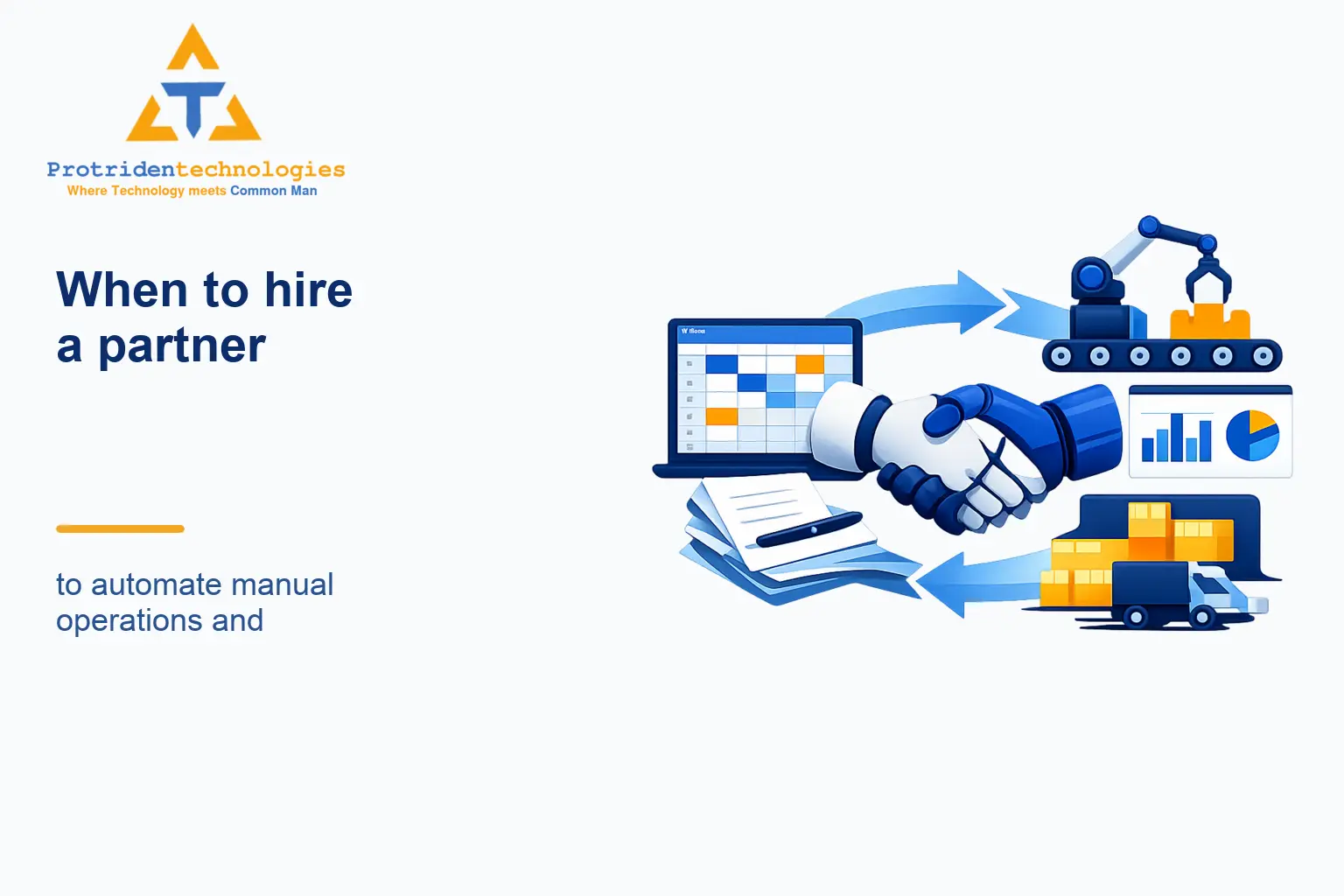
Your team spends hours copying, reconciling and emailing spreadsheets to keep operations moving. Errors, missed orders and delayed approvals slow fulfilment, add headcount pressure and make growth risky. You need a way to reduce repetitive work and regain operational predictability without derailing day-to-day business.
Hiring an external automation vendor can be faster than building internally: vendors map processes, deliver sprints and integrate systems so in-house teams can keep the lights on. The right partner blends workflow design with pragmatic engineering to replace brittle spreadsheet steps.
This article helps operations leaders and founders decide when to hire a vendor, what mistakes to avoid, a practical checklist for vendor selection, and how local context in India—especially Karnataka and Kundapura—affects engagement and delivery.
Why This Topic Matters
Manual, spreadsheet‑heavy processes create hidden operational cost: errors, rework, slow approvals and constrained throughput. Automating repetitive work reduces execution time, lowers error rates and lets staff focus on higher-value tasks. Practical automation is not just a cost play; it improves reliability and scales operations without linear headcount growth.
Vendors who focus on workflow automation can orchestrate multi-step processes that span departments and systems—order-to-cash, procurement, inventory adjustments and vendor onboarding—using a mix of API orchestration, file automation and targeted custom logic. This approach replaces manual handoffs and file exchanges with predictable, auditable flows (see S5).
Real implementations show measurable operational benefits when automation is scoped to preserve human checkpoints where decisions are required. For example, automating parts of failover or escalation procedures enabled teams to cut manual run times dramatically while ensuring an operator could still approve key steps (see S1).
- Automation reduces repetitive work, lowers error rates and improves process speed (S3, S5).
- Workflow orchestration and file-based automation handle cross-functional flows that spreadsheets cannot reliably support at scale (S5).
- Selective automation that preserves human approvals and decision points balances speed with control—consultants often deliver this faster than stretched internal teams (S1).
- Vendor-focused implementations can increase throughput without a proportional increase in headcount when properly designed and tested (S8).
Research references: Reduce Manual Repetitive Work With IT Automation | Info-Tech Research Group; Automation of manual processes: Your blueprint for scaling without breaking; How to Automate Manual Business Processes in 7 Steps; How To Automate Manual Tasks And Eliminate Costly Processes.
Common Mistakes Businesses Make
The most common mistake is automating the wrong thing: converting a broken spreadsheet process into an automated replica preserves inefficiencies. Start by mapping the process, clarifying outcomes and removing unnecessary steps before automating.
Another frequent error is underestimating scale and data shape. Automation that works on ten records can fail on thousands if flows are not bulkified and tested with realistic volumes. Poor documentation and hard-coded values create brittle systems that become maintenance liabilities.
- Automating flawed processes instead of redesigning them first.
- Skipping realistic load testing—what works for small batches may fail at scale (S2).
- Hard-coding business values in automation flows instead of using configurable metadata (S2).
- Neglecting file- and EDI-based transactions where partners rely on file exchange, creating partial solutions (S5).
- Choosing vendors who promise quick fixes without a roadmap for ongoing support and evolution.
Practical Checklist / Steps
Use this checklist to evaluate whether to hire a vendor and to compare proposals. The steps focus on outcomes, not specific technologies, so you can compare vendors who propose low-code platforms, RPA, or custom integrations.
- Clarify the business outcomes you need: Document the concrete improvements you expect—reduced reconciliation time, fewer invoice disputes, faster order fulfilment—and map baseline metrics to measure ROI later.
- Map the end-to-end process before choosing tech: Create a current-state process map that shows handoffs, data sources (spreadsheets, ERP, email), decision points and exception paths. Highlight pain points and data owners.
- Define the minimum viable automation scope: Break the work into small, testable sprints that deliver immediate value—e.g., automate data ingestion, then validation, then exceptions—so you can show progress and limit risk.
- Require bulk and edge-case testing in proposals: Ask vendors to describe how they will test with realistic volumes and exception scenarios; ensure they avoid loop-based operations that don't scale (S2).
- Insist on configurable business rules: Ensure automations use configurable rule sets or metadata rather than hard-coded values so non-developers can adjust thresholds and mappings when business needs change (S2).
- Plan for file-based and API integrations: If partners still use CSVs, EDI or file exchanges, require the vendor to include reliable file automation or EDI support alongside API work (S5).
- Check vendor support and knowledge transfer: Confirm ongoing support SLAs, maintenance plans and a knowledge-transfer schedule so your team can operate or extend the solution after delivery.
- Compare proposals on deliverables, not just hours: Evaluate vendor offers by deliverables, testing approach, documentation, and phased rollout plans. Vague promises of ‘automation’ without clear milestones are a red flag.
Cost, Timeline, or Decision Factors
Cost and timeline depend on process complexity, number of systems to integrate, data quality, partner readiness and whether you use low-code platforms, RPA or custom development. Vendors will price differently for integration work (APIs), file automation or building custom connectors.
Expect longer timelines when legacy systems lack APIs, when processes require heavy exception handling, or when organizational change management is necessary. Vendors can often deliver initial sprints quickly, but full end-to-end automation of mature processes typically arrives in phased releases.
- Process complexity: more decision points and exceptions increase scope and timeline.
- Systems integration: APIs simplify work; file/EDI integration adds mapping and validation effort (S5).
- Data quality and volume: cleansing and bulk testing add time but reduce long‑term failures (S2, S5).
- Governance and approvals: organizations that require many stakeholder sign-offs will see longer delivery schedules.
- Platform choice: low-code vendors can accelerate delivery for standard flows; custom code is required for unique integrations or performance at scale.
Local Relevance: India, Karnataka, and Udupi
Protriden Technologies is located in Kundapura, Udupi, Karnataka, India. For SMEs in the region, a local partner reduces travel time for scoping workshops and makes it easier to schedule in-person sessions when needed.
Local engagements also make it easier to align with regional business practices, language preferences and working hours, while still allowing remote development or cloud deployment when that is preferable for speed and cost efficiency.
- Kundapura, Udupi and greater Karnataka businesses can benefit from a nearby vendor for face-to-face process discovery and faster on-site follow-ups.
- Local presence simplifies coordination for pilot deployments, user acceptance testing and operational handoffs.
How Protriden Technologies Can Help
Protriden Technologies offers custom ERP, dashboards, billing, inventory and workflow automation services and can help scope a phased automation roadmap that replaces brittle spreadsheet steps with auditable flows. We combine UI/UX, backend APIs and cloud deployment expertise to deliver working, supportable solutions.
A practical vendor engagement from Protriden focuses on delivering small, measurable sprints that integrate with your existing systems, document flows and train staff so automation reduces operational risk without disrupting current operations.
- Process mapping and solution design for order-to-cash, procurement and inventory workflows.
- Custom integrations, API work and file/EDI automation to replace manual imports and exports (S5).
- Cloud deployment, monitoring and post-launch support to keep automations reliable (company services).
- Documentation, testing with realistic volumes and knowledge transfer so your team can maintain flows.
Final Thoughts
Deciding to hire an automation vendor is less about replacing staff and more about removing repetitive work that creates risk and slows growth. The right partner helps you redesign processes, automate reliably and measure improvements.
Start small, demand bulk testing and configurable rules, and choose a vendor with a clear phased roadmap and support plan. That approach delivers visible wins fast while preserving flexibility for future automation.
FAQs
When is the right time to hire an external automation vendor instead of building in-house?
Hire a vendor when manual workflows are causing measurable delays or errors, when internal teams are overloaded keeping day-to-day systems running, or when you need faster integration across multiple systems. Vendors can accelerate delivery by providing process design, reusable connectors and implementation experience.
How can I ensure a vendor won't just automate a broken spreadsheet process?
Require an initial process mapping and a proposed redesigned target state before any automation work begins. Include acceptance criteria that measure time saved, error reduction and throughput, and make sure the vendor documents and explains design decisions.
What kinds of automation approaches should I expect vendors to propose?
Vendors may propose low-code workflow platforms for standard flows, RPA for screen-level automation where APIs are absent, or custom integrations when unique systems and performance are needed. The right choice depends on your systems, volume and long-term maintenance expectations (S5).
How do I compare proposals from different vendors effectively?
Compare deliverables, testing strategies, documentation and post-launch support rather than hourly rates alone. Ask for a phased roadmap with measurable milestones and for examples of bulk testing and exception handling approaches.
Do I need to worry about data quality before automation?
Yes. Data cleansing and establishing canonical data formats are often part of the initial scope. Addressing data quality early reduces exceptions and rework and should be included in vendor proposals and timelines (S2, S5).
Discuss your highest-impact manual process with Protriden for a no-obligation process audit and a phased automation roadmap you can use to request scoped proposals.
Explore our software development services or discuss your requirements with the Protriden Technologies team.