Vibe Coding Risk: What Startups, CISOs and Developers Must Know Before Shipping AI-Generated Code
Vibe coding has made software development feel faster than ever.
A founder can describe an app idea and get working screens.
A student can generate code without fully understanding every line.
A junior developer can build features faster.
A solo entrepreneur can create a prototype in days instead of months.
This speed is powerful. But it also creates a serious problem: Just because AI-generated code works does not mean it is safe, scalable or maintainable. Many vibe-coded products look impressive during demos. Buttons work. Pages load. Forms submit. Dashboards show data. But behind the screen, there may be hidden risks:
- Hardcoded secrets
- Data leaks
- Injection flaws
- Flawed business logic
- Missing error handling
- Vulnerable dependencies
- Hallucinated libraries
- Weak authentication
- Poor access control
- Brittle architecture
- Technical debt
- AI code review gaps
- Shadow IT systems
- Unclear ownership
For students, vibe coding can be a good learning tool.
For startups, it can be useful for quick prototyping.
For CISOs, engineering managers and IT leaders, it can become a governance and security risk if unmanaged.
The real question is not:
“Should we use AI for coding?”
The better question is:
“How do we use AI coding without losing security, architecture, quality and human judgment?”
This blog explains the major vibe coding risks and how Protriden Technologies helps startups and businesses move from AI-generated prototypes to secure, maintainable and production-ready systems.
What Is Vibe Coding?
Vibe coding is a style of AI-assisted software development where the user describes what they want in natural language and the AI generates code.
For example:
“Create a login page with email and password.”
“Build an admin dashboard for orders and payments.”
“Add a payment gateway.”
“Create an API for user registration.”
“Fix this error.”
The AI then generates code, file structures, components, database queries or deployment instructions.
This can be useful for:
- Learning
- Prototyping
- MVP experiments
- UI generation
- Small internal tools
- Hackathons
- Early idea validation
But vibe coding becomes risky when generated code is pushed into production without architecture review, security testing, dependency verification, code audit and proper deployment practices.
Why Vibe Coding Risk Matters Now
Vibe coding is not only used by developers. It is now used by founders, students, product managers, freelancers, marketers, learners and non-technical users. This creates a new software risk. Earlier, production code usually passed through developers, team reviews and deployment pipelines. Now, AI-generated code can be copied, modified and deployed quickly by people who may not fully understand the system. This can create shadow IT. Shadow IT means software systems are created or used without proper IT, security or engineering oversight.
For startups, this can look like fast progress.
For companies, this can create hidden risk.
For security teams, this can create unknown applications, unknown dependencies and unknown data exposure.
For developers, it can create systems that are difficult to debug and maintain later.
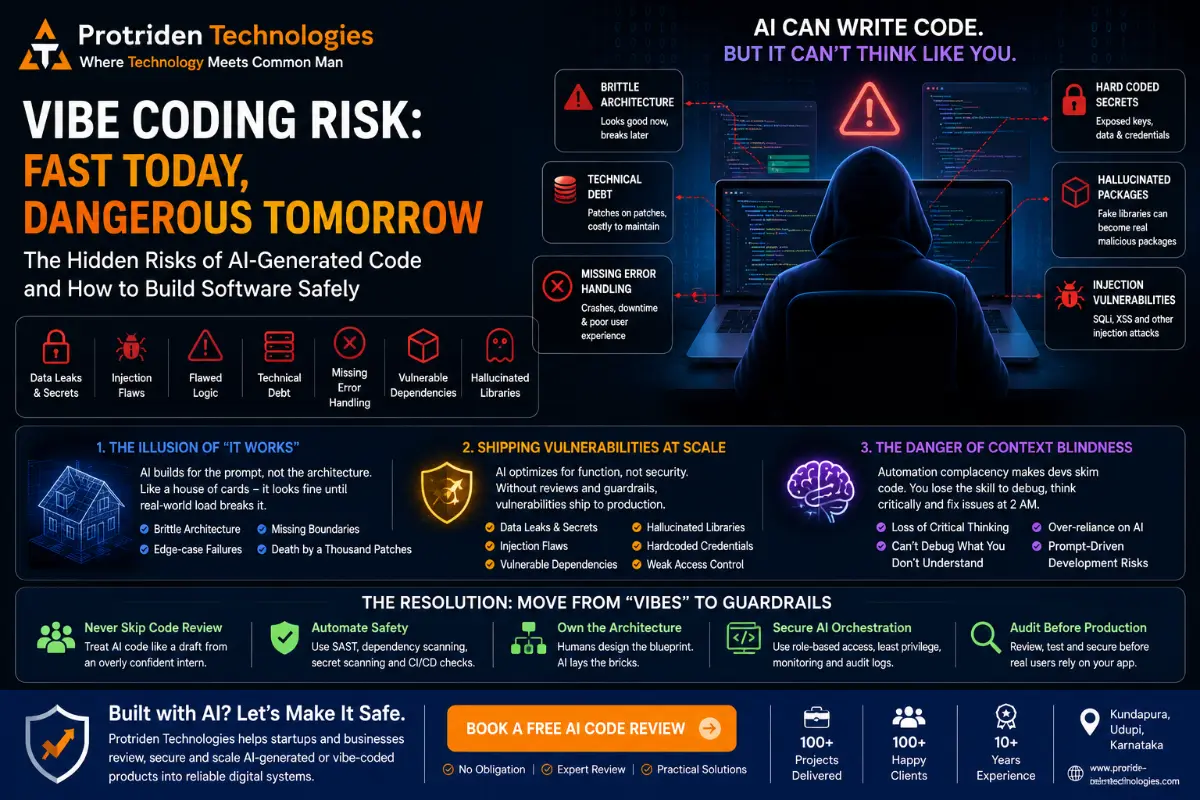
Section 1: The Illusion of “It Works”
This is the biggest trap in vibe coding. The code works today. So everyone assumes it is good. But working code is not the same as well-designed software. AI often builds for the immediate prompt, not the complete system architecture.
If you ask for a login screen, it may create a login screen.
If you ask for a dashboard, it may create a dashboard.
If you ask for payment integration, it may create a payment flow.
But it may not understand the full product context:
How authentication should work across the system
How roles and permissions should be designed
How errors should be handled
How database relationships should scale
How APIs should be secured
How logs should be managed
How the app should behave during failure
How future features will fit
How technical debt will affect maintenance
This creates brittle architecture.
The app may look fine from outside, but inside it becomes a house of cards.
The House of Cards Problem
Imagine building a house where each room is designed by a different architect.
One person designs the bedroom.
Another designs the kitchen.
Another designs the bathroom.
Another designs the electrical wiring.
Another designs the plumbing.
Each room looks good separately.
But nobody checks if the plumbing connects properly, if the electrical plan is safe, or if the structure can carry the load. Everything looks fine until you turn on the plumbing. That is what often happens with vibe-coded software. Each generated feature may work separately. But the full system may fail when real users, real data, real edge cases and real business rules come in.
This is where you see:
- Brittle architecture
- Edge-case failure
- Missing error boundaries
- Inconsistent coding patterns
- Repeated patches
- Duplicated logic
- Poor state management
- Unclear data flow
- Death by a thousand patches
The result is technical debt.
And technical debt becomes expensive when the product grows.
What Technical Debt Looks Like in Vibe-Coded Apps
Technical debt is not always visible on day one.
It appears slowly.
For example:
A small bug fix breaks another feature.
A new developer cannot understand the code.
A dashboard loads slowly as data grows.
A database query works for 100 users but fails for 10,000 users.
The app has repeated logic across multiple files.
Error messages are unclear.
APIs return inconsistent responses.
Authentication is handled differently in different modules.
Dependencies are added without checking whether they are safe.
A feature works only in the exact condition used during prompting.
This is why engineering managers and startup founders should not treat vibe-coded prototypes as production-ready products.
AI can help lay bricks.
But humans must design the blueprint.
Section 2: Shipping Vulnerabilities at Scale
For CISOs, DevSecOps teams and IT leaders, the biggest vibe coding risk is security. AI-generated code often optimizes for functionality. It tries to satisfy the prompt.
But secure software needs more than functionality. It needs threat modeling, input validation, authentication, authorization, secure configuration, dependency checks, error handling, secrets management, logging, monitoring and secure deployment. When vibe coding bypasses traditional code review and security checks, vulnerabilities can enter the product quickly. And because AI can generate code fast, insecure code can also be generated fast. This means companies may ship vulnerabilities at scale.
Data Leaks and Hardcoded Secrets
One common risk in AI-generated code is secret leakage. A user may paste API keys, database URLs, tokens, cloud credentials or production configuration into an AI tool while asking for help. AI may also generate examples that include environment variables directly in code.
This can lead to:
- Hardcoded API keys
- Database passwords inside source code
- Cloud access keys committed to repositories
- Exposed payment gateway secrets
- Public frontend access to backend credentials
- Broad cloud permissions
- Misconfigured storage buckets
For example, a vibe-coded app may include something like:
Database connection details directly inside a file.
An AWS access key in source code.
A Firebase config with weak rules.
A payment gateway secret used in frontend code.
These mistakes can expose customer data, business data and infrastructure access. Proper development should use environment variables, secret managers, restricted permissions and repository secret scanning.
Injection Flaws
Injection flaws happen when user input is not properly validated, sanitized or parameterized.
This can lead to attacks such as:
- SQL injection
- Cross-site scripting
- Command injection
- NoSQL injection
- Template injection
For example, an AI-generated login API may directly insert user input into a database query. Or a search field may display user-provided text without escaping it. Or an admin panel may accept HTML without validation.
The feature may work during demo. But an attacker may use the same input field to manipulate the database, steal data or run malicious scripts. This is why every input field, API endpoint and database operation needs careful security review.
Flawed Logic and Broken Access Control
Security is not only about code syntax. It is also about logic. AI-generated code may produce workflows that look correct but fail in real business situations.
For example:
A normal user can access admin data by changing an ID in the URL.
A vendor can view another vendor’s orders.
A customer can update payment status from the frontend.
A deleted account can still access old API tokens.
A role check exists in the UI but not in the backend.
A discount rule can be manipulated.
A booking can be confirmed without payment validation.
These are flawed logic issues. They may not be caught by basic testing. They need business understanding and security-aware code review.
Vulnerable Dependencies
Modern software depends on packages and libraries. AI tools often suggest dependencies to solve a problem quickly. But they may recommend outdated, vulnerable or unnecessary packages. This creates dependency risk.
A package may have known vulnerabilities.
A package may be poorly maintained.
A package may introduce too many sub-dependencies.
A package may conflict with existing architecture.
A package may be unnecessary and increase attack surface.
Dependency scanning, version locking, package review and security updates are important before production deployment.
Hallucinated Libraries and Malicious Packages
One of the most dangerous AI coding supply chain risks is package hallucination. Sometimes AI suggests a package that does not actually exist. If a developer installs that hallucinated package name later, an attacker may register a malicious package with the same name. This is called a slopsquatting-style risk.
The danger is simple:
AI invents a package.
Developer trusts it.
Attacker registers the package.
Developer installs it.
Malicious code enters the app.
This can affect npm, PyPI or other package ecosystems. To avoid this, developers should verify every package before installing it.
Check:
Does the package exist?
Who maintains it?
How many downloads does it have?
When was it last updated?
Are there known vulnerabilities?
Does it have suspicious install scripts?
Is it actually needed?
Never install AI-suggested packages blindly.
Missing Error Handling
AI-generated code often handles the happy path. The happy path means the ideal case where everything works correctly. But real software must handle failure.
Examples:
Database is down
Payment gateway fails
Network request times out
User uploads invalid data
File size is too large
API returns an unexpected response
Cloud storage fails
Email service is unavailable
Token expires
User refreshes during transaction
Duplicate request is submitted
If the app has missing error handling, users may see blank screens, failed transactions, broken workflows or exposed technical errors. Missing error boundaries can also make the app unstable. A production app should fail safely, show clear messages, log errors properly and protect sensitive information.
Shadow IT AI Coding
Shadow IT becomes a serious risk when teams build small tools using AI without approval from IT or security teams.
For example:
A sales team creates a customer tracking tool.
A marketing team creates a lead management dashboard.
A founder creates a prototype with customer data.
A junior developer deploys an internal tool using AI-generated code.
If these tools store business data, customer data or credentials without oversight, the organization may face compliance, security and data leakage risks.
This is why IT leaders should create safe AI coding policies instead of completely ignoring the trend.
Section 3: The Danger of Context Blindness
Vibe coding also creates a human risk. The AI gives 200 lines of clean-looking code.
The developer skims it.
The code runs.
The feature looks complete.
But the developer may not fully understand why it works.This is context blindness. The code may be accepted because it looks professional. But professional-looking code can still contain poor logic, weak security or hidden bugs. This creates automation complacency. The user begins to trust the AI output more than their own review process.
The Loss of Critical Thinking
For junior developers and learners, vibe coding can become dangerous if it replaces thinking. Good developers build mental muscle memory through:
- Debugging
- Reading errors
- Understanding flow
- Testing edge cases
- Designing data models
- Writing logic
- Reviewing code
- Breaking and fixing systems
If AI writes most of the code and the developer only prompts, this muscle memory may not develop properly. The developer may know how to ask the AI. But they may not know how to fix the app when it breaks at 2:00 AM. This is a serious learning risk. AI should support learning. It should not replace understanding.
If You Do Not Know Why It Works, You Will Not Know How to Fix It
A production incident does not wait for a perfect prompt.
When the app fails, you need to understand:
- Where the request failed
- Which API is involved
- What the logs mean
- Which dependency changed
- Why the database query is slow
- Why authentication failed
- Why a user accessed the wrong data
- Why a payment was marked incorrectly
- Why the server crashed
If the team does not understand the codebase, debugging becomes slow and risky. This is why vibe-coded systems need human ownership. Every generated line should be reviewed, understood and accepted by a responsible developer.
The Dangers of Prompt-Driven Development
Prompt-driven development can create speed. But without discipline, it can also create chaos. The danger is that every new prompt adds another patch. One prompt fixes login.
Another changes the dashboard.
Another adds payment.
Another fixes a bug.
Another changes the database.
Another updates the API.
Slowly, the codebase becomes a collection of patches instead of a designed system. This creates:
- Unclear architecture
- Repeated logic
- Poor naming
- Inconsistent error handling
- Unplanned dependencies
- Security gaps
- Hard-to-maintain code
- Weak testing coverage
A serious product cannot be built only through prompts. It needs architecture, standards, reviews and guardrails.
Moving from Vibes to Guardrails
The answer is not to stop using AI. The answer is to use AI safely. AI can be useful when it is placed inside a disciplined development process.
Here are practical guardrails.
1. Never Skip Code Review
Treat AI-generated code like a draft from an overly confident intern.
It may be useful.
It may be fast.
It may even be mostly correct.
But it still needs review.
Review for:
- Security
- Logic
- Error handling
- Performance
- Architecture fit
- Code duplication
- Dependency risk
- Data exposure
- Access control
- Maintainability
No AI-generated code should go directly to production without review.
2. Automate Safety in CI/CD
Manual review is important, but it is not enough. Use automated checks in the development pipeline.
Important checks include:
- Static Application Security Testing
- Dependency scanning
- Secret scanning
- Linting
- Unit tests
- Integration tests
- API tests
- Container image scanning
- Infrastructure-as-code scanning
- License checks
- Build validation
- Deployment approval
These checks act as guardrails. They help catch issues before they reach production.
3. Verify Every Dependency
Do not blindly install packages suggested by AI.
Before using a package, verify:
- Package name
- Official documentation
- Repository activity
- Maintainer reputation
- Known vulnerabilities
- License
- Download pattern
- Recent releases
- Open issues
- Transitive dependencies
For important systems, use lock files and approved dependency lists.
4. Protect Secrets Properly
Never paste production secrets into AI tools. Never hardcode credentials into code.
Use:
- Environment variables
- Secret managers
- Restricted access permissions
- Key rotation
- Repository secret scanning
- Least privilege cloud roles
- Separate development and production credentials
Secrets should be handled as a security process, not as random configuration.
5. Own the Architecture
Humans must design the blueprint. AI can help write parts of the implementation.
Before coding, define:
- System architecture
- Database design
- User roles
- API structure
- Authentication flow
- Authorization rules
- Error handling pattern
- Logging strategy
- Deployment plan
- Testing strategy
- Security requirements
- Maintenance plan
This prevents the house-of-cards problem.
6. Audit AI-Generated Code Before Production
If you already built a product using vibe coding, do not panic. But do not launch blindly. Audit the code before real users depend on it. An AI code audit should check:
- Secrets and credentials
- Authentication
- Authorization
- Input validation
- Database queries
- API security
- Error handling
- Dependencies
- Cloud permissions
- Data storage
- Logging
- Performance
- Code structure
- Testing gaps
- Deployment configuration
This helps identify what must be fixed before launch.
How Protriden Technologies Avoids Vibe Coding Risks
At Protriden Technologies, the focus is not on blindly generating code. The focus is on building practical, secure and maintainable digital systems that solve real business problems. Protriden’s approach is human-led and engineering-focused. The team avoids unsafe vibe coding practices by focusing on: Requirement understanding before development Architecture planning before implementation
- MVP scope clarity
- Secure coding practices
- Backend and admin panel planning
- Proper error handling
- Role-based access control
- Environment-based configuration
- Code review
- Dependency verification
- Testing before deployment
- Cloud and DevOps planning
- Security-focused development
- Post-launch support and maintenance
AI tools can help speed up certain development tasks. But they should not replace engineering judgment. Protriden treats software development as a structured process, not just prompt generation.
How Protriden Helps Startups Already Using Vibe Coding
Many startup founders and solo builders use vibe coding to create early prototypes. That is not wrong. A prototype can help validate an idea. But before taking it to real users, payments or customer data, the system needs to be checked.
Protriden Technologies can help with:
- AI-generated code review
- Security audit
- Architecture review
- Backend cleanup
- Admin panel rebuilding
- Dependency check
- Cloud deployment review
- Secret leakage check
- Database design improvement
- API security review
- Performance optimization
- MVP planning
- Production-readiness assessment
- Maintenance and support
If your vibe-coded app works but feels unstable, slow, insecure or difficult to improve, Protriden can help you turn it into a proper product.
Who Should Care About Vibe Coding Risk?
CISOs and IT Leaders
You should care because AI-generated code can create security, governance, compliance and shadow IT risks.
Startup Founders and Solo Entrepreneurs
You should care because a fast prototype may not be safe enough for real customers, payments or investor demos.
Engineering Managers and Dev Leaders
You should care because AI-generated code can increase review load, technical debt and architecture inconsistency.
Junior Developers and Learners
You should care because AI can help you learn faster, but only if you understand the code and do not skip debugging, review and fundamentals.
Final Thoughts
Vibe coding is powerful. But it is not magic.
It can help build prototypes faster.
It can help students learn.
It can help founders visualize ideas.
It can help developers move faster.
But it can also introduce data leaks, injection flaws, flawed logic, technical debt, missing error handling, vulnerable dependencies, hallucinated packages, shadow IT risk and weak architecture. The safest approach is not “no AI.” The safest approach is controlled AI.
Use AI for speed.
Use humans for architecture.
Use code review for quality.
Use automated guardrails for security.
Use DevOps pipelines for safe deployment.
Use audits before production.
If you have built a product using vibe coding and you are not sure whether it is secure, scalable or production-ready, Protriden Technologies can help you review, fix and strengthen it. The goal is simple:
Move from vibes to guardrails.
Build fast.
But build safely.
FAQs
1. What is vibe coding risk?
Vibe coding risk refers to the security, architecture, quality and maintenance problems that can happen when AI-generated code is used without proper review, testing and engineering controls.
2. Is vibe coding safe for startups?
Vibe coding can be useful for prototypes and MVP experiments. But before launching to real users, the code should be reviewed for security, architecture, dependencies, secrets, error handling and scalability.
3. Can AI-generated code contain vulnerabilities?
Yes. AI-generated code can contain vulnerabilities such as injection flaws, weak access control, hardcoded secrets, insecure dependencies, missing validation and flawed business logic.
4. What are hallucinated libraries in AI coding?
Hallucinated libraries are package names invented by AI tools. If developers install these packages without verification, attackers may register malicious packages with the same names and create supply-chain risk.
5. Why is vibe coding risky for junior developers?
Junior developers may accept AI-generated code without understanding it fully. This can reduce debugging skills, critical thinking and the ability to maintain or fix production issues.
6. What is shadow IT in AI coding?
Shadow IT in AI coding happens when teams or individuals build and deploy software using AI tools without proper IT, security or engineering oversight.
7. How can companies reduce vibe coding risk?
Companies can reduce risk through code review, secure coding standards, SAST tools, dependency scanning, secret scanning, CI/CD checks, architecture reviews, access control and developer training.
8. Can Protriden Technologies audit AI-generated code?
Yes. Protriden Technologies can help review AI-generated or vibe-coded prototypes, identify security and architecture gaps, improve backend systems, check dependencies, review cloud setup and make the product more production-ready.
Built Something With Vibe Coding?
A working prototype is a good start. But before you launch it for real users, customer data, payments or business operations, make sure it is secure, scalable and maintainable. At Protriden Technologies, we help startups, founders and businesses review and strengthen AI-generated or vibe-coded products.
We can help with:
AI-generated code review
Security audit
Architecture review
Dependency check
Secret leakage check
Backend cleanup
Admin panel development
Cloud and DevOps setup
Production-readiness assessment
Maintenance and support
Book a free AI code and product readiness discussion with Protriden Technologies.