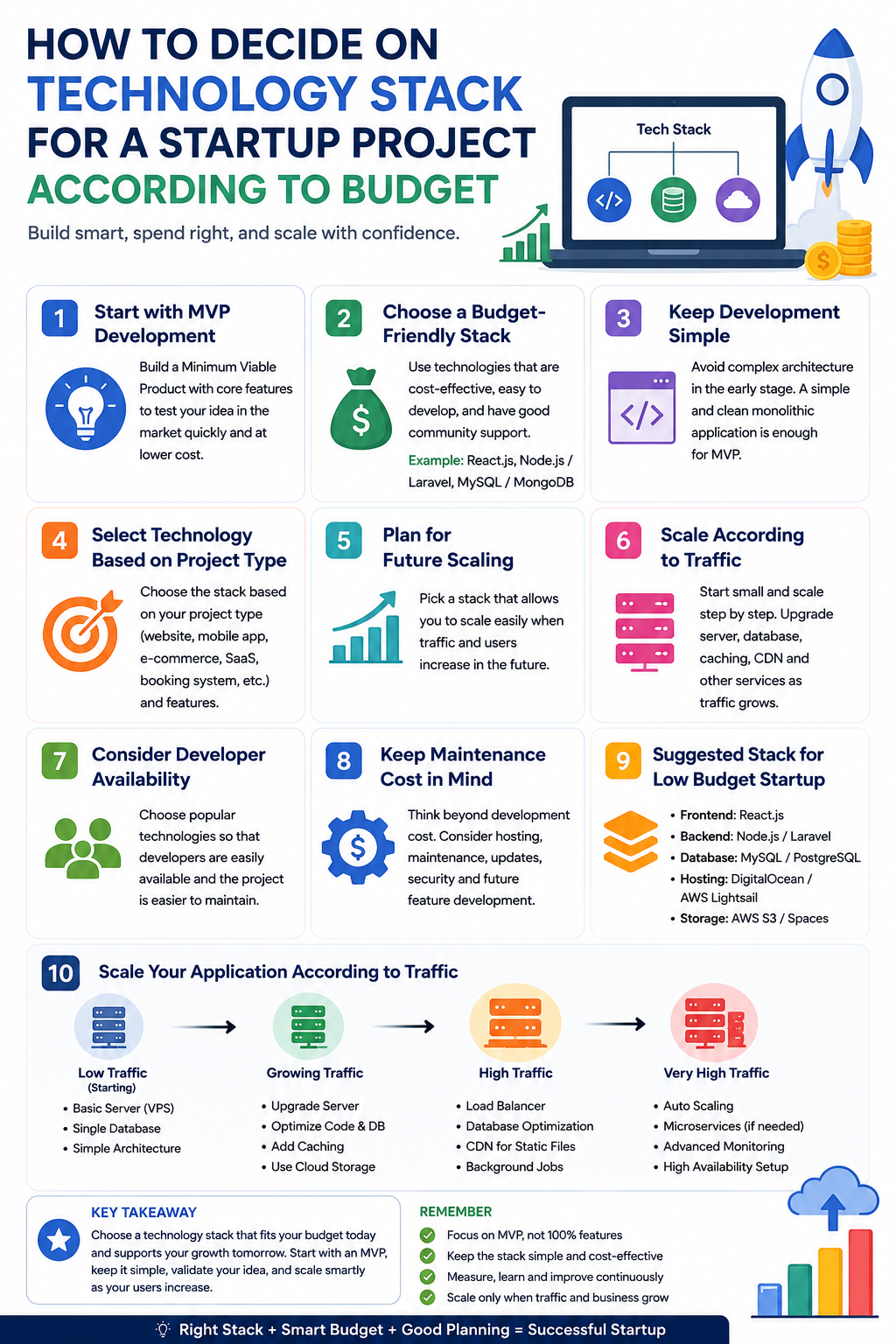
Choosing the right technology stack is one of the most important decisions for a startup project. The right stack helps you build faster, reduce development cost, launch an MVP quickly, and scale the application when traffic increases.
1. Start with MVP Development
For a startup, the first goal should be to build an MVP, which means Minimum Viable Product. An MVP includes only the most important features needed to test the idea in the market.
Instead of building every feature in the beginning, focus on the core features like user registration, login, main service flow, payment, dashboard, and basic admin panel. This saves time and reduces development cost.
2. Choose a Budget-Friendly Stack
If the budget is low, choose technologies that are easy to develop, easy to maintain, and have good community support. Avoid using too many complex tools in the beginning.
For many startup projects, a simple stack like React.js for frontend, Node.js or Laravel for backend, and MySQL or MongoDB for database can be a good choice. This type of stack is cost-effective and suitable for MVP development.
3. Keep Development Simple
In the early stage, do not overcomplicate the project with microservices, advanced DevOps, or expensive cloud architecture. A simple monolithic backend with a clean database structure is enough for most MVPs.
The main focus should be fast development, stable performance, and easy future upgrades.
4. Select Technology Based on Project Type
The technology stack should depend on the type of project. A simple business website, mobile app backend, e-commerce platform, booking system, or SaaS product may need different technologies.
For example, a content-based website can use WordPress or Laravel, while a real-time application may need Node.js. A mobile app backend can use Node.js, Laravel, or Django depending on the features and budget.
5. Plan for Future Scaling
Even if you start with a small setup, your technology stack should allow future scaling. When traffic increases, you should be able to upgrade the server, optimize APIs, improve database queries, add caching, and move files to cloud storage.
Good planning in the beginning helps avoid major technical problems later.
6. Scale According to Traffic
Do not spend heavily on scaling before your project gets users. Start with a basic server and scale step by step when traffic grows.
When users increase, you can improve the application by adding load balancing, caching, database optimization, CDN, background jobs, and separate services for heavy tasks.
7. Consider Developer Availability
Choose technologies for which developers are easily available. A startup should avoid rare or highly complex technologies unless there is a strong reason to use them.
Popular technologies like React.js, Node.js, Laravel, Python, MySQL, PostgreSQL, and MongoDB are easier to maintain because many developers already know them.
8. Keep Maintenance Cost in Mind
Development cost is not the only cost. You should also consider server cost, maintenance cost, bug fixing, updates, security, and future feature development.
A simple and well-known technology stack usually reduces long-term maintenance cost.
9. Suggested Stack for Low Budget Startup
For a low budget startup MVP, you can start with a simple and practical stack:
10. Conclusion
The best technology stack for a startup is not always the most advanced one. It should match your budget, project requirements, development timeline, and future growth plan.
Start with an MVP, keep the stack simple, control the cost, and scale the application step by step according to real traffic and business growth.