
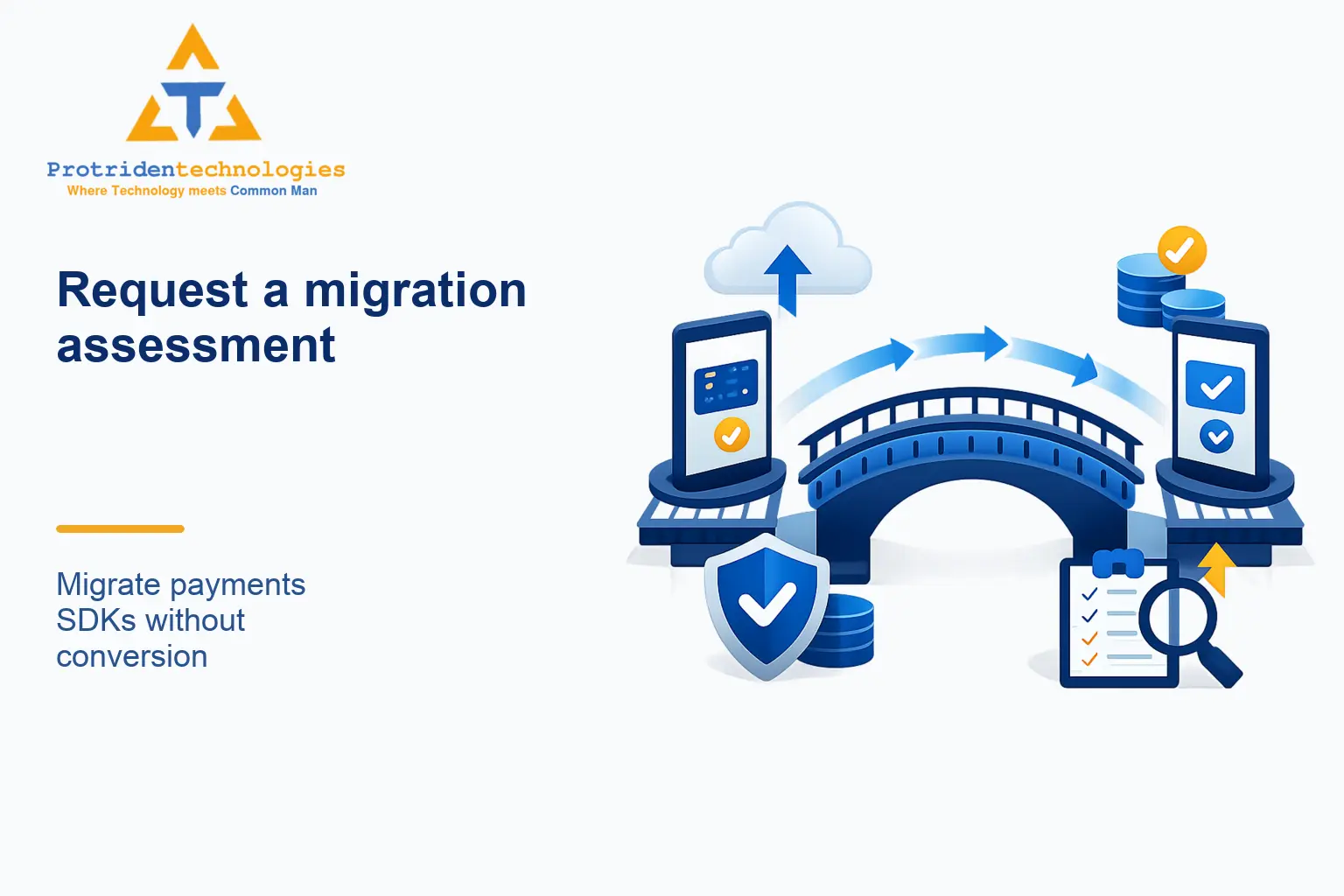
You must replace or upgrade a payments SDK in a live Android/iOS app, but the migration risks breaking merchant verification, triggering app-store or payments-provider compliance checks, and causing measurable conversion drops. Your product roadmap and regulatory deadlines leave little margin for error, and your internal team has limited time for a low-risk cutover.
A specialist assessment can scope the technical cutover, map merchant verification gaps and design an A/B rollback plan so revenue funnels stay intact during the transition.
This article explains what to include in a migration assessment, common mistakes to avoid, a practical checklist for the cutover, and how a local vendor can help your team in India, including Karnataka and Udupi-region specifics.
Why This Topic Matters
Payments SDK migrations are high-risk platform changes. A poor cutover can interrupt checkout flows, invalidate stored tokens, or change retry logic, which directly affects conversion and revenue. Well-run migrations use parallel staging, phased traffic shifts and measurement to keep user experience consistent while verifying merchant verification paths and compliance.
Vendor and in-house migration guides emphasize a phased approach: parallel integrations, sandbox validation, token and subscription handling and rollback safety nets. A focused assessment identifies which of these controls are missing for your app and quantifies the exposure to conversion loss and compliance flagging.
- Parallel migration reduces customer-visible errors by keeping the old and new SDKs available until the new flow proves reliable.
- A/B analysis and server-side feature flags are required to measure conversion delta and enable a fast rollback if conversion drops.
- Merchant verification workflows and tokenization must be tested end-to-end to avoid app-store or payments-provider rejections.
Research references: Switching Your International Payment Gateway: A Migration Guide for Indian Businesses (2026) - Razorpay Blog; Payment Processing Migration Checklist: How to Avoid Downtime; What Is a Payment Gateway SDK? A Developer's Guide; Payment Gateway Integration Services India | All Major Gateways | PrecisionTech.
Common Mistakes Businesses Make
Teams often treat SDK replacement as a pure engineering task and omit product and analytics validation. Without coordinated measurement, an integration can subtly change checkout timing or error handling and cause conversion loss that only appears after rollout.
Common gaps include insufficient sandbox testing with representative merchant accounts, incomplete token migration plans for subscriptions, weak rollback mechanisms and lack of documentation for merchant-verification edge cases.
- Relying solely on unit tests and SDK examples, without end-to-end merchant verification in realistic environments.
- Skipping parallel traffic phasing and immediate A/B measurement during the cutover.
- Failing to validate stored payment tokens, recurring billing or card-on-file migration before switching live traffic.
- Assuming the new SDK will handle identical retries, timeouts and error codes to the old version.
Practical Checklist / Steps
Use this checklist as the scope for a migration assessment deliverable. Each item should produce clear acceptance criteria, test plans and rollback triggers that a vendor can document and hand over to your team.
- Map current payment flows and dependencies: Document every payment path in the app: guest checkout, logged-in checkout, saved cards, subscriptions, wallets, UPI flows and webviews. Note backend endpoints, tokenization flows and merchant-verification steps that the current SDK triggers.
- Inventory SDK features and deviations: Compare capabilities and default behaviors between old and new SDKs: retry policies, 3DS handling, webhook formats, error codes, logging levels, and any differences in client-side validations.
- Define measurement and success metrics: Agree on primary conversion metrics (checkout success rate, drop-off at payment step, authorization success rate), sampling windows, and A/B statistical thresholds that will trigger rollback or continued rollout.
- Design parallel integration and traffic phasing: Plan a rollout where both SDKs can operate simultaneously or where a server-side gateway routes test traffic to the new provider. Include feature flags and percentage ramps tied to defined metrics.
- Prepare merchant verification and compliance tests: Create test cases for merchant verification flows, app-store payment disclosures and any required documentation checks. Validate with representative merchant accounts and, if relevant, switch to live modes only after verification.
- Plan token and subscription migration: Identify stored payment tokens and subscriptions; document whether tokens can be reused or must be re-tokenized. If re-tokenization is needed, design UX flows and backend support to minimize friction.
- Build a rollback and incident playbook: Define immediate rollback triggers, engineering steps to revert traffic, communication templates for customers and merchants, and monitoring dashboards to detect issues within minutes of rollout.
- Run staged end-to-end validation: Execute staged tests in sandbox and limited production slices covering payment success, declines, partial failures, network interruptions and retry behavior. Include payment provider webhook and reconciliation checks.
Cost, Timeline, or Decision Factors
Cost and timeline for a migration assessment depend on the complexity of your payment flows, the number of platforms (Android, iOS, web), tokenization and subscription footprint, and whether merchant verification requires coordination with third parties. Integrations that need token migration or customized reconciliation will require more engineering and validation time.
Assessments typically produce a prioritized remediation list and a staged implementation plan. Because detailed timelines vary by scope, the assessment should clarify which items are high-risk and must be resolved before cutover versus which can be mitigated with phased rollout controls.
- Technical complexity: multi-gateway, multi-region or non-standard payment flows increase effort.
- Tokenization and subscriptions: migrating stored tokens or active subscriptions raises both cost and testing needs.
- Compliance and merchant verification: additional coordination with payment providers or app stores can lengthen timeline.
- Analytics and rollback tooling: if A/B frameworks or server-side feature flags are not in place, add time to implement them.
Local Relevance: India, Karnataka, and Udupi
India’s payments ecosystem includes UPI flows, domestic gateways and wallet systems that often require specific SDK support and regional configuration. Indian apps also rely on gateway features like tokenization and recurring billing that must be verified during migration.
Protriden Technologies is based in Kundapura, Udupi, Karnataka. Local presence can help coordinate with Indian payment providers, run live merchant-verification tests using representative local bank and gateway accounts, and support on-ground validation where required.
- Include UPI flows, local wallets and domestic gateway behavior in the assessment to catch India-specific edge cases.
- Validate app-store disclosures and merchant verification steps that are commonly required by Indian payment providers and gateway integrations.
- Local testing in Karnataka or nearby regions can use realistic network conditions and merchant accounts relevant to your user base.
How Protriden Technologies Can Help
Protriden Technologies can run a focused migration assessment that combines technical scoping, merchant-verification testing, A/B measurement design and a documented rollback plan. The assessment produces an actionable remediation backlog, test plans and an implementation phasing recommendation that your engineering and product teams can execute or task to a delivery partner.
Our local engineering capabilities include mobile (Android, iOS, Flutter) development, backend APIs, billing and subscription workflows, CI/CD deployment and application security practices. We can also support cloud deployment, monitoring and post-launch verification to keep payment funnels healthy after cutover.
- Deliverables: migration assessment report, prioritized remediation list, A/B experiment design and rollback playbook.
- Technical capabilities: native and cross-platform mobile development, backend API changes, token and subscription handling.
- Operational support: sandbox and limited-production test runs, monitoring dashboards, and post-cutover validation.
Final Thoughts
A migration assessment is not a luxury; it’s a risk-control tool for a change that touches revenue and compliance. By scoping the work, identifying merchant-verification gaps and designing measurement-backed rollouts, you protect conversion and reduce the chance of disruptive compliance checks.
Engage a partner to run the assessment if your team lacks bandwidth for end-to-end merchant testing, A/B measurement setup or rapid rollback tooling. The assessment clarifies decision points and gives you a safe path to cut over the new SDK with contingency plans in place.
FAQs
What exactly does a migration assessment deliver?
A migration assessment typically delivers a documented map of current payment flows, comparison between old and new SDK behaviors, an A/B measurement plan, a prioritized remediation backlog, token/subscription migration strategy and a rollback playbook with acceptance criteria.
How can we measure conversion impact during the cutover?
Use an A/B framework or server-side feature flags to route a percentage of traffic to the new SDK, instrument checkout success metrics and monitor them against pre-defined thresholds. The assessment defines the metrics, sampling windows and rollback triggers.
Will the assessment tell us how to handle stored payment tokens?
Yes. The assessment analyzes whether tokens can be reused by the new SDK, whether the gateway supports token export or if re-tokenization is needed, and it proposes UX and backend flows to minimize customer friction when tokens must be refreshed.
Can a migration be done without any downtime?
Many migrations use parallel integrations and phased traffic shifts to avoid customer-visible downtime. The assessment evaluates whether your architecture and provider support such an approach and documents the steps and fallbacks needed to keep live revenue flowing.
How long does an assessment take and when should we engage a vendor?
Assessment duration varies by scope: number of platforms, complexity of payment flows and tokenization needs. Engage a vendor early—before coding the cutover—so the assessment can define test requirements, measurement plans and rollback capabilities that reduce rework and risk.
Request a migration assessment from Protriden to scope your payments SDK cutover, get an A/B rollback plan and preserve conversion. Contact us to start the scoping conversation.
Explore our software development services or discuss your requirements with the Protriden Technologies team.