
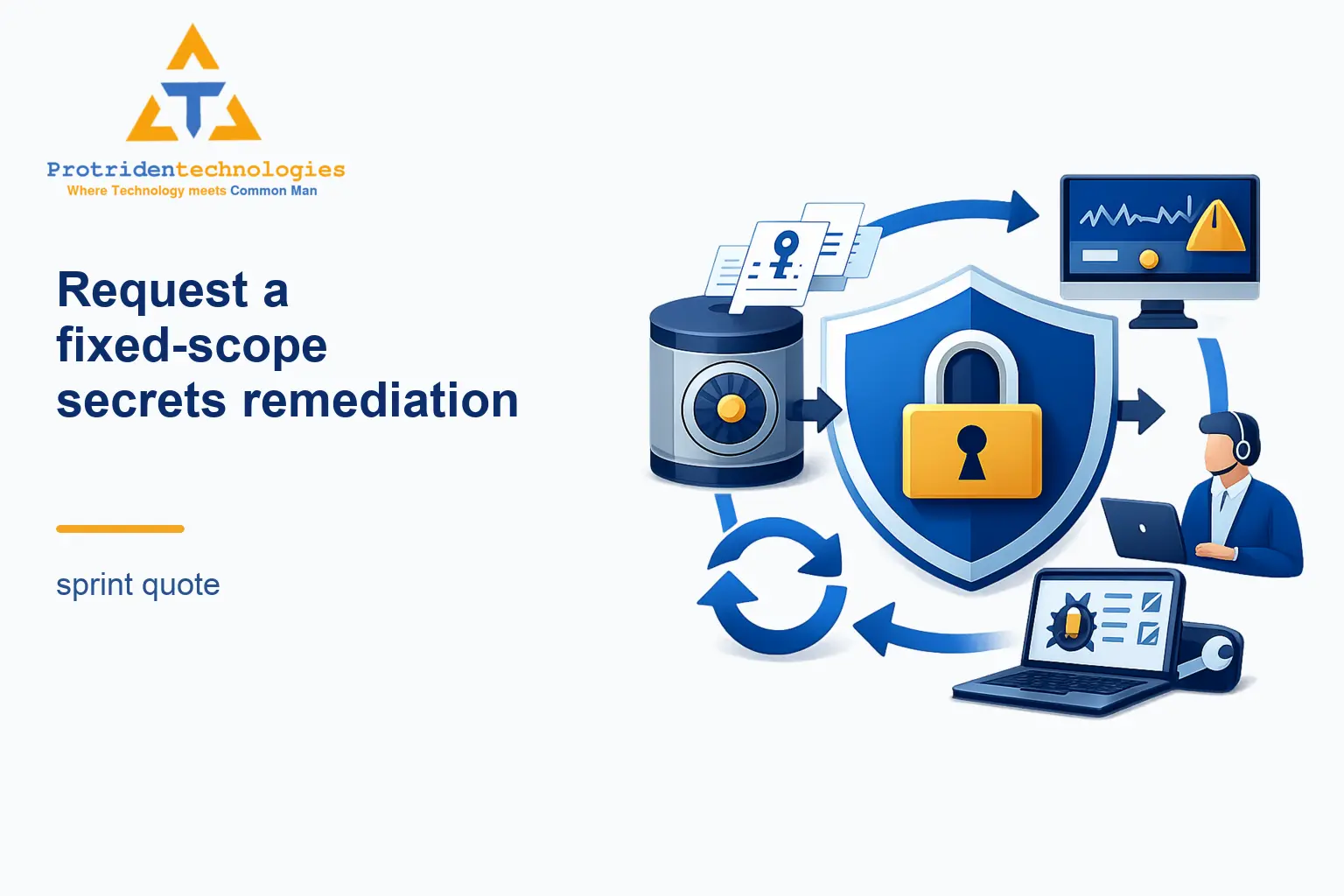
Your team has discovered publicly exposed API keys or unexplained cloud charges and needs an immediate, low-risk way to stop credential abuse. In-house teams are stretched: you must contain active abuse, rotate affected credentials safely across CI/CD and IaC, and ensure services don’t break during remediation.
A short, fixed-scope remediation sprint—focused on secrets vaulting, telemetry and a rollback plan—lets you hire specialist execution without long procurement cycles. The sprint is tactical: contain abuse, rotate secrets, update automation and validate telemetry.
This guide helps technical leaders compare vendor sprint offers, avoid common pitfalls and pick a practical checklist that limits blast radius while restoring safe operations.
Why This Topic Matters
Exposed credentials are a fast-moving operational and security emergency. Rapid, coordinated remediation is required to stop abuse, control costs and reduce risk to production systems. Well-scoped sprints that combine secrets management and telemetry narrow the window between detection and safe recovery.
Best-practice remediation emphasises production-first prioritisation, automated deployments and telemetry validation so rotating secrets doesn’t introduce downtime or fallback to revoked credentials. Tactical sprints are designed to deliver those outcomes quickly and predictably (see linked guidance).
- Production-first remediation reduces user impact and prevents prolonged downtime (see S1).
- Automated, consistent updates to CI/CD and IaC avoid manual drift and human error during rotation (see S1).
- Comprehensive telemetry is required to confirm there are no fallback behaviors to revoked secrets and to detect ongoing abuse (see S1 and S8).
- Secret sprawl remains widespread; short, focused sprints can reduce surface area fast and enforce vaulting and lifecycle controls (see S8).
Research references: Secret Remediation Best Practices: A Step-by-Step Guide | Aembit; The State of Secrets Sprawl 2026: 9 Takeaways for CISOs.
Common Mistakes Businesses Make
When rushing to revoke a leaked credential, teams often rotate keys without updating all dependent locations (CI/CD, IaC, environment variables), causing outages or creating hidden fallbacks. Another frequent error is relying solely on manual edits instead of using automation to push consistent changes across environments.
Overtrust in fully automated remediation is also risky: automation helps speed, but without accurate ownership mapping, safe execution rules and post-deploy validation, it can break services or leave shadow credentials active.
- Rotating secrets without updating every reference (CI, IaC, config stores) leads to service failures.
- Skipping telemetry validation after rotation can miss applications silently falling back to the old credential.
- Attempting broad automated rotation without clear ownership and guardrails risks production outages.
- Not documenting incident tickets, approvals and rollback steps increases time to recover if remediation introduces faults.
Practical Checklist / Steps
Use this checklist to evaluate vendor proposals and to plan an internal or external sprint. The steps are sequenced to reduce blast radius while enabling predictable rollouts and fast verification.
A well-scoped sprint typically runs through triage, containment, controlled rotation, vault integration, telemetry, and validation with explicit rollback plans and incident tickets.
- Triage the exposure and prioritise assets: Identify the exposed credentials, classify their environment (production, staging, dev), map connected services and list cloud or third-party API owners. Prioritise production and high-risk keys for immediate containment.
- Contain active abuse: Apply short-term containment controls such as temporarily restricting key scopes, applying IP whitelists, or creating emergency rate limits. Document the containment actions in incident tickets and note required owner approvals for permanent changes.
- Plan controlled rotation and rollback: Define a rotation plan that sequences environments and services. Prepare a rollback plan with clear criteria (failed healthchecks, authentication errors) and automated rollback steps to restore previous credentials if necessary.
- Integrate a secrets vault or managed secret store: Select and configure a vault or managed secret store to hold new credentials. Update authentication flows so applications fetch secrets at runtime instead of static config. Ensure access policies and audit logging are enabled.
- Automate updates across CI/CD and IaC: Deploy automation to replace secrets in CI pipelines, environment variables and IaC templates. Use discrete, auditable deployments and change-sets to prevent drift and to allow quick reverts when required.
- Deploy telemetry and telemetry-driven validation: Instrument authentication paths to capture failed auths, rate-limit events and unusual usage patterns. Define post-rotation healthchecks and verify there are no fallbacks to revoked credentials.
- Run staged rollouts and integration tests: Rotate secrets in a canary subset, monitor telemetry, then expand to broader environments. Run automated integration and smoke tests to confirm services authenticate correctly.
- Close incident tickets and produce handover documentation: Document actions taken, new ownership, rotation policies and rollback instructions. Deliver a concise handover packet so platform and ops teams can maintain the new state and respond to future leaks.
Cost, Timeline, or Decision Factors
Vendors and internal teams should use a consistent decision checklist when sizing a fixed-scope sprint. Exact cost and timeline depend on multiple variables—do not accept blanket price claims. Instead, require vendors to explain how they measure scope and what is included.
When sellers present a 3–4 week sprint, confirm the sprint boundaries: which environments are covered, how many unique credentials, whether vault integration is required, and the responsibilities for incident approvals and testing.
- Scope size: number of exposed credentials, services, repositories and environments to update.
- Complexity: presence of IaC, multiple CI/CD pipelines, legacy systems or third-party integrations that require manual updates.
- Existing tooling: whether a vault or secret manager is already in use and whether automation scripts or pipelines exist to perform updates.
- Required assurance: level of telemetry, audit logs and testing expected after rotation (more verification increases time).
- Organisational constraints: approval workflows, change windows and stakeholder availability can extend timelines.
Local Relevance: India, Karnataka, and Udupi
Protriden Technologies is based in Kundapura, Udupi, Karnataka, India, and offers cloud, application security and maintenance services from that location. For organisations in India and Karnataka, local vendor presence can simplify coordination, follow-up support and on-site engagement when required.
If your platform or engineering teams are operating in India time zones, a local partner reduces communication friction for urgent remediation work and handover. Confirm vendor availability, expected response SLAs and whether the sprint includes remote or on-site follow-up.
- Local presence (Kundapura, Udupi, Karnataka) can speed scheduling, knowledge transfer and post-sprint support.
- Ask vendors how they handle local compliance reviews, required approvals and cross-team coordination in Indian enterprise environments.
- Verify language, time-zone and escalation paths for emergency post-deployment support.
How Protriden Technologies Can Help
Protriden Technologies provides services that match the technical needs of a secrets remediation sprint: application security, Docker and CI/CD, AWS and DigitalOcean deployment, monitoring, backend APIs and maintenance. These capabilities support vault integration, automated updates and telemetry-based validation during a sprint.
When evaluating a Protriden engagement, expect them to propose a scoped plan that focuses on quick containment, controlled rotation, automation for CI/CD and IaC, telemetry instrumentation and a rollback and handover package aligned with your operations.
- Vault integration and configuration using established secret stores.
- CI/CD and IaC updates automation to replace secrets reliably across environments.
- Telemetry, monitoring and post-deployment health checks to validate rotations.
- Incident ticketing, rollback plans and handover documentation for platform teams.
Final Thoughts
Short, fixed-scope remediation sprints are a practical response when exposed credentials are actively abused or causing unexplained cloud charges. The goal is not only to stop current abuse, but to leave you with vault-backed secrets, reliable automation and telemetry so future leaks are less disruptive.
Select vendors who clearly define scope, show a checklist-driven approach, include telemetry validation and handover, and explain how they will reduce blast radius while keeping production available. Use the checklist in this guide to compare proposals and ask for a technical assessment.
FAQs
What does a fixed-scope secrets remediation sprint typically include?
A well-defined sprint usually includes triage of exposed credentials, containment to stop active abuse, controlled rotation of secrets, integration with a vault or secret manager, automation to update CI/CD and IaC, telemetry instrumentation and a rollback plan plus handover documentation.
How long will a vendor remediation sprint take?
Sprints are often described as 3–4 weeks, but actual duration depends on scope: number of credentials, environments to update, complexity of CI/CD/IaC and the level of telemetry and testing required. Ask vendors for a scope checklist and conditional timelines rather than fixed guarantees.
Will rotating keys break production services?
If rotations are planned without mapping all references and without staged rollouts, they can cause outages. Best practice is production-first prioritisation, canary rollouts, automated CI/IaC updates and telemetry-driven validation. Insist on a rollback plan and healthchecks before broad rollout.
Can automated remediation fully replace manual work?
Automation reduces time and human error, but it requires accurate ownership data, safe execution rules and testing. Automated rotation helps at scale, but manual checks and approvals remain essential for high-risk, production-impact changes.
How should I compare vendor quotes for a remediation sprint?
Compare scope inclusions (environments, number of credentials), the vendor’s approach to vault integration, CI/CD/IaC automation, telemetry and rollback plans. Ask for a clear incident ticketing model, handover deliverables and how they measure success. Avoid vendors who provide price-only quotes without technical scope.
Request a technical assessment from Protriden to get a fixed-scope remediation sprint quote and an action plan tailored to your exposed credentials.
Explore our software development services or discuss your requirements with the Protriden Technologies team.