
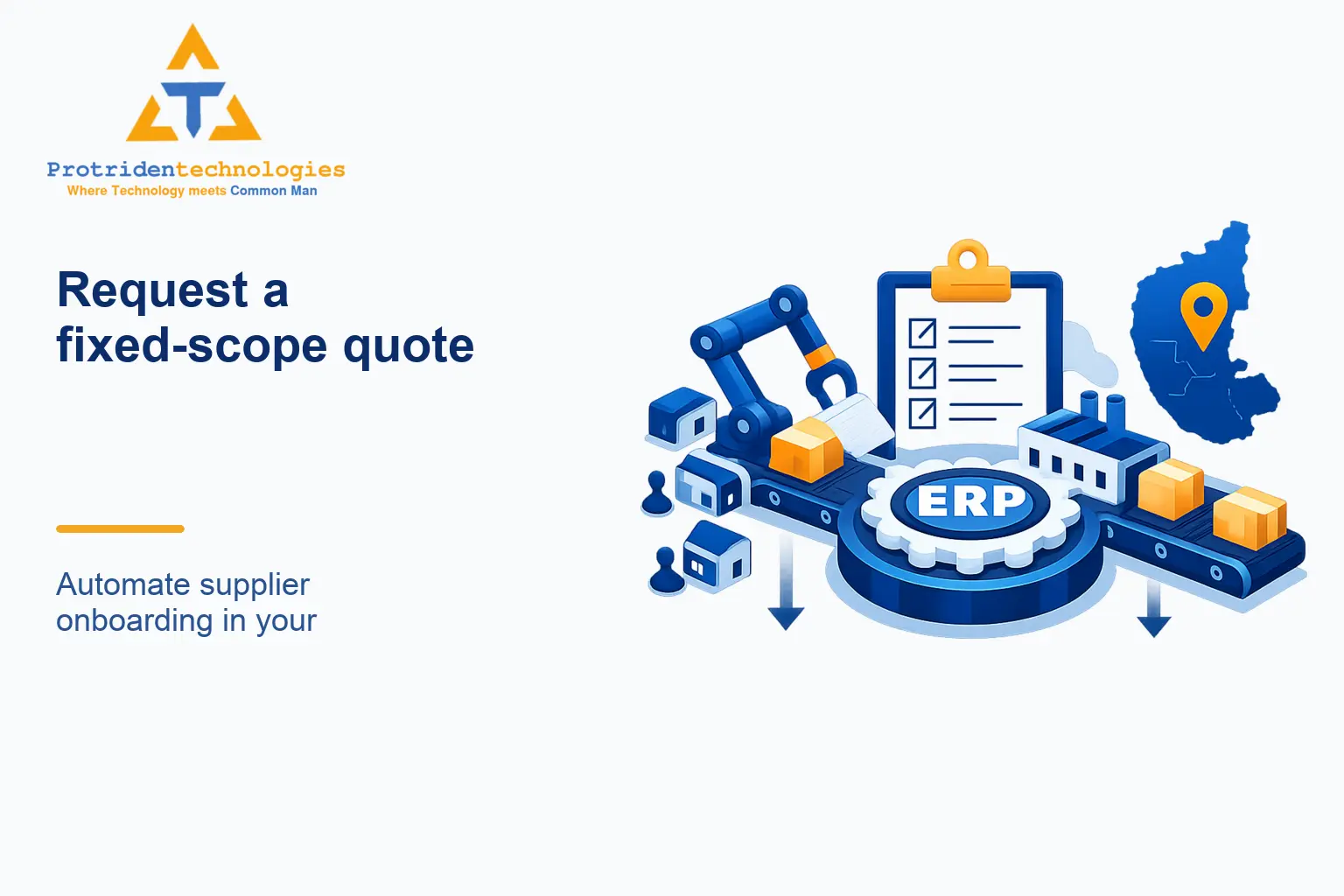
Manual supplier onboarding—spreadsheets, email chains and paperwork—causes delays, PO errors and slow payments that directly raise operating costs. For growing manufacturers and distributors, inconsistent vendor records and missing bank or compliance data mean invoicing and payments stall and procurement teams waste time reconciling duplicate or incomplete profiles.
Many SMEs need a predictable, fixed-scope project to move from ad-hoc onboarding to an ERP-integrated supplier portal without an open-ended IT engagement.
A targeted automation sprint replaces repetitive manual tasks with a supplier self-service portal, approval workflows and direct ERP synchronization so vendor records are accurate from day one.
Why This Topic Matters
Automating supplier onboarding removes routine friction from procure-to-pay and reduces human error at the data entry point where most downstream issues begin. Centralized onboarding improves data quality for purchasing, accounts payable and inventory systems, and speeds supplier activation so your team can place POs and process invoices faster.
A fixed-scope approach gives businesses a predictable path to automation. Instead of an open-ended build, a scoped sprint focuses on defined deliverables—supplier portal, data mapping, validation rules and ERP integration—so stakeholders can measure outcomes and control budget and timeline.
- Eliminates duplicate supplier records and data-entry errors that lead to payment delays and failed POs.
- Standardizes required documents and automates expiration alerts and compliance checks to reduce manual follow-up.
- Connects onboarding workflows directly into the ERP so approved supplier data, bank details and tax identifiers flow automatically into accounting and procurement modules.
- Supports tiered onboarding tracks (low-risk vs high-risk suppliers) so verification effort matches supplier importance and exposure.
Research references: Supplier Onboarding Guide: Best Practices & Automation; [Automate Supplier Onboarding: Key Steps & Benefits [2026]](https://www.flowforma.com/demo-library/how-to-automate-supplier-onboarding); Supplier Onboarding Software Solution: Power By AI Agents.
Common Mistakes Businesses Make
Many projects fail to deliver measurable improvements because scope is vague or stakeholders don’t agree on the required supplier data model. Others treat onboarding as a one-off product feature instead of an integrated workflow that must map to ERP fields and approval gates.
Technical errors such as assuming an ERP has a single, stable API or planning only for the happy path (no exceptions) create late-stage delays and costly rework.
- Skipping a precise mapping of supplier fields to ERP records, leading to missing or misaligned data after deployment.
- Applying one-size-fits-all onboarding for every supplier, which wastes effort on low-risk vendors and under-verifies critical suppliers.
- Failing to automate document expiry alerts and bank verification, so compliance works remain manual.
- Neglecting exception handling and human approvals for fraud or complex KYC, causing frequent stoppages in the automated flow.
- Underestimating data cleanup needs—migrating messy spreadsheet records into the ERP without validation.
Practical Checklist / Steps
Use this checklist to prepare for a fixed-scope supplier-onboarding sprint. Each step is designed to keep scope predictable while ensuring the integration is robust and supports real-world exceptions.
- Define scope and success criteria: Agree on what 'done' looks like: number of supplier records migrated, key fields to capture, approval SLAs, and acceptance tests for ERP synchronization. Fix out-of-scope items to avoid scope creep.
- Inventory current supplier data and processes: Collect existing spreadsheets, email templates and the current approval matrix. Identify common missing data elements and calculate the percentage of clean vs incomplete records to estimate cleanup effort.
- Map supplier data to ERP fields: Create a field-by-field mapping between the supplier portal model and the ERP (legal name, PAN/GST or local tax IDs, bank account fields, contact persons, payment terms). Note custom ERP fields that need special handling.
- Design tiered onboarding workflows: Define low-risk, standard and high-risk tracks with different required documents and approval steps. Specify automated checks (document presence, basic validations) and manual approvals for exceptions.
- Specify verification and compliance checks: Decide which checks to automate (bank account format, document expiration, certificate presence). Determine who does manual verification and when the supplier is moved to active status in the ERP.
- Plan integrations and data sync rules: List ERP endpoints, required APIs or file interfaces, and how the system will handle updates (one-way push vs bi-directional sync). Define error-handling and retry rules for failed pushes.
- Prepare data migration and cleanup: Define scripts or manual steps to deduplicate and validate existing supplier records before migration. Create a rollback plan and ensure backups of current ERP data.
- Agree testing, training and handover: Plan acceptance testing with real suppliers or test accounts, produce user guides for procurement and AP teams, and schedule a handover window with support SLAs for post-launch issues.
Cost, Timeline, or Decision Factors
Cost and timeline depend on scope choices and technical complexity rather than fixed templates. Key cost drivers include the ERP integration method, number of supplier fields and documents, complexity of approval workflows, and the quality of existing supplier data.
A fixed-scope sprint is intended to limit uncertainty: it focuses on a defined set of deliverables and acceptance tests. Expect the project timeline to be driven by API availability, the need for custom ERP connectors, and how much supplier data needs cleaning or enrichment.
- ERP connectivity: Native API availability and documentation reduce integration effort; older ERPs or those without stable APIs require workarounds or middleware.
- Volume and complexity of supplier records: Large or messy datasets require more time for deduplication and validation.
- Workflow complexity: Multiple approval layers, conditional routing, or high-risk verification add effort.
- Compliance checks and document management: Automating document expiry, certificate validation and bank verification adds integration and testing tasks.
- Change management: Training procurement and accounts teams, and piloting with a subset of suppliers, affect schedule and acceptance.
Local Relevance: India, Karnataka, and Udupi
Protriden Technologies is based in Kundapura, Udupi, Karnataka, India, so local buyers in Karnataka and nearby regions can coordinate directly with a nearby development team for discovery and follow-up. Local presence simplifies scheduling and can reduce time-zone friction during deployment.
Indian SMEs commonly work with local banks, tax identifiers and regulatory documents that must be captured accurately during onboarding. Designing the portal and validation rules with local context reduces manual corrections and speeds supplier activation.
- Local coordination from a Kundapura-based team helps with on-site discovery, language preferences and faster iterative feedback cycles for Karnataka customers.
- A partner familiar with Indian supplier documentation and banking formats can tailor validation rules to reduce exceptions during ERP synchronization.
How Protriden Technologies Can Help
Protriden Technologies offers focused technical capabilities to deliver a fixed-scope supplier onboarding sprint: design and implement a supplier self-service portal, map and synchronize approved profiles into custom or off-the-shelf ERPs, and build admin panels and approval workflows to manage exceptions.
We combine UI/UX, backend APIs, ERP integration, secure hosting and post-launch support so the sprint delivers usable automation and a clear handover path.
- Custom ERP and workflow automation tailored to your procurement and AP processes.
- Supplier portal development with document management, status transitions and admin dashboards.
- API integrations, secure deployments on AWS or DigitalOcean, Docker-based CI/CD and application security best practices.
- UI/UX, training materials and post-launch maintenance to ensure the solution is operable by procurement and finance teams.
Final Thoughts
A fixed-scope supplier-onboarding sprint removes a common bottleneck in procure-to-pay by converting manual effort into repeatable, auditable workflows that feed clean data into your ERP. The goal is not to automate everything at once but to deliver a reliable microservice that stops errors and speeds supplier activation.
Start with a clear scope, realistic acceptance tests and a pilot group of suppliers. That approach minimizes risk, keeps budgets predictable and gives procurement and AP teams measurable improvements within a compact timeline.
FAQs
What does a fixed-scope quote include for supplier onboarding?
A fixed-scope quote typically defines the deliverables, acceptance criteria and the sprint length. For supplier onboarding this usually includes the supplier portal screens, data model, approval workflows, ERP integration points, testing, and a handover plan. The quote should spell out what's out of scope so the budget remains predictable.
How long does a fixed-scope supplier onboarding sprint take?
Timeline varies by scope and technical complexity. For a small-to-medium scope—single ERP instance, a standard data model and a limited set of workflows—teams commonly plan compact sprints. Actual duration depends on ERP APIs, data cleanup needs and the number of verification checks required.
Will automating onboarding stop all exceptions and manual checks?
No. Automation reduces routine work and handles standard validations, but exceptions—fraud checks, complex KYC or unusual bank verification—should be planned as manual or semi-automated review steps. A good solution balances automated checks with defined human approvals for exceptions.
What integrations are required to push supplier data into an ERP?
Integrations can range from API-based pushes to file-based imports depending on your ERP. Required elements include endpoints for creating supplier master records, bank and tax fields, and status changes. The integration plan should include error-handling, retries and data reconciliation routines.
What post-launch support should I expect after a fixed-scope sprint?
Expect a short warranty or support window to fix defects found in production, documentation for administrators, and optionally ongoing maintenance or monitoring. The fixed-scope agreement should define the duration and response SLAs for post-launch issues.
Request a fixed-scope estimate from Protriden Technologies to evaluate your supplier onboarding needs. We will schedule a discovery call, document the scope and deliver a written estimate and sprint plan—no open-ended commitments.
Explore our software development services or discuss your requirements with the Protriden Technologies team.