
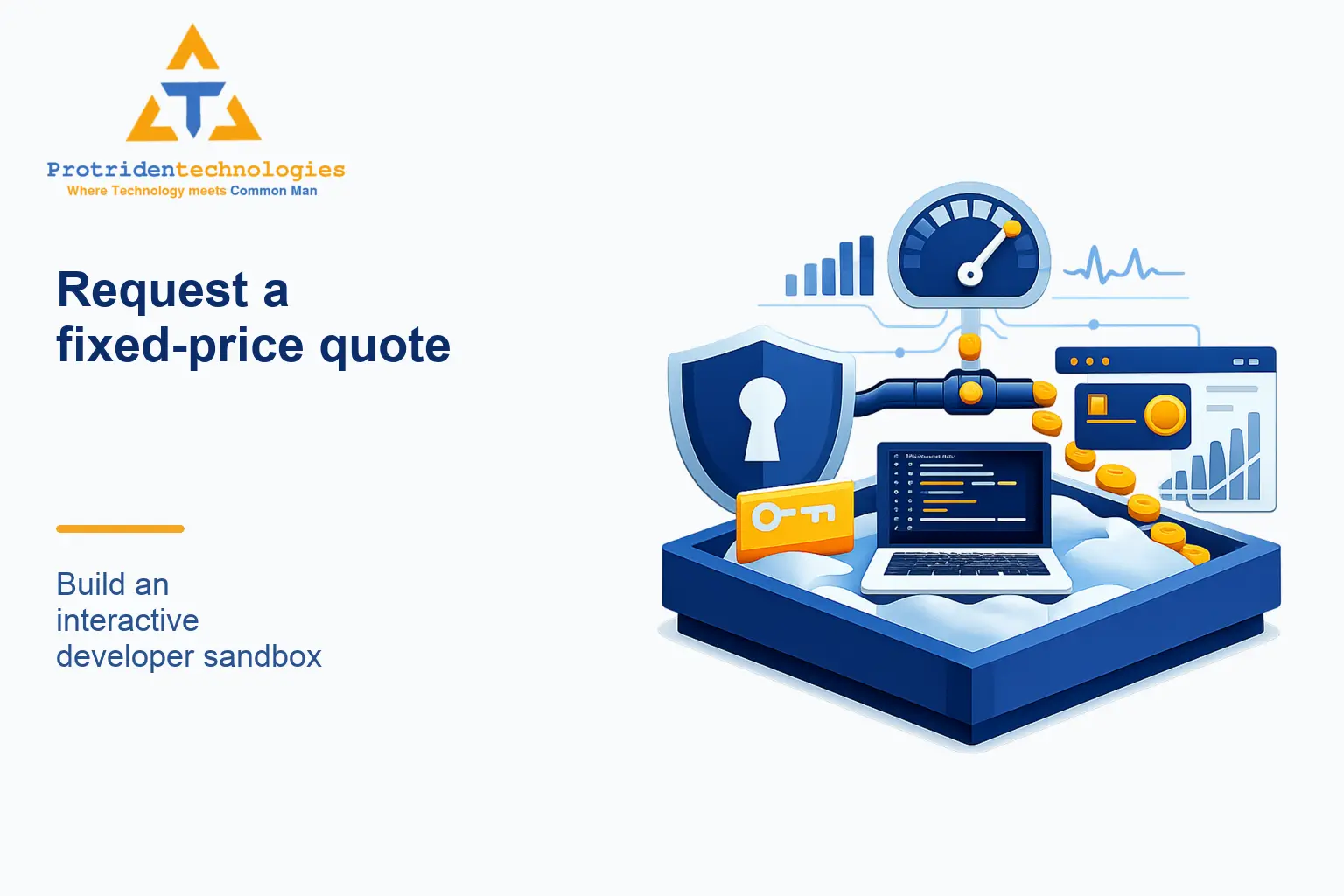
Product and platform leaders at B2B SaaS and FinTech lose deals and delay partner pilots because the developer sandbox doesn’t recreate realistic billing or prevent credential misuse. Technical buyers drop out when trials fail to expose expected quota behaviour, invoice signals or secure ephemeral keys, slowing procurement and increasing RFP friction.
An effective sandbox needs three things: credible usage and billing telemetry, secure ephemeral credentials, and an onboarding UX that guides developers and procurement through realistic trials.
External delivery partners are often needed because sandbox work requires coordinated API runtime, billing instrumentation, and UX specialists plus secure deployment and maintenance practices.
Why This Topic Matters
An interactive developer sandbox that includes billing telemetry reduces buyer uncertainty and speeds evaluation. When trials surface realistic quota limits, usage-based signals and cost implications, procurement and engineering stakeholders can validate integration and budget impact before contract signatures.
Billing telemetry also acts as an early detection and education tool. Developers and partners learn real-world behaviour—rate limits, session costs, and overage patterns—without compromising production credentials. For API-first businesses, this lowers onboarding friction and improves conversion from trial to paid usage.
- Realistic billing telemetry aligns technical evaluation with commercial impact and reduces surprises during procurement.
- Ephemeral credentials and secure sandboxes reduce risk of leaked keys and accidental cross-environment usage.
- Measurable sandbox usage data shortens the feedback loop between product, sales and finance during pilot phases.
- Billing telemetry supports pricing experiments (for example hybrid free + usage models) and clearer RFP responses.
Research references: How I Monetized My Dev Tools and APIs in 2026 (And What Actually Worked) - DEV Community; Battleships: sandbox, VM and runtime pricing for AI agents; AI Sandbox Pricing, Compared: What Agent Sandboxes Cost and How the Billing Models Differ.
Common Mistakes Businesses Make
Teams often treat a sandbox as a static demo environment rather than a production-like trial. That leads to missing telemetry, unrealistic quotas and no cost signals—so buyers cannot model expected spend.
Another common error is reusing production credentials or providing long-lived sandbox keys, which increases security risk and complicates post-trial cleanup.
Finally, teams underinvest in UX for onboarding and billing visibility. Without clear guidance and billing dashboards, even a technically complete sandbox fails to influence buying decisions.
- Providing unlimited requests or inconsistent quotas that don’t reflect production limits.
- Issuing permanent API keys instead of short-lived ephemeral keys or token rotation.
- Exposing billing data that is unclear or delayed, preventing stakeholders from estimating cost impact.
- Building the sandbox in isolation without aligning telemetry fields to product billing metrics and finance needs.
Practical Checklist / Steps
Use this checklist to scope a build or vendor evaluation. Each item maps to technical and commercial outcomes you can test during a pilot.
The checklist assumes you will instrument usage at the API gateway/runtime layer and expose summarized billing signals to trial users and internal stakeholders.
- Define trial objectives and success metrics: Agree which commercial and technical outcomes the sandbox must show: e.g., session cost, average request cost, quota enforcement, or overage behaviour. Map these objectives to measurable telemetry events.
- Design a billing model for the sandbox: Choose how the sandbox will meter usage for trials (free quota with overages, capped usage, or simulated charges). Ensure the model mirrors the production billing units you use, such as compute-seconds, egress, or request types, so telemetry is meaningful.
- Plan secure credential flows: Adopt short-lived ephemeral keys, automatic rotation, and limit scope (tenant or org-level). Build enrollment flows for ephemeral keys with clear lifecycle and revocation methods to prevent leakage and accidental production access.
- Instrument telemetry at the gateway/runtime: Emit consistent events for requests, session starts/stops, compute time and egress. Tag telemetry so finance and product can reconcile sandbox usage with billing units and expected costs.
- Surface billing telemetry in the developer UI: Provide a dashboard that shows live usage, remaining quota, estimated cost and simulated invoices. Include both developer-facing and internal admin views so sales and finance can monitor pilots.
- Simulate real-world limits and errors: Enforce the same rate limits, throttling and error responses as production. Simulate overage notifications and show how the product behaves when quotas are exceeded.
- Run security and abuse tests: Test for credential misuse, rate-limit evasion and injection attempts. Validate that ephemeral keys cannot access production resources and that revocation works as expected.
- Pilot with select partners and iterate: Onboard a small set of partners, gather qualitative and quantitative feedback, and refine telemetry, quotas and UX before wider roll-out.
Cost, Timeline, or Decision Factors
Fixed-price proposals are most useful once scope is explicit: which billing metrics you want surfaced, whether sessions are stateful or ephemeral, the degree of UX polish required, and the security hardening level. Those decisions materially change engineering effort and operational complexity.
Several technical choices influence cost and timeline: the billing granularity (per-second compute vs per-request), sandbox session persistence, the need to simulate multi-tenant billing, and the amount of telemetry storage and retention required.
- Billing metric selection: per-second compute or egress billing requires different instrumentation than request-count billing.
- Session model: short-lived stateless sessions are simpler; persistent sessions with per-user state add work.
- Security scope: implementing ephemeral keys, automated rotation and tight isolation increases effort but reduces long-term risk.
- UX scope: a developer dashboard and onboarding flows add front-end design and product copy time.
- Operational model: hosting choice (existing cloud accounts vs isolated accounts), telemetry retention and reporting frequency affect ongoing costs.
Local Relevance: India, Karnataka, and Udupi
India’s API and cloud adoption is expanding, and security is a rising concern for API-first businesses. Building a secure interactive sandbox with billing telemetry is directly relevant to Indian SaaS and FinTech vendors that need predictable partner onboarding and clearer commercial signals.
Protriden Technologies operates from Kundapura in Udupi district, Karnataka, which enables locally based scoping, workshops and follow-up support for clients in the region and elsewhere in India.
- Local presence in Kundapura, Udupi, Karnataka allows on-site discovery sessions and closer timezone overlap for South India customers.
- Regulatory and data residency needs in India can influence sandbox hosting and telemetry retention choices; design the sandbox to meet local compliance requirements.
How Protriden Technologies Can Help
Protriden Technologies provides UI/UX, backend API development, billing instrumentation, secure deployment and post-launch maintenance. For organisations evaluating an external partner, Protriden can scope requirements and deliver a fixed-price quote after a structured discovery phase.
Their services include cloud deployment and monitoring, application security and maintenance—all relevant to building a production-like developer sandbox that emits billing telemetry and uses ephemeral credentials.
- Discovery and requirements workshops to align billing metrics, quota models and success criteria.
- Design and build of developer UX, sandbox runtime, and billing telemetry integration.
- Secure credential flows using ephemeral keys, rotation and isolation patterns.
- Cloud deployment, monitoring and post-launch support aligned to your operational model.
Final Thoughts
A developer sandbox that reproduces billing behaviour and enforces secure credentials reduces procurement friction, improves pilot fidelity and clarifies commercial outcomes for buyers and internal stakeholders. Investing in telemetry and UX up front prevents late-stage surprises that slow deals.
Before accepting a fixed-price bid, explicitly define the billing units to mirror production, agree session persistence rules, and require a planned pilot with partner feedback. That makes a fixed-price engagement a predictable step toward faster partner onboarding and better RFP outcomes.
FAQs
What exactly is billing telemetry in a sandbox and why does it matter?
Billing telemetry captures the usage signals (for example request types, compute time, egress) that map to your production billing units. It matters because it lets evaluators estimate cost and quota behaviour during a trial, making commercial decisions more informed and reducing surprises at contract time.
Can a sandbox safely expose billing without risking production data or costs?
Yes—by using isolated runtime environments, short-lived ephemeral keys, and simulated or capped charges you can show realistic billing signals without exposing production data or incurring uncontrolled costs. Proper instrumentation and limits are essential to balance realism with safety.
Do vendors charge by request or compute time for sandboxes?
Billing models vary: some systems bill per request, others by compute-seconds or session duration. Different models affect instrumentation and cost visibility. Align your sandbox telemetry with the production billing metric you intend to use so trial signals are meaningful (see industry discussions on billing granularity).
How long does it take to build a sandbox with billing telemetry?
Timeline depends on scope: the chosen billing granularity, session persistence, security requirements and UX polish each change effort. A structured discovery phase is necessary to provide an accurate fixed-price timeline and to surface any integration risks.
What does Protriden need to prepare a fixed-price quote?
Protriden typically needs a short discovery workshop to agree success metrics, the billing units to simulate or meter, desired session and security models, and the target onboarding UX. With those inputs they can scope work, outline deliverables and propose a fixed-price engagement.
Request a scoped fixed-price quote from Protriden: start with a 60–90 minute discovery workshop to define billing metrics, security and UX goals.
Explore our software development services or discuss your requirements with the Protriden Technologies team.