
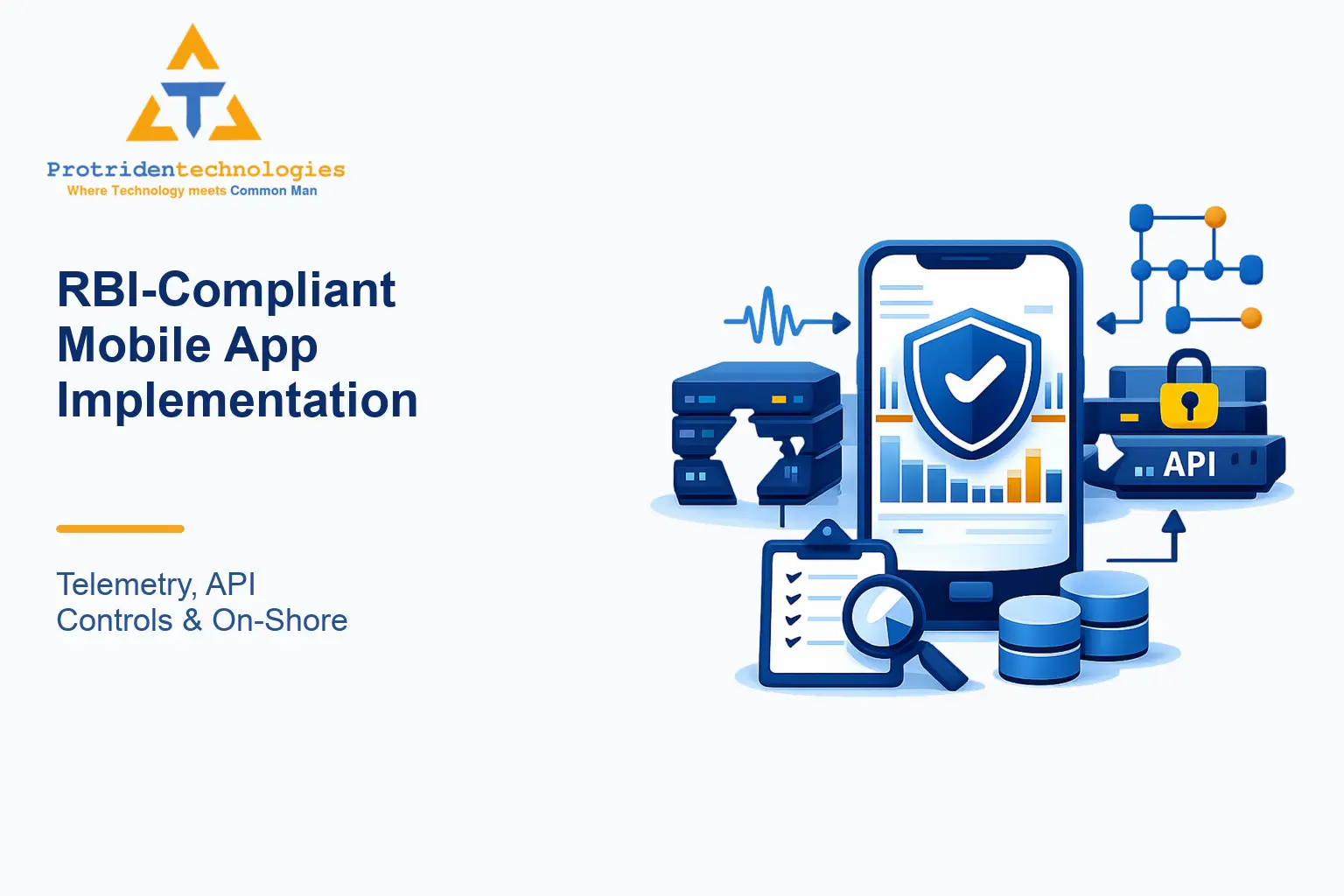
Digital lenders face two parallel pressures: RBI audits demanding demonstrable, tamper‑resistant telemetry and API controls, and app‑store review processes that can flag permissions or data flows. Without an implementation plan that captures audit‑grade evidence and respects on‑shore data expectations, lenders accumulate compliance debt that risks fines, delistings or operational disruption.
Mobile telemetry on client devices differs from backend tracing; it must buffer on unstable networks, redact PII and produce verifiable artifacts for auditors without degrading app performance.
RBI guidance and mobile security best practices require a combination of client telemetry, server‑side API gating and localized data handling. Practical implementation ties engineering work to audit artifacts and a measurable pilot scope.
Why This Topic Matters
For regulated digital lenders, mobile app telemetry and API controls are not optional engineering features: they form the technical evidence auditors use to validate controls, incident response and customer‑facing flows. RBI frameworks and industry guidance increasingly expect implementable controls across client apps and server APIs, and auditors will request durable telemetry that survives mobile process termination and intermittent connectivity.
Good telemetry supports forensics, dispute resolution, fraud detection and regulatory reporting. Proper API gating prevents unauthorized endpoints from processing sensitive flows, while on‑shore data controls address residency and lawful access expectations. Together these measures reduce risk and shorten remediation cycles during regulatory or app‑store reviews.
- Telemtry must be efficient, persistent and privacy aware to work reliably on mobile devices (see OpenTelemetry client guidance).
- API gating and rate‑limiting protect backends and create enforceable checkpoints for sensitive actions.
- On‑shore data residency and controlled telemetry exports limit cross‑border exposure and relate to RBI expectations for data handling.
Research references: Mobile Finance App Security Compliance in India | Guardsquare; Why does OpenTelemetry work differently on mobile versus backend apps? | CNCF; Android | OpenTelemetry.
Common Mistakes Businesses Make
Teams commonly try to reuse backend tracing patterns on mobile without accounting for device constraints, leading to dropped spans, oversized uploads or battery impact. Mobile telemetry requires buffering strategies and attribute redaction before export.
Another frequent error is treating app‑store and RBI checklists as identical; measures that satisfy Play Store privacy prompts can conflict with RBI expectations (for example, removing permissions that are needed for audit trails).
Lenders also assume telemetry alone solves compliance. Without API gating, authentication hardening and server‑side logging tied to client signals, telemetry becomes isolated data that auditors cannot reconcile with backend state.
- Copying backend telemetry patterns to mobile without disk persistence or offline buffering.
- Exporting raw attributes containing PII without systematic redaction or consent flows.
- Failing to couple client telemetry with server‑side API controls and synchronized identifiers.
- Assuming cloud defaults provide India residency without verifying telemetry export endpoints and region settings.
Practical Checklist / Steps
This checklist focuses on implementable steps that produce audit artifacts: durable client telemetry, API gating and an on‑shore export strategy. Each step maps to testable outcomes—logs, traces, export configurations and access controls—that auditors can verify.
- Define compliance scope and evidence requirements: List the regulator's expected evidence (telemetry types, retention, access logs) and align them with product flows (onboarding, disbursement, repayment). Obtain legal and compliance sign‑off on what constitutes PII and retention windows.
- Instrument mobile app with mobile‑aware telemetry: Use a mobile client telemetry library that supports disk persistence, offline buffering and span snapshots so data survives unexpected process termination. Ensure sampling and batching settings are tuned for low CPU, memory and battery impact.
- Implement attribute redaction and consent flows: Identify sensitive attributes and implement client‑side redaction or pseudonymization prior to export. Add clear consent/UI indicators tied to telemetry categories to align with app‑store expectations and privacy reviews.
- Establish deterministic identifiers for cross‑system correlation: Create stable, non‑PII correlation keys that link client telemetry to backend logs and API events. Ensure these keys are applied consistently across mobile SDKs and server instrumentation for audit reconciliation.
- Build server‑side API gating and policy enforcement: Enforce step‑up authentication, endpoint allowlists, and rate limits at API gateways. Gate sensitive operations with explicit flags and record audit events for each gated action tied to the correlation identifiers.
- Configure regional export targets and on‑shore processing: Ensure telemetry export endpoints are hosted in India or routed to on‑shore collectors. Validate that any third‑party telemetry processors support Indian residency or that you retain raw exports within on‑shore infrastructure.
- Design tamper‑resistant log storage and retention: Use write‑once or append‑only stores and immutable storage options where possible. Maintain retention policies aligned with compliance requirements and log access controls to produce chain‑of‑custody evidence.
- Integrate telemetry into incident and audit playbooks: Define runbooks that use telemetry to reconstruct events, escalate suspicious flows, and produce a reproducible audit packet. Include steps to export a snapshot when an incident occurs.
Cost, Timeline, or Decision Factors
Cost and timeline for implementing RBI‑grade telemetry depend on app complexity, existing telemetry maturity and the degree of required server changes. Migrating a mature backend with existing tracing is faster than retrofitting telemetry across multiple legacy client builds. On‑shore processing choices (self‑hosted collectors vs. India‑region cloud services) materially affect operational costs and vendor contracts.
A recommended pilot duration often quoted by solution teams is a focused 4–8 week engagement to deliver telemetry pipelines, API gating proof‑points and initial audit artifacts. However, the exact timeline should be estimated after scoping device platforms, build release cadence, and regulator evidence detail.
- Application complexity: number of platforms (Android, iOS, Flutter) and custom native modules.
- Existing telemetry: presence of client instrumentation, and whether correlation keys are already available.
- Infrastructure choice: cloud region availability, third‑party support for India residency, or the need for self‑hosted collectors.
- Release cadence and app‑store review times which affect how quickly telemetry updates reach users.
Local Relevance: India, Karnataka, and Udupi
India's regulatory environment and RBI guidance make on‑shore data handling and demonstrable controls especially relevant for lenders operating here. Implementations should ensure telemetry export endpoints and storage are aligned with residency expectations and accessible for lawful audit requests.
For teams in Karnataka and coastal tech hubs like Udupi and Kundapura, local engineering partners can help bridge regional cloud choices, recruitment of Android/iOS expertise and on‑site compliance reviews. Proximity to the team handling operational telemetry can streamline validation and incident response.
- Confirm telemetry export and processing regions are set to India if residency is required by policy.
- Leverage local cloud or managed services that explicitly support data residency or self‑hosting in India.
- Coordinate with in‑state engineering resources for faster iteration and compliance reviews in Karnataka/Udupi/Kundapura.
How Protriden Technologies Can Help
Protriden Technologies provides mobile application development, application security and cloud deployment services. We can help lenders implement mobile‑aware telemetry, instrument APIs and configure on‑shore telemetry ingestion to produce verifiable audit artifacts.
Our regional base in Kundapura, Udupi, Karnataka positions us to work directly with local teams on pilot implementations, validations and integration with Indian cloud regions or self‑hosted collectors.
- Instrument mobile apps (Android, iOS, Flutter) for efficient, persisted telemetry and attribute redaction.
- Design API gating and server logging patterns that map to audit evidence requirements.
- Deploy and configure on‑shore telemetry collectors and cloud infrastructure with secure access controls.
- Provide pilot engagements that deliver telemetry pipelines and starter audit artifacts for regulator review.
Final Thoughts
Implementing RBI‑grade mobile telemetry and API controls is a cross‑discipline effort that must balance device constraints, privacy and regional data handling. Start with a scoped pilot that produces concrete artifacts auditors can validate and iterate from there.
Treat app‑store reviews and RBI audits as separate but overlapping checklists: align UI permissions and consent with telemetry design while preserving the evidence auditors need to validate critical lending workflows.
FAQs
What makes mobile telemetry different from backend tracing?
Mobile telemetry must handle intermittent connectivity, device restarts and resource limits. Techniques such as disk persistence, span snapshots and conservative batching are needed so telemetry survives crashes and can be exported later without harming user experience.
Can I use OpenTelemetry on Android and still meet RBI expectations?
OpenTelemetry has mobile guidance (including Android specifics) for disk buffering and attribute redaction that help meet regulator expectations, but you must configure export endpoints, region settings and redaction policies to align with RBI evidence requirements.
Do app‑store privacy settings conflict with RBI telemetry needs?
They can. App‑store reviews emphasize permission minimization and user consent, while regulators require audit trails. Design consent flows and telemetry categories so required signals are captured without violating platform policies or exposing unnecessary PII.
What factors determine whether telemetry must be processed on‑shore?
Regulatory policy language, legal advice and the nature of the telemetry determine residency needs. If policy or counsel requires India residency for certain data types, ensure collectors and storage are configured accordingly or that third‑party processors provide explicit India‑region hosting.
How should lenders start a compliance pilot?
Begin by scoping the high‑risk flows, selecting one platform (for example Android) and instrumenting client telemetry with disk persistence, correlation keys and redaction. Pair this with API gating proof‑points and on‑shore export configuration. Define success criteria and audit artifacts up front.
Download our RBI‑compliance checklist and discuss a scoped pilot to deliver telemetry pipelines, API gating and starter audit artifacts; book a discovery call to tailor scope and timeline for your app.
Explore our software development services or discuss your requirements with the Protriden Technologies team.