
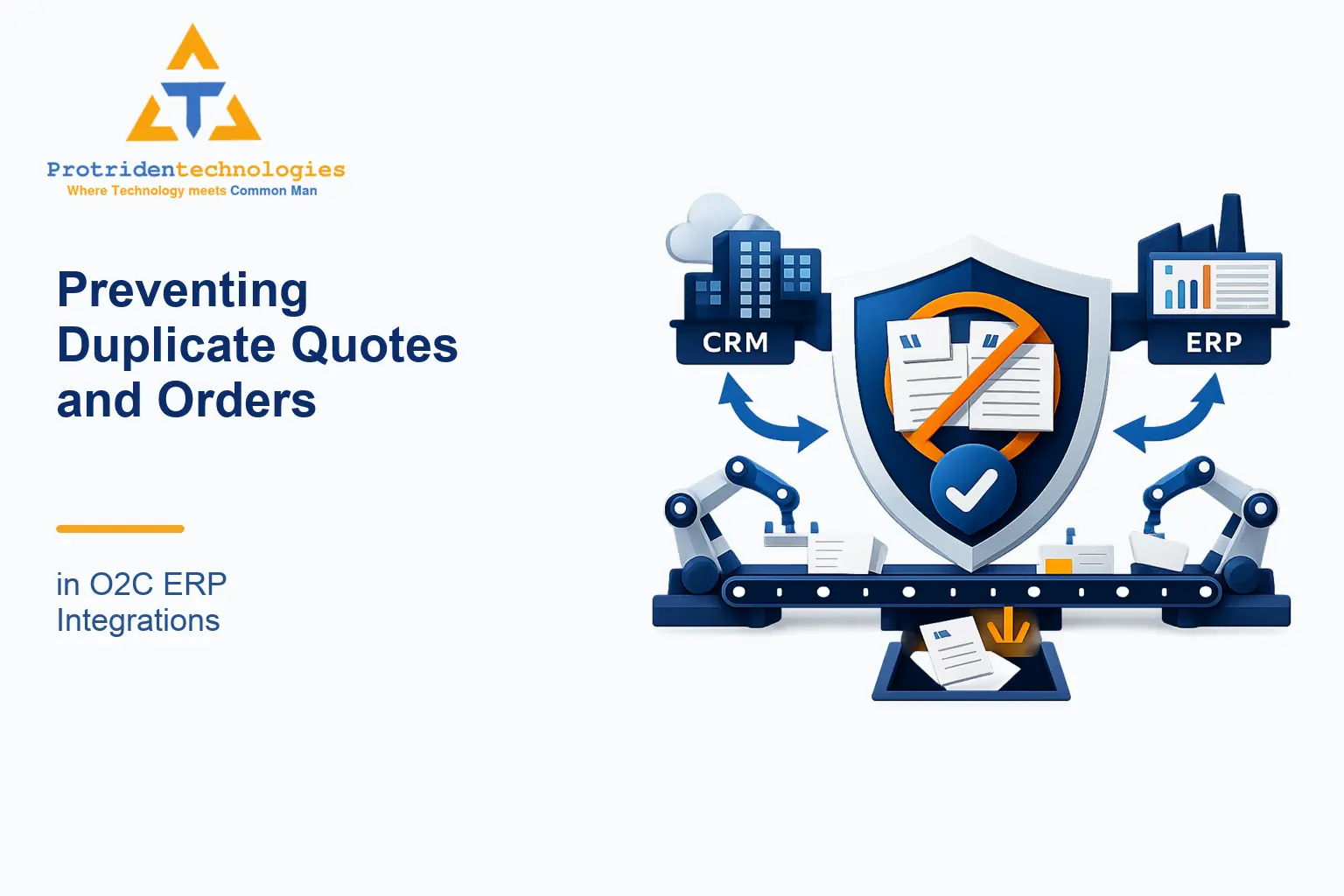
Duplicate quotes, orders or invoices created during quote-to-order handoffs cause shipping mistakes, duplicate purchasing and billing confusion. For companies moving quotes from CRM into ERP, the same opportunity or quote can be created twice when integrations retry, events replay, or external systems lack idempotency checks—resulting in extra costs and damaged customer experience.
Integrations that connect CRM, CPQ and ERP remove manual steps but introduce new failure modes: out-of-order events, retries and missing cross-system identifiers can each produce duplicates.
Technical teams must design idempotent create flows and reconciliation checks so that a single sales opportunity maps to a single ERP order or invoice, even when middleware or platform events retry deliveries.
Why This Topic Matters
Duplicate records in the order-to-cash cycle create direct operational costs (extra shipments, duplicated vendor orders, rework) and indirect costs (disputed invoices, customer friction). A resilient O2C integration requires explicit duplicate detection and guardrails so business teams can rely on automation.
Architectural patterns and integration design choices determine whether retries or platform event replay produce duplicate creates. Implementing checks both before and after create calls reduces the chance of duplicated ERP entries and simplifies reconciliation.
- Platform and middleware retries or replay can re-send the same event payload with different metadata; systems that lack idempotency checks will create duplicates (see S1).
- Store authoritative cross-system IDs (for example, ERP order ID on the CRM opportunity) and verify that mapping before creating a second record (see S3).
- Treat billing and payment flows cautiously: store invoice IDs and handle out-of-order events to prevent duplicate invoices or unapplied payments (see S6).
Research references: Order-to-Cash in ERP and Salesforce Architecture; Quote-to-Order Automation: CRM Quotes to ERP Orders; How Billing Systems Sync With an ERP: Quote-to-Cash Integration Guide.
Common Mistakes Businesses Make
Teams often assume a single successful API call equals one record created. When networks, middleware platforms or event buses retry or replay messages, that assumption fails unless the integration enforces idempotency and cross-system mapping checks.
Another frequent error is missing reconciliation and observability. Without easy ways to detect duplicate creates and the root cause, manual cleanup becomes costly and recurring.
- Not storing or checking the ERP order ID on the originating CRM record before attempting a create call.
- Relying solely on transient request IDs or timestamps that change on retries instead of stable business keys.
- Skipping post-create verification and reconciliation that would detect duplicates early and trigger automated compensating actions.
- Ignoring billing-specific edge cases such as payments arriving before invoices or duplicated invoice creates.
Practical Checklist / Steps
Use this checklist to design or review O2C integrations that move quotes into ERP orders and invoices. The goal is to prevent duplicate creates and make duplicates that do occur easy to detect and correct.
Implement the items below iteratively: some are low-effort checks while others require architecture or product changes.
- Define stable business keys for idempotency: Choose a stable identifier that both systems can reference—examples include CRM opportunity ID plus quote version or a CPQ quote number. Ensure create operations check for existing records using this business key rather than ephemeral request IDs.
- Persist ERP record IDs back to the CRM or CPQ: After the ERP create succeeds, store the ERP order or invoice ID on the originating CRM opportunity or deal. Future create attempts should verify this field first and skip duplicate creates.
- Add a pre-create existence check: Before issuing a create call to ERP, call a lightweight lookup using the stable business key or external ID. If a match exists, reconcile status and skip creation; if not, proceed.
- Design idempotent APIs or use idempotency tokens: Where supported, use idempotency tokens that the ERP accepts for create operations. If the ERP lacks token support, implement application-level guards that de-duplicate requests before sending.
- Handle out-of-order and replayed events: Build intake logic that recognizes replayed events by inspecting platform metadata and payloads. When events arrive out of sequence (for example, payment before invoice), hold or queue them until the dependent record exists or apply them as unapplied payment entries as appropriate.
- Implement reconciliation reports and alerts: Create nightly or real-time reconciliation checks that compare CRM deal states and ERP orders/invoices. Alert on mismatches such as multiple ERP orders linked to one CRM opportunity so staff can intervene quickly.
- Log and surface root-cause details: Capture request payloads, platform event IDs, replay IDs and middleware metadata in logs accessible to engineers. Rich context speeds diagnosis and reduces repeat incidents.
- Plan compensating actions for duplicates: Define automated or semi-automated cleanup flows: mark duplicate ERP orders for hold, cancel duplicate shipments, and create reversal invoices. Ensure these actions are auditable and communicated to customer service.
Cost, Timeline, or Decision Factors
The cost and timeline to implement robust duplicate detection in O2C integrations vary by system complexity, transaction volume and the quality of existing data and APIs. Important factors include how many endpoints must be changed, whether the ERP supports idempotency tokens, and how mature your logging and reconciliation processes are.
Because each organization’s ERP and CRM landscapes differ, a scoped assessment is the first step to accurately estimate effort and delivery cadence.
- System count and heterogeneity: More systems (multiple CRMs, a CPQ, several ERPs) increase integration points and testing effort.
- API capabilities: Native idempotency support, search-by-external-ID and webhook semantics change implementation complexity.
- Transaction volume and SLAs: High-volume flows require more robust queuing, deduplication and monitoring solutions.
- Data quality and existing mappings: Poor or missing cross-system IDs require data cleanup and canonical mapping work.
- Compliance and audit requirements: Finance and legal constraints may require additional controls, retention and audit trails.
- Operational readiness: Availability of platform engineers, middleware expertise, and test environments affects timeline.
Local Relevance: India, Karnataka, and Udupi
Protriden Technologies is located in Kundapura, Udupi, Karnataka, India, and provides local access to development and maintenance for businesses in the region. For India-based companies, local teams can help bridge process knowledge gaps between sales, finance and IT during integration work.
Many Indian SMEs and growing firms adopt ERP modules incrementally; ensuring quote-to-order flows are robust from the start avoids operational pain as transaction volumes rise.
- Local presence in Kundapura and Udupi makes on-site workshops, training and follow-up easier for regional customers.
- Proximity enables cultural alignment with Indian business processes and faster communication during implementation and post-launch support.
How Protriden Technologies Can Help
Protriden Technologies can help assess your current quote-to-order pathways, design idempotent create flows, build reconciliation dashboards, and implement the code or middleware changes required to prevent duplicate ERP entries. Our approach starts with a scoped review and a prioritized set of fixes.
We combine custom ERP and integration development with cloud deployment and operations support to ensure a sustainable solution.
- Custom ERP, billing, inventory and workflow automation to enforce stable IDs and mapping.
- Backend APIs, admin panels and integration code to implement pre-create checks and persistence of ERP IDs.
- Cloud deployment, monitoring and performance (AWS and DigitalOcean) plus Docker and CI/CD to maintain reliable production flows.
- Application security, maintenance and post-launch support to keep reconciliation and alerting robust.
Final Thoughts
Preventing duplicate quotes, orders and invoices is a combination of good data design, careful integration patterns and operational visibility. Addressing the problem early saves recurring operational cost and preserves customer trust.
Begin with a short scoped assessment to identify the highest-risk flows—quick wins like storing ERP IDs on CRM records and adding pre-create checks often reduce most duplicate incidents with modest effort.
FAQs
What typically causes duplicate orders when moving quotes into an ERP?
Duplicates usually arise from retries, platform event replay, or missing cross-system identifiers. If middleware or an event bus re-sends a payload and the receiving system does not use stable business keys to detect existing records, a duplicate create can occur (see S1).
What is the simplest way to avoid creating an ERP order twice from a CRM quote?
Store the ERP order ID back on the CRM opportunity or quote after a successful create and check that field before attempting to create again. This direct mapping prevents repeated creates when the integration retries (see S3).
Do ERPs support idempotency tokens to prevent duplicate creates?
Some ERP platforms provide idempotency or external ID support; others do not. Where the ERP supports it, use idempotency tokens or external IDs. If not, implement application-level guards and pre-create lookups to achieve similar behavior (see S1 and S3).
How should payments and invoices be handled to avoid duplication?
Store invoice IDs and verify before creating invoices. For out-of-order events—such as a payment arriving before its invoice—either hold the payment until the invoice exists or post it as unapplied cash and match it later; reconciliation logic is essential (see S6).
How long does it take to implement duplicate detection in an existing O2C integration?
Timelines vary with system complexity, API capability, transaction volume and required cleanup. A short assessment will identify quick wins (pre-create checks, persisting IDs) versus larger architecture changes; use that assessment to plan phased work rather than expecting a single fixed delivery date.
Request a consultation with Protriden to assess your O2C integration and build a practical plan to prevent duplicate quotes and orders.
Explore our software development services or discuss your requirements with the Protriden Technologies team.