No Code vs Vibe Coding: Which Is Better for Startups, Students and AI Coding Users?
Building a website, mobile app, SaaS product, internal tool, or startup MVP has become easier than before.
Today, you do not always need to start with a full development team.
You can use no-code tools.
You can use AI coding tools.
You can even describe your idea in simple English and generate code with the help of AI.
This has created a new question for students, startup founders, and AI coding users:
No code vs vibe coding — which one should you choose?
The answer depends on what you are trying to build.
If you want to test an idea quickly, no-code may help.
If you want to experiment with AI-generated code, vibe coding may help.
If you want to build a serious business product with users, payments, security, backend, admin panel, and long-term support, you may need professional custom software development.
Let us understand this clearly.
What Is No-Code Development?
No-code development means building applications or workflows without writing traditional code.
Instead of coding manually, you use visual tools, drag-and-drop builders, forms, templates, databases, automations, and integrations.
No-code tools are commonly used for:
- Landing pages
- Simple websites
- Internal dashboards
- Basic CRM systems
- Automation workflows
- Form-based applications
- MVP validation
- Simple ecommerce stores
- Booking forms
- Data collection tools
For example, a startup founder may use a no-code tool to create a landing page, collect emails, test demand, or manage a simple workflow.
A student may use no-code to build a small project without learning full frontend, backend, and database development.
A business owner may use no-code to automate simple tasks like form submissions, email alerts, or lead tracking.
What Is Vibe Coding?
Vibe coding is a newer way of building software with the help of AI coding tools.
Instead of writing every line of code manually, the user explains what they want in natural language.
For example:
“Create a login page with email and password.”
“Build a dashboard that shows orders, users, and revenue.”
“Create a React component for a product card.”
“Fix this API error.”
“Build a simple booking app with admin panel.”
The AI tool then generates code.
The user reviews, tests, improves, and continues giving prompts until the result looks close to what they want.
This is why vibe coding is popular among:
Students
Beginner developers
Startup founders
Product builders
AI coding users
Hackathon participants
People testing app ideas quickly
Vibe coding feels fast because you can move from idea to prototype quickly.
But there is an important point:
AI-generated code still needs understanding, testing, security review, and proper engineering before it becomes a serious business product.
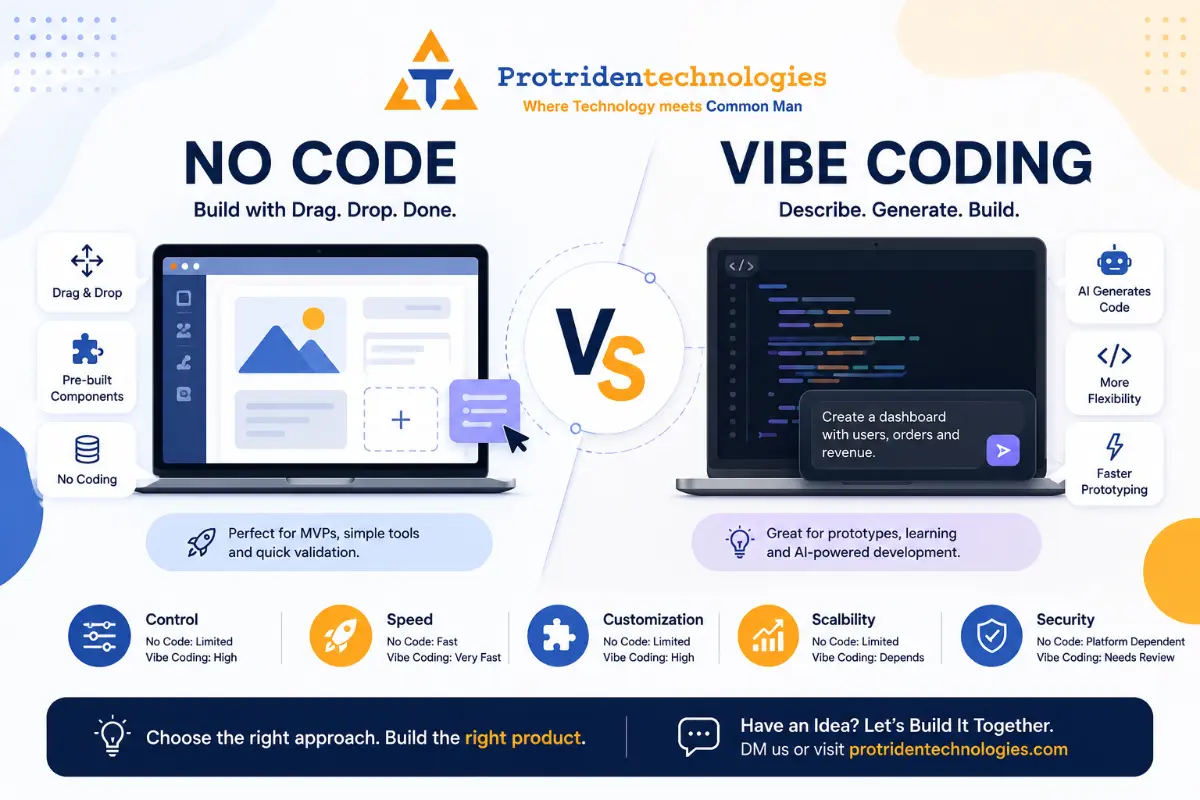
No Code vs Vibe Coding: Main Difference
No-code and vibe coding both help people build faster.
But they are not the same.
No-code uses ready-made platforms and visual builders.
Vibe coding uses AI to generate actual code.
This creates important differences.
1. Control
No-code gives you less technical control.
You can build only within the limits of the platform.
If the platform supports your workflow, it is useful. If your requirement becomes complex, you may feel restricted.
Vibe coding gives more control because it can generate real code. But the code may become difficult to manage if the user does not understand the structure.
For simple use cases, no-code is easier.
For custom logic, vibe coding may offer more flexibility.
For serious products, custom software development gives the highest control.
2. Speed
Both no-code and vibe coding are fast.
No-code is faster for simple pages, forms, dashboards, and automations.
Vibe coding is faster for experiments, UI generation, small features, and early prototypes.
But speed should not be the only goal.
A fast prototype is useful.
A poorly planned product is risky.
If the product needs payments, user data, role-based access, admin panel, APIs, security, reporting, or scaling, proper architecture becomes important.
3. Customization
No-code tools are good when your requirement matches the platform.
But if your startup needs unique workflows, advanced logic, custom user roles, special integrations, or a complex admin panel, no-code may become limited.
Vibe coding can help generate custom code, but the output still needs review.
If the product is business-critical, the code should be structured, documented, tested, and maintainable.
This is where a software development company becomes important.
4. Scalability
No-code tools can work well for early validation.
But as your users, data, features, and operations grow, you may face limits.
Common issues include:
Platform limitations
Higher subscription costs
Difficult custom changes
Data migration challenges
Performance issues
Limited backend control
Vendor dependency
Vibe coding can create flexible prototypes, but scalability depends on how the code is written.
If AI generates code without proper architecture, the product may work today but become difficult to improve later.
For long-term scalability, startups need proper backend, database, cloud, DevOps, testing, and maintenance planning.
5. Security and Maintenance
Security is one of the biggest differences.
No-code platforms usually manage some security at the platform level, but the final setup still depends on how the user configures access, data, integrations, and permissions.
Vibe coding can create security risks if the user accepts code without checking it properly.
Common risks include:
Weak authentication
Poor database rules
Exposed API keys
Insecure APIs
No input validation
Broken access control
No proper error handling
No backup planning
No monitoring
For student projects, this may not be a major issue.
For a startup product with real users, payments, customer data, or business operations, it is very important.
When Should Startups Use No-Code?
Startups can use no-code when they want to validate an idea quickly.
No-code is useful for:
Landing pages
Waitlist pages
Simple MVPs
Lead forms
Internal tools
Basic workflows
Customer surveys
Early-stage testing
Simple dashboards
Non-critical business tools
Example:
A founder wants to check if people are interested in a new service app.
Instead of building a full mobile app immediately, they can launch a simple landing page, collect enquiries, speak to users, and validate demand.
This saves money and reduces risk.
No-code is a good starting point when the goal is learning, testing, or collecting early feedback.
When Should Startups Use Vibe Coding?
Vibe coding is useful when the founder, student, or developer wants to create a quick working prototype with AI help.
It is useful for:
Learning coding concepts
Building demo projects
Generating UI screens
Testing app flows
Creating proof-of-concepts
Exploring feature ideas
Hackathon projects
Early MVP experiments
Small internal tools
Example:
A student wants to create a simple task management app.
An AI coding tool can help generate the frontend, backend, database structure, and basic features.
This can be great for learning.
A startup founder can also use vibe coding to create a rough prototype and explain the idea to a technical team.
But using vibe coding for a production app without review is risky.
The code must be checked, cleaned, secured, tested, and improved before real users depend on it.
When Should You Choose Custom Software Development?
You should choose custom software development when the product is serious, business-critical, or planned for real users.
Custom development is better when you need:
Mobile app development
Web application development
Admin panel
Backend APIs
Payment gateway
User roles
Booking system
Ecommerce platform
ERP or CRM
Dashboard and reports
Cloud hosting
Security setup
Third-party integrations
Long-term maintenance
Performance optimization
Scalable architecture
For startups, custom development does not always mean building everything in version one.
A good development partner will help you build an MVP first.
The goal is to build the right features first, launch, learn from users, and then improve.
No-Code vs Vibe Coding vs Custom Development
Here is a simple way to decide.
Use no-code when you want to test a simple idea quickly.
Use vibe coding when you want to experiment with AI-generated code or create a working prototype.
Use custom software development when you want to build a secure, scalable, maintainable product for real users.
For students, vibe coding can be a useful learning tool.
For startups, no-code and vibe coding can help with early validation.
For real business operations, custom development is usually the safer long-term path.
Common Mistakes Students and Startups Make
Mistake 1: Thinking no-code can solve every problem
No-code is powerful, but it has limits.
If your business workflow is unique, you may need custom development.
Mistake 2: Trusting AI-generated code without review
AI can generate useful code, but it can also create bugs, security issues, or messy structure.
Always review and test.
Mistake 3: Building without an admin panel
Many startup products fail operationally because the team cannot manage users, orders, payments, content, or reports properly.
Mistake 4: Ignoring cloud and hosting
A product is not complete after development.
It needs hosting, backups, monitoring, deployment, security, and support.
Mistake 5: Building too many features in version one
Startups should not build everything at once.
Build the MVP first.
Then improve based on real users.
How Protriden Technologies Helps Startups and AI Coding Users
Protriden Technologies helps startups, students, founders, and businesses move from idea to practical digital product.
If you have built something using no-code or vibe coding, our team can help you understand whether it is ready for real users.
We can help with:
- MVP planning
- Website development
- Mobile app development
- Custom software development
- Admin panel development
- Backend development
- Cloud infrastructure
- DevOps and deployment
- Security review
- Code review
- Performance improvement
- Business automation
- Post-launch maintenance
For startups, we help convert ideas into clear development plans.
For students and AI coding users, we can help review prototypes and explain what is needed to make them production-ready.
For businesses, we build secure and scalable systems that reduce manual work and improve operations.
Final Thoughts
No-code and vibe coding are useful.
They make software creation faster and more accessible.
But they are not replacements for proper product planning, software architecture, security, testing, deployment, and maintenance.
No-code is good for quick validation.
Vibe coding is good for fast prototyping and learning.
Custom software development is better when your product needs stability, security, scalability, and long-term business value.
If you are planning to build a startup MVP, website, mobile app, admin panel, or custom software, start with clarity.
Understand the problem.
Choose the right development path.
Then build a product that can grow with your users and business.
FAQs
1. What is the difference between no-code and vibe coding?
No-code uses visual platforms and prebuilt components to build apps or workflows without traditional coding. Vibe coding uses AI tools and natural-language prompts to generate code. No-code is easier for simple tools, while vibe coding offers more flexibility but requires code review and testing.
2. Is vibe coding better than no-code?
Vibe coding is better when you want more custom code and faster experimentation. No-code is better when you want a simple tool, landing page, form, dashboard, or automation without managing code. For serious products, both may still need expert review.
3. Can startups use no-code to build an MVP?
Yes. Startups can use no-code to validate ideas, create landing pages, collect leads, build basic workflows, and test early demand. But if the product needs custom logic, payments, user roles, security, or scaling, custom development may be needed.
4. Can vibe coding build a real app?
Vibe coding can help create a working prototype or even parts of a real app. But before using it for real customers, the code should be reviewed, tested, secured, and properly deployed.
5. Is vibe coding good for students?
Yes. Vibe coding can help students learn app development, understand code structure, build projects, and experiment with ideas. But students should also learn how the code works instead of only copying AI output.
6. Is no-code safe for business applications?
No-code can be safe for simple use cases if configured properly. But for sensitive data, payments, customer records, or business-critical workflows, security, access control, backup, and data ownership should be checked carefully.
7. When should I choose custom software development?
Choose custom software development when your product needs scalability, security, advanced features, custom workflows, admin panels, backend APIs, integrations, mobile apps, or long-term maintenance.
8. Can Protriden Technologies improve an AI-generated or no-code prototype?
Yes. Protriden Technologies can review prototypes, identify technical gaps, rebuild critical parts, create admin panels, improve security, set up cloud hosting, and convert early prototypes into production-ready software.
Built a Prototype Using No-Code or AI Coding?
That is a good first step.
But before you launch it for real users, make sure it is secure, scalable, and maintainable.
At Protriden Technologies, we help startups, students, and founders turn early ideas, no-code prototypes, and AI-generated code into practical digital products.
We can help with MVP planning, website development, mobile app development, admin panels, backend systems, cloud setup, security review, and long-term support.