
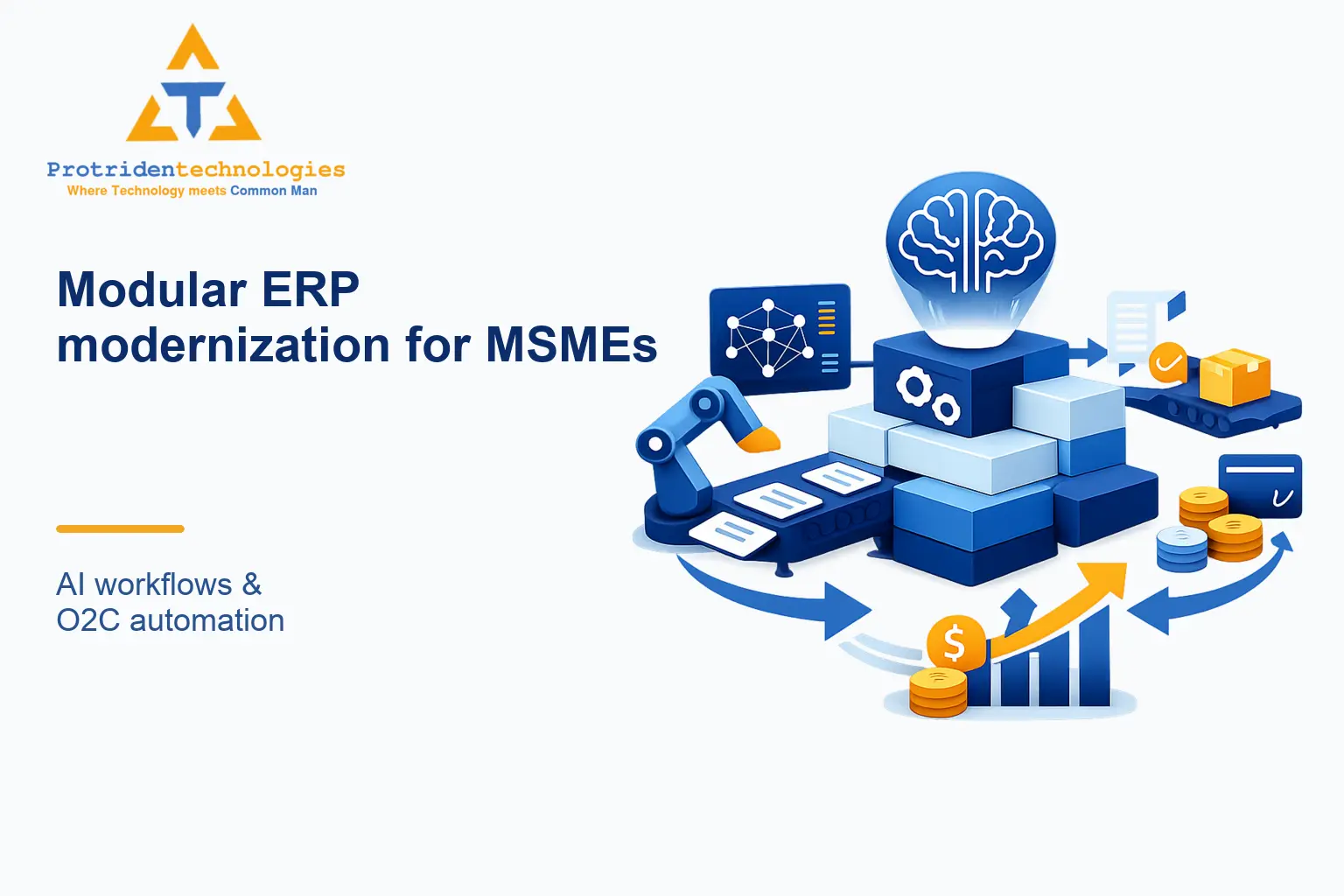
Many MSMEs have adopted point AI tools for forecasting, quality checks or sales outreach but still keep core operations on spreadsheets, legacy accounting and disconnected order systems. This creates repeated manual reconciliations, late or missed invoices, weak receivables visibility and a bottleneck to scaling sales or automating workflows.
A phased, modular ERP modernization lets teams deliver high-value modules — such as Order‑to‑Cash — quickly, then integrate AI-enabled workflows and shopfloor data later without a big-bang replacement.
Protriden Technologies, based in Kundapura (Udupi, Karnataka), provides custom ERP, workflow automation and cloud deployment services that support modular rollouts, local implementation and ongoing support.
Why This Topic Matters
For MSMEs, the core problem is not AI itself but disconnected systems: analytic and generative AI tools can suggest decisions, but without integrated transactional data from orders, inventory and accounts, those suggestions require manual follow-up. A modular ERP approach addresses that by delivering usable business processes module by module so AI workflows operate against reliable transactional data rather than siloed spreadsheets.
Modularity reduces risk because teams can pilot and refine single modules — for example Order‑to‑Cash — and progressively add sales, inventory, production and accounting. Research and practical deployments highlight the value of modular, user-centered design and shopfloor integration to reduce approval times and human error while improving traceability.
Choosing a modular ERP also matters because modern systems are designed to integrate with AI services and third-party applications. That integration capability lets firms automate repetitive tasks, reduce manual reconciliations and make AI recommendations actionable in the same workflow where orders are created, fulfilled and invoiced.
- Modular ERP enables phased delivery and early business value from the first working module (e.g., Order‑to‑Cash).
- Shopfloor and document automation reduce approvals, errors and traceability gaps when integrated with ERP.
- APIs and modular design make it practical to attach AI workflows, analytics and external services to operational data.
Research references: (PDF) Towards Digital Transformation in SMEs: A Custom Software Solution for Shopfloor–ERP Integration; Custom ERP Software for Manufacturing and Logistics SMEs | Codebaker; (PDF) The Role of Modular Systems in Modern Enterprise Resource Planning (ERP) Solutions.
Common Mistakes Businesses Make
Many SMEs approach modernization as a single large replacement and delay delivery until every module is ready. That increases project risk, extends timelines and keeps manual workarounds active during the project.
Another frequent mistake is trying to bolt AI tools onto poor-quality data or fragmented processes. Without reliable order and inventory data inside an ERP, AI outputs require manual reconciliation and lose practical value.
Finally, selecting an off-the-shelf module without process analysis can leave critical local workflows uncovered, creating expensive custom patches later.
- Attempting a big-bang ERP replacement instead of a phased modular rollout.
- Deploying AI features before transactional workflows and master data are cleaned and integrated.
- Choosing a packaged module without validating it against shopfloor and billing realities.
Practical Checklist / Steps
Use this practical checklist to plan a phased ERP modernization focused on Order‑to‑Cash and AI workflow integration. Each step is designed to reduce disruption while delivering measurable benefits early.
- Map current Order-to-Cash and data sources: Document how orders are placed, approved, fulfilled and invoiced today. Include the tools, spreadsheets and manual steps involved, and list where customer, order and inventory data currently resides.
- Identify the highest-impact module to release first: Choose a module that removes the most manual work and improves cash visibility — commonly Order‑to‑Cash or invoicing — so you deliver tangible benefits in the near term.
- Perform focused process analysis on the pilot area: Spend one to three weeks on-site or with remote stakeholder workshops to capture exceptions, approval rules and shopfloor handovers that must be supported by the pilot module.
- Design modular data and API boundaries: Define master data (customers, products, price lists) and APIs for exchanging orders, inventory and invoices so the first module can integrate later AI services and other modules without rework.
- Deliver a measurable pilot and collect feedback: Deploy the pilot to a single department or customer segment, measure time-to-invoice, error rates and reconciliation effort, then iterate before wider rollout.
- Integrate AI workflows to augment tasks, not replace checks: Connect AI features (e.g., invoice classification, credit-risk signals, automated follow-ups) where they assist user decisions, while keeping final approval controls in the ERP workflow.
- Plan sequential module releases with rollback options: Schedule subsequent modules (sales, inventory, procurement, accounting) and keep the ability to revert or patch the previous release if unforeseen issues arise.
- Establish cloud, backup and monitoring practices: Use managed cloud or local hosting with automated backups and application monitoring to keep production modules stable during staged modernization.
Cost, Timeline, or Decision Factors
Cost and timeline for modular ERP modernization depend on several factors: the complexity of existing processes, the number of systems to integrate, data cleanup needs, custom reporting and regulatory compliance. Vendor experience with shopfloor integration and the availability of APIs for existing systems also change effort estimates.
Rather than fixed prices, budget planning should be scenario-based: pilot cost for a single module, incremental cost per additional module, and a contingency for unexpected integrations or master-data remediation.
- Current process complexity and undocumented exceptions increase analysis and development time.
- Data quality and migration needs affect both effort and risk; messy master data requires cleaning before effective automation.
- Integration surface: each external system or legacy database adds design and testing work.
- Custom reports, local tax and compliance features add development time compared to standardized modules.
- Vendor experience with phased rollouts and shopfloor integration shortens implementation cycles and reduces rework.
Local Relevance: India, Karnataka, and Udupi
In India, MSMEs often manage diverse processes across multiple sites and rely on local support for change. Protriden Technologies operates from Kundapura in Udupi district, Karnataka, and lists custom ERP, billing, inventory, workflow automation and cloud deployment among its services. Local presence aids faster process analysis, shopfloor visits and close collaboration during pilot deployments.
Karnataka hosts a dense manufacturing and services ecosystem; for MSMEs in Kundapura and Udupi, proximity to a local implementation partner can reduce travel time for discovery workshops and speed up iterative testing of modules such as Order‑to‑Cash and shopfloor integrations.
- Local implementation enables in-person process mapping and quicker issue resolution during early module releases.
- Compliance and GST nuances in India mean local knowledge is helpful when configuring billing and tax logic.
- A nearby partner can provide faster post-launch support and performance tuning for cloud or on-prem deployments.
How Protriden Technologies Can Help
Protriden Technologies provides services that match the modular ERP modernization path: custom ERP and workflow automation, mobile and web applications, cloud deployment and monitoring, and ongoing maintenance. Their offering is positioned to deliver phased modules and integrate AI-enabled workflows into operational processes.
Working with a partner that can develop API-backed modules, deploy on cloud infrastructure, and provide UI/UX and testing support reduces coordination overhead and accelerates time-to-value for the first working module.
- Custom ERP modules tailored to your current Order‑to‑Cash and inventory processes.
- Workflow automation to replace manual approvals and reduce reconciliation work.
- Cloud deployment, monitoring and application security to stabilize phased releases.
- Mobile interfaces and shopfloor data capture to connect production activities to ERP records.
- Post-launch maintenance and iterative improvements after pilot feedback.
Final Thoughts
A pragmatic modernization approach combines selective modular ERP rollout with carefully integrated AI features. Start with the business process that most affects cash and customer experience, prove value with a pilot, then expand modules while maintaining clean master data and well-defined APIs.
Avoid the temptation to deploy advanced AI automation before the transactional foundation is stable. When AI is layered onto reliable ERP data and workflows, it becomes a tool that lowers manual effort and supports faster, more confident growth.
FAQs
How quickly can an MSME expect value from a modular ERP approach?
A modular approach is designed to deliver usable software quickly by releasing a single high-impact module first—commonly Order‑to‑Cash. The exact speed depends on discovery and integration needs, but many projects deliver a pilot module in weeks rather than waiting months for a full replacement.
Can AI workflows be added later or must they be included from the start?
AI workflows can and often should be added after the pilot module is stabilised. That ensures transactional data quality and APIs are in place so AI outputs are reliable and actionable within ERP workflows.
Will a modular ERP work with existing accounting or legacy systems?
Yes, modular ERP designs use APIs and integration layers to exchange orders, inventory and invoices with legacy systems. Integration complexity varies by the legacy system’s interfaces and data quality, so plan for analysis and testing work.
What are typical risks when automating Order‑to‑Cash for small businesses?
Typical risks include incomplete master data, overlooked approval rules, and insufficient exception workflows. These are mitigated by thorough process mapping, pilot testing with real transactions and keeping human-in-the-loop approvals for edge cases.
How does local partnership help during ERP modernization in Karnataka?
A local partner can accelerate discovery workshops, perform shopfloor visits, understand regional billing and compliance needs, and provide faster on-site support during pilot deployments and iteration cycles.
Discuss your Order‑to‑Cash modernization needs with Protriden’s team—share your current process and we’ll propose a phased roadmap and pilot scope.
Explore our software development services or discuss your requirements with the Protriden Technologies team.