
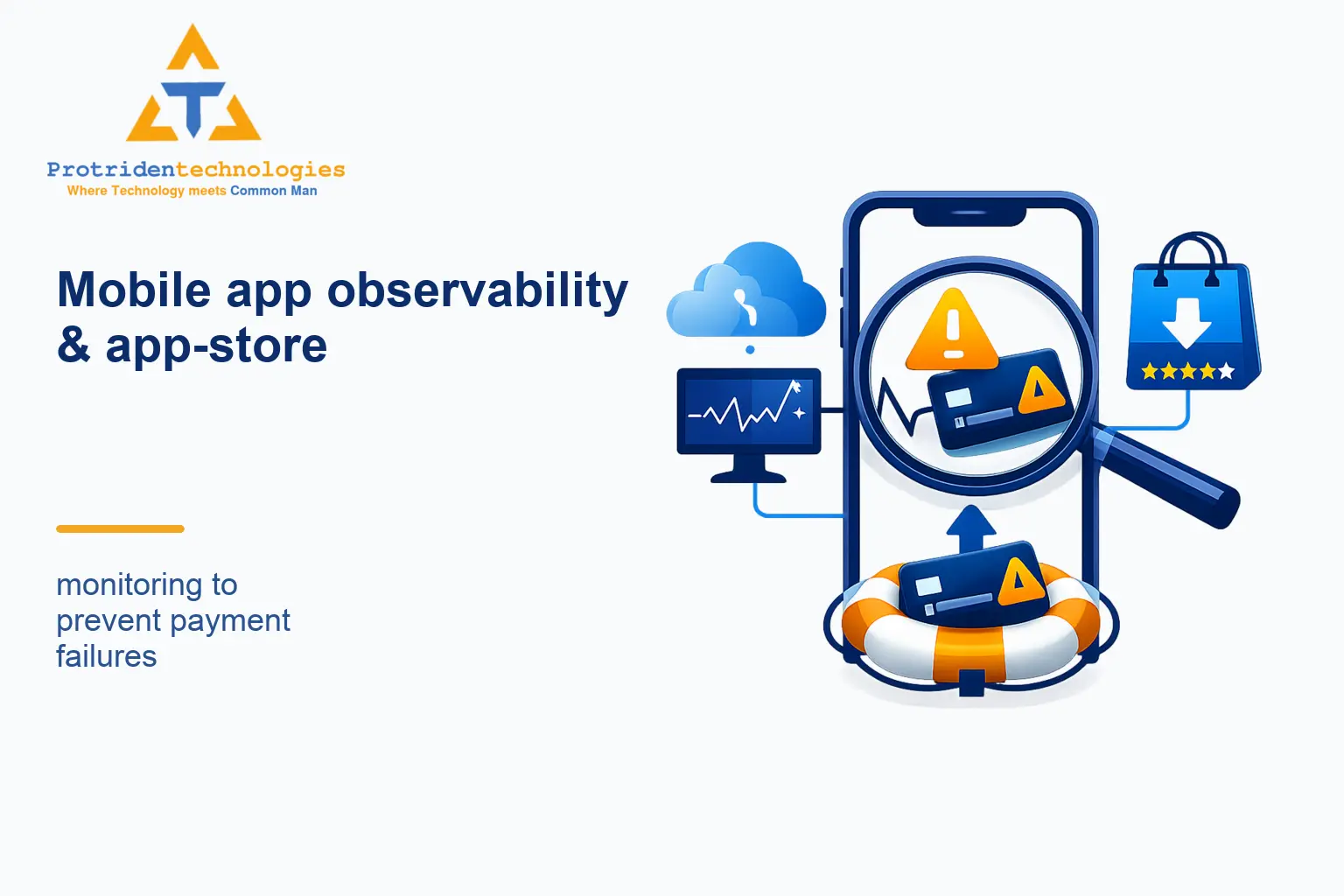
Unexpected or intermittent mobile payment failures and unexplained churn are silently costing revenue and undermining product trust. Product teams often only notice problems after users complain or conversion metrics fall — by then the root cause may span SDKs, network conditions, store-side rejections or client-side UI errors.
Mobile apps combine device SDKs, payment gateways, network calls and app-store delivery; failures can originate anywhere in that chain and be invisible without end-to-end telemetry.
Product and mobile leads need implementable observability that ties failed authorizations to device models, app versions and store events so fixes can be prioritized and rolled out quickly. An observability pilot focused on payments delivers that visibility fast.
Why This Topic Matters
Mobile payment reliability and retention are tightly coupled: users expect frictionless checkout and will abandon apps that fail during payment. Observability turns transient errors and performance regressions into diagnosable signals by collecting traces, metrics and contextual logs across the mobile client, third‑party SDKs and the network path. That business visibility helps reduce revenue loss and informs product decisions about UX, SDK updates and server-side resilience.
For product leaders, observability is not merely a developer tool — it is a commercial lever. Near-real-time alerts for payment declines, guardrails for app-store rejections and retention cohorts segmented by failure type let teams measure direct business impact and focus engineering effort where it moves revenue. Implementations that combine mobile telemetry with app-store monitoring enable faster root-cause analysis when payment drops align with store push changes, SDK updates or policy enforcement.
Practical observability collects three complementary data types: metrics for conversion and latency, traces for request flows through SDKs and gateways, and contextual logs for client state and error payloads. Together they enable actionable alerts and targeted fixes that reduce churn and increase transaction completion rates.
- Observability ties payment failures to device, OS, app version and store events (S1).
- Combined metrics, traces and logs provide the fastest path from alert to fix (S6).
- Payment observability treats payments as a commercial system where latency and errors directly affect conversion (S7).
Research references: Observability for Mobile with OpenTelemetry | by Dotan Horovits (@horovits) | Medium; Observability Best Practices - Embrace.io; Payment Observability: Metrics, Tracing & Alerting.
Common Mistakes Businesses Make
Product and engineering teams commonly underestimate the scope of mobile failure modes — assuming backend monitoring alone will surface checkout problems. Mobile-specific issues (network variability, SDK race conditions, platform store behaviors) require client-side instrumentation and correlation to backend traces.
Another frequent mistake is instrumenting only for crashes or generic errors. Payment failures often manifest as silent declines, timeouts, or token refresh problems that won’t appear in crash reports. Without semantic events tied to payment steps, teams can’t measure where users drop off or generate useful alerts.
- Relying solely on backend logs and server-side APM and ignoring client telemetry.
- Collecting too much raw data without defined business events (e.g., payment‑init, auth-challenge, authorization-result).
- Waiting for user complaints or app-store rating drops instead of proactive app-store monitoring tied to release events.
- Treating observability as a point effort rather than an iterative program that includes retention metrics and alert tuning.
Practical Checklist / Steps
The checklist below is a practical path to a 4–6 week observability pilot focused on payment failure detection and app-store monitoring. Tailor scope by selecting critical payment flows, highest-volume regions, and the app versions that see most conversions.
- Define clear business events to track: Map the payment flow and list semantic events (payment initiated, checkout submit, token refresh, bank redirect start, authorization result) and retention cohorts. Instrumenting these events is the fastest way to link telemetry to revenue impact.
- Instrument client-side telemetry: Add lightweight spans and metrics in the mobile client for critical payment steps. Capture device metadata, network type, SDK versions, and OS. Ensure sampling preserves traces for failed authorizations and high-latency paths.
- Correlate client and backend traces: Ensure trace identifiers propagate from the app to backend services and payment gateways so a single trace recreates the whole authorization path. That correlation is crucial to identify whether failures are client- or gateway-side.
- Implement semantic logging and failure payloads: Log meaningful error codes and server responses at points of failure. Avoid free-text dumps; include structured fields like error category, gateway response code, and retry allowed to enable automated triage.
- Set business-aware alerts and dashboards: Create alerts driven by business thresholds (e.g., authorization rate drop by X% in 30 minutes for a major region). Dashboards should show conversion funnel, per-device failure rate, and app-store release overlays for quick diagnosis.
- Add app-store monitoring and release guards: Monitor app-store review status, staged rollout metrics and store-side policy alerts. Overlay store events on observability timelines to detect if a drop follows a new release or store enforcement action.
- Run a 4–6 week pilot with prioritized cohorts: Start with the highest transactional user cohort and a limited set of app versions. Iterate alert thresholds, validate false positives, and produce a prioritized remediation backlog for engineering and product.
- Operationalize learnings and handoff: After pilot, document instrumentation patterns, onboard SRE and support teams to dashboards, and embed observability tasks in release pipelines so future releases include payment-focused telemetry. Schedule periodic reviews tied to retention KPIs.
Cost, Timeline, or Decision Factors
Cost and timeline for an observability engagement vary by current telemetry maturity, app complexity, number of platforms (Android, iOS, Flutter), and the need to instrument third‑party payment SDKs. Key decision factors include existing telemetry, engineering bandwidth, compliance needs, and whether correlation across client, backend and store requires custom adapters.
Rather than fixed prices or delivery guarantees, teams should evaluate proposals by scope (pilot vs organization-wide rollout), desired SLAs for alerting and triage, and vendor experience with payment systems and app-store monitoring. The pilot approach reduces risk: pick a 4–6 week scope that proves value before committing to broader rollout.
- Existing instrumentation and CI/CD maturity — less work if traces and identifiers already propagate.
- Number of payment flows and external gateways that need correlation.
- Platforms to support (native Android/iOS, Flutter) and any legacy SDK constraints.
- Compliance and data retention policy needs affecting telemetry storage and aggregation.
Local Relevance: India, Karnataka, and Udupi
In India, increasing regulatory attention on digital payments and periodic app-store policy enforcement make observability especially important for consumer finance and retail apps. Regulatory guidance often leads to backend or SDK changes that can unpredictably affect mobile payment flows, so teams must be able to correlate store events and policy-driven changes with conversion metrics.
For product leaders and engineering teams in Karnataka — and specifically in coastal technology hubs like Kundapura and Udupi where Protriden Technologies operates — the combination of local engineering talent and proximity to regional markets enables quicker collaboration on instrumentation and pilot delivery. Local knowledge of developer ecosystems, payment gateway partners and store behavior in Indian markets speeds diagnosis and remediation.
Startups and mid-market fintechs in India often rely on multiple third-party SDKs and regional gateways; observability pilots that include device-model segmentation and store-release overlays are especially valuable to diagnose payments that fail only on specific carriers, regions or device configurations.
- Observability helps surface issues caused by regional gateways, carrier networks and India-specific payment flows.
- Local delivery and support from firms based in Kundapura/Udupi reduces coordination friction during pilot sprints.
- Pilots should include Indian app-store behaviors and release practices to catch store-driven failures early.
How Protriden Technologies Can Help
Protriden Technologies provides mobile and cloud engineering services, including Android, iOS and Flutter app development, cloud deployment and monitoring, and post-launch support from its Kundapura, Udupi, Karnataka base. We can run an observability pilot that focuses on payment failure detection and app-store monitoring, leveraging pragmatic instrumentation patterns and dashboards that align with product KPIs.
Our approach is to scope a focused 4–6 week pilot that instruments critical payment events, correlates client traces with backend paths, and integrates app-store release signals into dashboards. We emphasize measurable outcomes: clearer failure attribution, defined remediation actions, and tuned alerts that reduce noise for on-call teams.
We do not promise specific revenue gains or timing guarantees; instead we commit to delivering a working pilot that demonstrates visibility into payment failure modes and a prioritized remediation backlog your team can act on. Our services include instrumentation, dashboarding, alerting setup, and knowledge transfer so your team can scale observability after the pilot.
- Pilot scoping and instrumentation for Android, iOS or Flutter apps.
- Trace correlation between mobile client and backend/payment gateways.
- App-store monitoring integration and release overlay on observability timelines.
- Dashboarding, alerting configuration and operational handoff to internal teams.
Final Thoughts
Mobile payment reliability is both a technical reliability problem and a business optimization opportunity. Observability converts hidden failure modes into prioritized engineering work that directly protects revenue and retention.
Start with a narrow, high-value pilot: instrument the critical payment path, correlate traces, and overlay app-store events. The resulting visibility typically yields faster fixes and clearer prioritization than ad hoc debugging or ticket-driven firefighting.
If your team has seen sudden payment drops, app-store alerts, or rising churn with no clear cause, a focused observability assessment will surface where to act first and build a repeatable instrumentation practice for future releases.
FAQs
What exactly is included in a 4–6 week observability pilot?
A pilot typically includes scoping the critical payment flows, adding client-side instrumentation for payment events, ensuring trace propagation to backend services, setting up dashboards and business-aware alerts, and integrating app-store release signals. The outcome is a working dashboard, tuned alerts and a prioritized remediation backlog.
Will the pilot require major app changes or impact users?
Pilots favor lightweight instrumentation patterns that minimize runtime overhead and avoid broad UI changes. Most work is additive telemetry and server-side correlation. Any release to production follows your normal CI/CD and rollout practices to avoid user impact.
Can observability detect issues caused by third‑party payment SDKs?
Yes. Properly instrumented traces and structured failure payloads let you isolate whether failures occur inside a payment SDK, during token exchange, or in gateway responses. In some cases, SDKs require collaboration with the vendor to expose richer diagnostics.
How do you handle data privacy and retention for telemetry in India?
Telemetry design considers data minimization and structured fields; sensitive PII is excluded from traces. Retention and storage follow agreed policies and can be adapted to compliance needs. Specific retention durations are part of scoping and contract discussions.
How quickly will we see useful signals after starting the pilot?
Useful signals often appear within days of instrumenting the critical payment path, but meaningful business trends and tuned alerts may take several weeks as you validate thresholds and reduce false positives during the pilot.
Request an observability & app-store monitoring assessment to scope a 4–6 week pilot focused on payment failure detection and retention improvement. Contact Protriden to schedule a discovery call.
Explore our software development services or discuss your requirements with the Protriden Technologies team.