
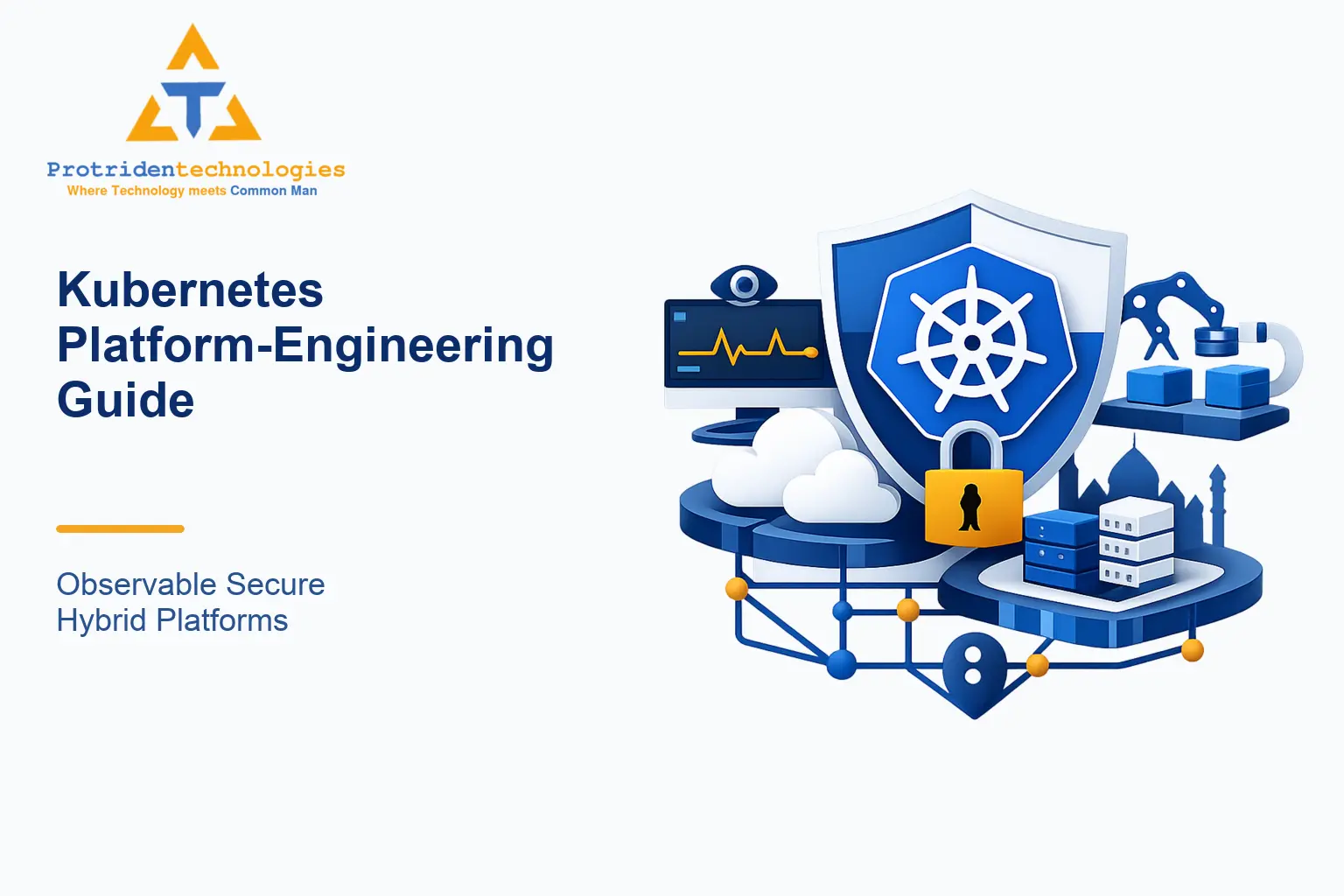
Product teams and startups often struggle to convert Kubernetes experiments into reliable internal developer platforms. They face fragmented tooling, unclear SLOs, and fragile CI/CD pipelines that slow feature delivery and increase toil. Teams need repeatable platform patterns that combine security, observability and developer ergonomics without becoming another operational burden.
Platform engineering on Kubernetes brings together orchestration, developer workflows and platform automation so teams can ship faster while maintaining control. Well-designed platforms provide golden paths, standard operators and service templates that reduce onboarding time and outages.
For India-based product teams, choosing the right balance between managed services and self-hosted components matters for cost, skills and compliance. Protriden Technologies operates from Kundapura, Udupi, Karnataka and provides cloud deployment, monitoring, application security, Docker and CI/CD services that can support phased platform work.
Why This Topic Matters
Platform engineering reduces cognitive load for application teams by providing standardized building blocks and prescriptive workflows that sit on Kubernetes. When platform engineering is done with attention to observability, security and CI/CD, development velocity and operational reliability both improve. Guides and industry practitioners emphasize that the platform should serve developers with opinionated defaults while exposing escape hatches for advanced use cases (see sources for design patterns).
Observability and SLO-driven operations are central: teams need metrics, traces and logs wired into dashboards and alerting that reflect user-centric service quality. Service mesh and CI/CD operator patterns help enforce security and deployment policies consistently across clusters and clouds. Adopting these as platform-level capabilities prevents ad-hoc, team-by-team implementations that lead to tool sprawl and fragile runbooks.
Hybrid or multi-cluster deployments are increasingly common as teams balance latency, data residency and cost. Platform engineering practices help operators manage this complexity with consistent configurations, operators and GitOps workflows that reconcile desired state across environments. This focus on consistency is what separates transient Kubernetes experiments from production-grade platforms.
- Makes developer experience repeatable with golden paths and self-service APIs
- Encodes security and compliance at platform layer to reduce drift
- Builds observability and SLOs into the platform for proactive operations
- Supports hybrid and multi-cluster patterns to meet latency and data residency needs (on-premises, cloud, edge)
Research references: Platform Engineering on Kubernetes: Principles and Best ...; Platform Engineering on Kubernetes: A 2026 Guide.
Common Mistakes Businesses Make
Teams often start by installing many open-source tools without defining clear ownership, golden paths or upgrade procedures. The result is a brittle assemblage of dashboards and scripts that only the original engineers can operate. Platform work needs governance: component selection, upgrade cadence and a clear support model.
Another frequent mistake is treating the platform as a product built by a siloed 'platform' team with minimal developer input. Platform teams should collaborate closely with application teams to define developer workflows, SLOs and template requirements. Otherwise, the platform becomes a set of constraints rather than an enabler.
Finally, many teams deploy service mesh, observability and CI/CD tools without an operational plan for scaling, security policies or costs. For example, sidecar-heavy meshes and high-cardinality metrics can balloon resource usage. Each addition needs a review against SLOs, resource budgets and retention policies.
- Installing tools before defining developer workflows and SLOs
- Siloed platform development without continuous feedback from product teams
- Ignoring operational costs of telemetry, sidecars and multi-cluster control planes
- Lack of upgrade and lifecycle plans for platform components
Practical Checklist / Steps
This checklist is for product teams and small platform groups designing or hardening a Kubernetes-based internal developer platform. Treat each item as a decision point: document trade-offs and expected outcomes before implementation.
- Define platform goals and service-level objectives: Align stakeholders on what the platform must deliver: developer onboarding time, deployment frequency, mean time to restore and data residency constraints. Capture these as measurable SLOs that drive tooling and alerting requirements.
- Map developer workflows and golden paths: Identify common developer tasks—service creation, CI/CD, rollbacks, secret management—and create opinionated templates and operators that automate them. Keep escape hatches for advanced use cases.
- Choose a GitOps control plane and operator patterns: Use GitOps to enforce desired state across clusters. Select operators for cluster lifecycle, ingress, and platform components; standardize CRDs and reconcile loops to reduce drift.
- Design observability with low-noise alerts: Instrument code with traces and metrics, centralize logs, and create dashboards tied to SLOs. Use sampling, cardinality limits and retention tiers to control costs and alert fatigue.
- Adopt a service mesh strategy aligned to needs: Evaluate lightweight proxies or managed meshes for security and traffic control. Document mTLS, policy, and sidecar injection strategies; measure CPU/memory impact in staging.
- Define CI/CD pipelines and promotion gates: Standardize pipelines as code with clear promotion gates (canary, smoke tests, SLO checks). Integrate security scans and dependency checks into the pipeline for shift-left security.
- Secure the platform by design: Centralize secrets, enforce RBAC and network policies, and integrate continuous vulnerability scanning for images and dependencies. Treat runtime detection as a complement to build-time checks.
- Plan for hybrid and multi-cluster deployments: Decide which workloads run where and define data access patterns. Implement cluster federation or multi-cluster GitOps patterns and ensure consistent policy enforcement across locations.
Cost, Timeline, or Decision Factors
Costs and timelines for platform work depend on several factors: current maturity (infrastructure as code, existing CI/CD), number of teams, compliance and data residency requirements, and whether components will be managed or self-hosted. Each choice changes operational effort and long-term maintenance burden.
Hybrid and multi-cluster designs increase complexity: they require additional control-plane tooling, cross-cluster service discovery, and consistent security policies. Choosing managed services reduces initial setup time but may constrain customization. Operator-based, self-hosted patterns offer flexibility at the cost of ongoing maintenance.
Skill availability and organizational processes are decisive. If your team lacks Kubernetes operator or SRE experience, expect a longer ramp for self-hosted platforms. Conversely, investing in platform automation and strong GitOps practices shortens long-term incident response and release cycles.
- Platform maturity and existing IaC/CI practices affect timeline
- Number of teams and workload diversity increase configuration scope
- Managed vs self-hosted components trade speed for customization
- Compliance, data residency and hybrid requirements lengthen design and validation phases
- Team skill levels determine whether to hire consultants, train staff, or opt for managed offerings
Local Relevance: India, Karnataka, and Udupi
India’s product ecosystem increasingly adopts platform engineering patterns to manage growth and scale. For teams in Karnataka—especially in coastal tech hubs like Udupi and Kundapura—choosing a pragmatic balance of managed cloud services and self-hosted platform components often matches local talent availability and cost objectives.
Protriden Technologies is based in Kundapura, Udupi, Karnataka and provides cloud deployment, monitoring and performance work, application security, Docker and CI/CD services. Regional teams can leverage these capabilities to run phased platform projects that start small and expand into managed or hybrid operations as needs evolve.
- Leverage nearby engineering resources and regional cloud expertise in Karnataka
- Start with small, measurable platform pilots in non-critical environments
- Opt for familiar cloud providers or managed clusters to reduce initial operational overhead (Protriden supports AWS and DigitalOcean deployments)
How Protriden Technologies Can Help
Protriden Technologies offers services that align with platform engineering needs: cloud deployment and monitoring, application security, Docker and CI/CD automation, and ongoing maintenance. These capabilities support platform projects from pilot to steady-state operations while keeping local presence in Kundapura, Udupi, Karnataka.
For teams evaluating next steps, Protriden can help with platform health assessments that review observability, CI/CD, security posture, and cluster lifecycle practices. Based on that assessment, a phased migration or improvement plan can be proposed that uses managed cloud components where appropriate and self-hosted operators where customization is required.
Protriden’s scope includes building repeatable developer workflows, automating CI/CD pipelines, instrumenting services for SLO-driven monitoring, and configuring platform security controls. The goal is to hand over predictable, repeatable patterns that reduce developer friction and operational surprises.
- Platform health review covering observability, CI/CD and security
- Phased implementation plan that balances managed services and operator patterns
- Cloud deployment, monitoring and performance optimization (AWS and DigitalOcean)
- Application security, Docker and CI/CD automation and maintenance
Final Thoughts
Kubernetes platform engineering is a deliberate practice that combines developer experience, operational rigor and measurable service expectations. Focus on SLO-driven observability, clear golden paths and a pragmatic hybrid strategy to make your platform a productivity multiplier rather than a maintenance burden.
Start with a constrained pilot that validates your golden paths, observability approach and promotion gates. Use that experience to expand the platform, keeping upgrade and lifecycle plans central to avoid technical debt and tool sprawl.
FAQs
How long does it typically take to build an initial platform MVP?
Timelines vary by starting point. If you already have infrastructure as code, containerized apps and a basic CI pipeline, a conservative pilot to deliver core golden paths, GitOps setup and observability can take several weeks to a few months. If you lack these foundations, expect a longer discovery and uplift phase. Key factors are team experience, number of workloads and compliance constraints.
Should startups use a service mesh from day one?
Not always. Evaluate service mesh when you need fine-grained traffic control, mTLS by default, or policy enforcement between services. For small teams or simple services, a mesh can add CPU/memory overhead and operational complexity. Consider starting with lightweight ingress and gradually adopt a mesh after validating resource and observability impact in staging.
What observability practices matter most for a platform?
Start with user-facing SLOs mapped to error rates, latency and availability. Instrument services with metrics and traces, centralize logs, and create dashboards and alerts tied to SLO breaches. Control telemetry costs via sampling and cardinality limits. The platform should expose observability templates and onboarding docs so teams can emit consistent telemetry.
Can we mix managed Kubernetes with self-hosted clusters in a hybrid model?
Yes. Hybrid models are common for latency, cost and data residency reasons. The platform must provide consistent configuration, security policies and GitOps workflows across cluster types. Expect additional work for cross-cluster discovery, secret management and unified observability; plan those pieces explicitly rather than treating clusters as independent silos.
What skills should my team invest in first for platform engineering?
Prioritize GitOps practices, Kubernetes operator patterns, CI/CD pipeline authoring, and observability basics (metrics, tracing, logging). Familiarity with container image security and runtime network policies is also important. If these skills are limited, consider phased training, hiring, or partnering with an experienced provider for the initial platform build.
Request a non-obligatory platform health review from Protriden Technologies to benchmark observability, CI/CD and security practices and receive a phased recommendation tailored to your teams and compliance needs.
Explore our software development services or discuss your requirements with the Protriden Technologies team.