
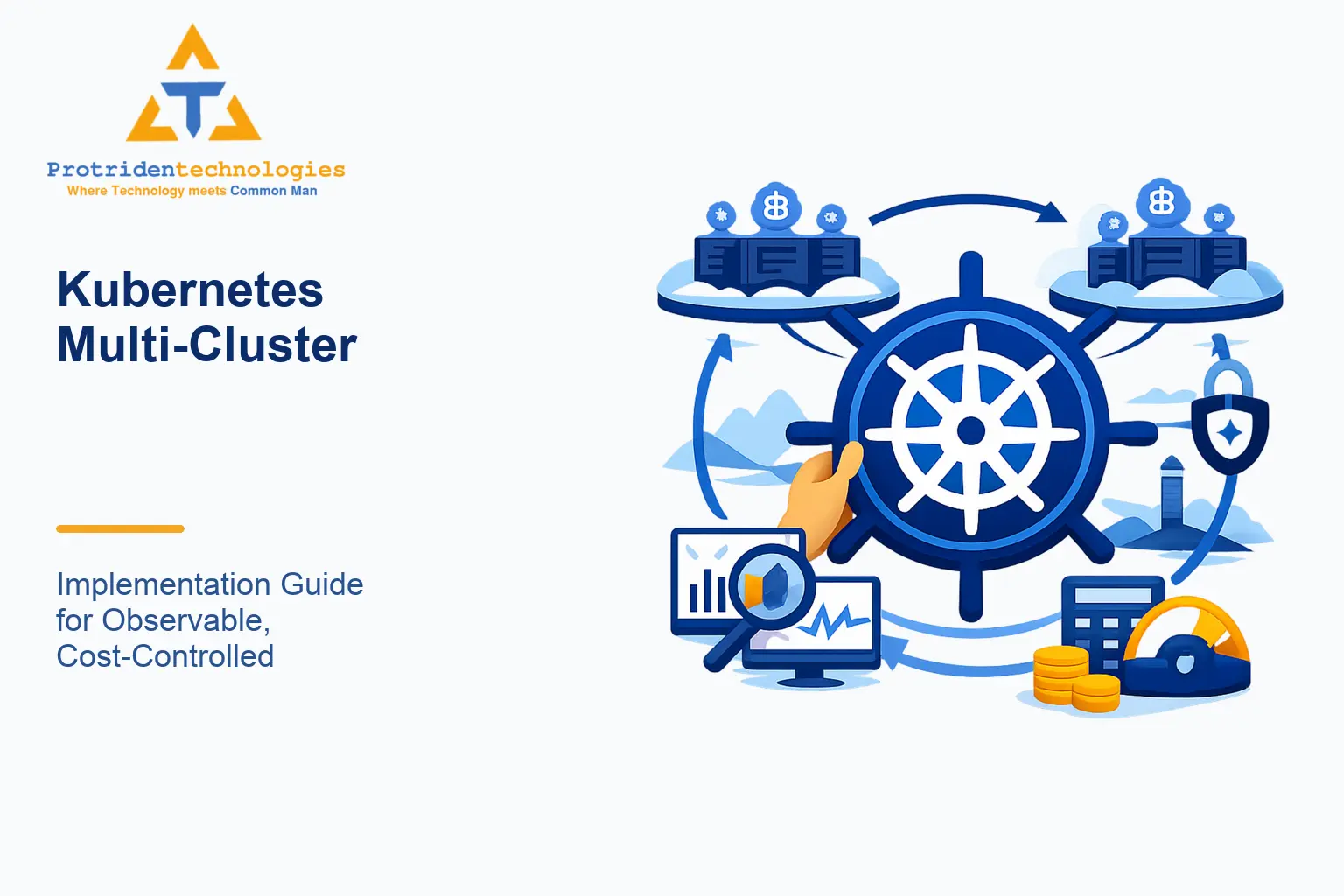
Platform and SRE teams are being asked to expand Kubernetes beyond a single cluster into multiple clusters—across cloud, edge and on-prem—while keeping costs predictable, maintaining security baselines, and ensuring end-to-end observability. Many organisations lack a repeatable platform model, struggle with drift between clusters, and face unclear decision criteria for multi‑cluster patterns.
A successful multi‑cluster rollout requires upfront platform standards (networking, policy, observability), provisioning automation, and guardrails for cost. Without those, teams accumulate operational debt and inconsistent security.
This guide distills practical implementation steps, common mistakes and decision factors platform teams can use to scope a workshop or a 4‑week platform assessment before a larger implementation engagement.
Why This Topic Matters
As organisations adopt microservices and distributed apps, single‑cluster models create limits for resilience, regulatory boundaries, performance and cost optimization. Multi‑cluster strategies let teams isolate workloads by trust boundary, region, compliance need or runtime profile while enabling independent lifecycle and upgrades.
Observability and cost governance are two levers that determine whether a multi‑cluster deployment reduces operational risk or multiplies it. Without a standardized observability baseline and cost controls, multi‑cluster environments become hard to troubleshoot and expensive to run.
Platform engineering practices—declarative provisioning, GitOps, standardized policies, and shared observability primitives—convert multi‑cluster complexity into repeatable conversations between platform owners and product teams.
- Multi‑cluster supports isolation (security, compliance), perf optimisation (regional clusters) and operational resilience (fault domain separation).
- A shared observability baseline (logs, metrics, traces, events) is essential to correlate incidents across clusters and reduce mean time to resolution.
- Cost controls—cluster sizing, autoscaling policies, workload placement and chargeback—are required to prevent runaway cloud spend in distributed deployments.
Research references: Chapter 1: Multi-Cluster - Kubernetes Guides - Apptio; A Guide to Multi-Cluster Kubernetes Management; Multi-Cluster Kubernetes: A Practical Guide.
Common Mistakes Businesses Make
Teams often treat a second cluster as a one‑off rather than as a repeatable platform artifact. This creates configuration snowflakes, uneven policies, and hidden operational costs.
Another frequent error is assuming existing observability and security tooling will scale unchanged. Tool misconfiguration, excessive telemetry volume, or lack of cross‑cluster context make troubleshooting slow and expensive.
Finally, skipping Day‑0 planning—cluster lifecycle, upgrade paths, and cost allocation—leads to technical debt that is costly to remediate later.
- Deploying clusters manually instead of declaratively (Cluster API, Terraform) produces drift and inconsistent baselines.
- Collecting unfiltered telemetry from every cluster without retention/cost policies increases observability bills and slows query performance.
- Mixing control plane responsibilities without clearly defined management clusters or GitOps patterns complicates updates and security audits.
Practical Checklist / Steps
Use this checklist to structure an assessment or a short implementation sprint. Each step is a decision point: choose a standard, validate it, then automate and enforce it across clusters.
- Define platform goals and cluster topology: Document what multi‑cluster solves for your organisation: isolation, latency, compliance, cost, edge/IoT. Map workloads to cluster types (production, staging, sandbox, edge) and decide if you'll use a management cluster pattern or a distributed control model.
- Standardize a minimal baseline: Specify the mandatory components for every cluster: CNI choice, ingress pattern, authentication integration (OIDC/AD), network policy enforcement, policy engine (OPA/Gatekeeper), and observability primitives (metrics, structured logs, traces). Keep the baseline minimal to limit overhead.
- Select provisioning and lifecycle tooling: Adopt declarative infrastructure provisioning (Cluster API, Terraform) and a GitOps operator (ArgoCD, Flux, Fleet) to bootstrap clusters and keep configuration consistent. Define bootstrap manifests and versioned component bundles.
- Design observability with cost controls: Choose an observability architecture that supports cross‑cluster correlation—centralized metrics/trace backends or federated collectors. Implement sampling, metric cardinality limits, retention policies and ingestion filters to control telemetry costs.
- Implement security and policy guardrails: Enforce runtime policies (PodSecurityStandards, network policies), image scanning in CI, admission controls for resource quotas and limit ranges. Define a managed secrets strategy and RBAC guardrails aligned to cluster types.
- Automate platform delivery and onboarding: Create onboarding templates for product teams: application manifests, resource quotas, CI/CD pipelines and cost‑aware deployment patterns. Use automation to enforce quotas and prevent cluster sprawl.
- Establish cost allocation and observability dashboards: Instrument cost allocation by namespace, label or tenant. Provide dashboards that combine cloud spend, cluster resource usage, and observability signals so teams can act on cost‑performance tradeoffs.
- Plan upgrades, backups and disaster recovery: Define upgrade windows, a tested upgrade path for each control plane and kubelet version policy, and backup/restore procedures for cluster state and application data. Validate cross‑cluster failover behaviours where appropriate.
Cost, Timeline, or Decision Factors
Cost and timeline depend on several variables: the number of clusters and their hosting model (cloud, on‑prem, edge), existing platform maturity, chosen tooling (Cluster API vs managed services), and the level of observability and security required. These factors influence tooling complexity, integration effort and operational overhead.
Rather than fixed prices or schedules, teams should estimate effort by profiling current artifacts, identifying gaps in automation, and scoping a minimal viable platform that satisfies regulatory and reliability requirements.
- Number and location of clusters: more clusters and multi‑region deployments increase provisioning and networking work.
- Existing automation maturity: teams with Terraform/Cluster API and GitOps in place need less Day‑0 work than teams with manual processes.
- Observability depth: full distributed tracing with long retention and high cardinality metrics increases operator and storage costs.
- Security posture: strict compliance and extensive policy enforcement require additional integration and validation effort.
Local Relevance: India, Karnataka, and Udupi
In India, cloud adoption and platform engineering are accelerating, and enterprises are balancing cost controls with performance and compliance. Teams in Karnataka, including technology hubs and coastal districts like Udupi and Kundapura, face both bandwidth and regional latency considerations when planning cluster placement and edge or on‑prem nodes.
Selecting a hybrid multi‑cluster model (mix of managed cloud clusters and local on‑prem nodes) can reduce latency for regional users while keeping central workloads in cloud. Local teams should evaluate data residency and connectivity costs as part of platform decisions.
- Consider regional cluster endpoints near user populations in Karnataka to lower latency for interactive services.
- For organisations in Udupi and Kundapura, hybrid clusters that keep sensitive data locally while using cloud clusters for bursty compute balance performance and compliance.
- Factor in local connectivity, support model and skills availability when choosing managed versus self‑managed cluster options.
How Protriden Technologies Can Help
Protriden Technologies can run a workshop and a 4‑week platform assessment to help platform teams validate a minimal multi‑cluster strategy and prepare a prioritized roadmap. Protriden offers cloud deployment, monitoring and performance work, application security, Docker and CI/CD services that align to platform engineering needs.
Following the assessment, Protriden can help automate cluster provisioning, implement observability baselines and integrate cost controls, while leaving platform ownership with internal teams or providing managed support as agreed.
- Assessment and workshop to align stakeholders, map topology and produce an actionable implementation plan.
- Declarative provisioning and GitOps setup using Terraform/Cluster API and GitOps operators to remove cluster drift.
- Observability and monitoring work to define collectors, sampling and dashboards tailored for multi‑cluster correlation.
- Application security and CI/CD integration, including container best practices and pipeline automation.
- Post‑launch maintenance and support, with local presence in Kundapura/Udupi to coordinate onsite or remote collaboration.
Final Thoughts
Multi‑cluster Kubernetes can deliver resilience, compliance boundaries and performance improvements—but only if teams treat the platform as a product with repeatable standards, automation and cost governance. Start small with a clear baseline, automate provisioning and enforce observability and security guardrails.
Use an assessment or short workshop to surface hidden assumptions, prioritise what to automate first, and build a defensible roadmap. That approach reduces risk and gives platform teams a controlled path from a single cluster to a scalable multi‑cluster platform.
FAQs
How do I decide between a management cluster and distributed control model?
Decide based on scale and trust boundaries. A management cluster that runs fleet or GitOps controllers centralises cluster lifecycle and reduces agent complexity, useful for many clusters under a single operator. A distributed model suits autonomous clusters with strict isolation needs. Evaluate operational familiarity, failure domains and security constraints when choosing.
What are the main ongoing cost drivers in multi‑cluster environments?
Primary drivers are node hours, storage, network egress, telemetry ingestion and retention, and management/control plane components. Observability volume (high-cardinality metrics or full‑trace capture) and many always‑on control plane instances across clusters can materially increase bills. Implementing quotas, sampling and retention policies helps control costs.
Can I use the same observability tooling across managed cloud clusters and on‑prem clusters?
Yes, but you must design for either centralized backends or federated collectors. Centralized backends simplify cross‑cluster correlation but may increase network egress; federated collection reduces egress but needs aggregation and consistent schemas. Define sampling and retention to balance observability value and cost.
How long does it take to get a usable multi‑cluster platform?
Timeline varies with scope and maturity. A focused workshop and assessment can clarify requirements and produce a roadmap within weeks; implementing a minimal viable baseline across a few clusters typically takes several sprints if automation is new. Key determinants are existing automation, required security/compliance work, and the number of clusters to onboard.
What common security steps should be Day‑0 for multi‑cluster?
Day‑0 security should include standardizing authentication (OIDC), enforcing PodSecurityStandards or similar, adding network policies, establishing image scanning in CI, and defining RBAC guardrails. Automate these as part of cluster bootstrapping so every cluster starts with a consistent security posture.
Schedule a workshop and a 4‑week platform assessment with Protriden to validate your multi‑cluster strategy and produce a prioritized implementation roadmap.
Explore our software development services or discuss your requirements with the Protriden Technologies team.