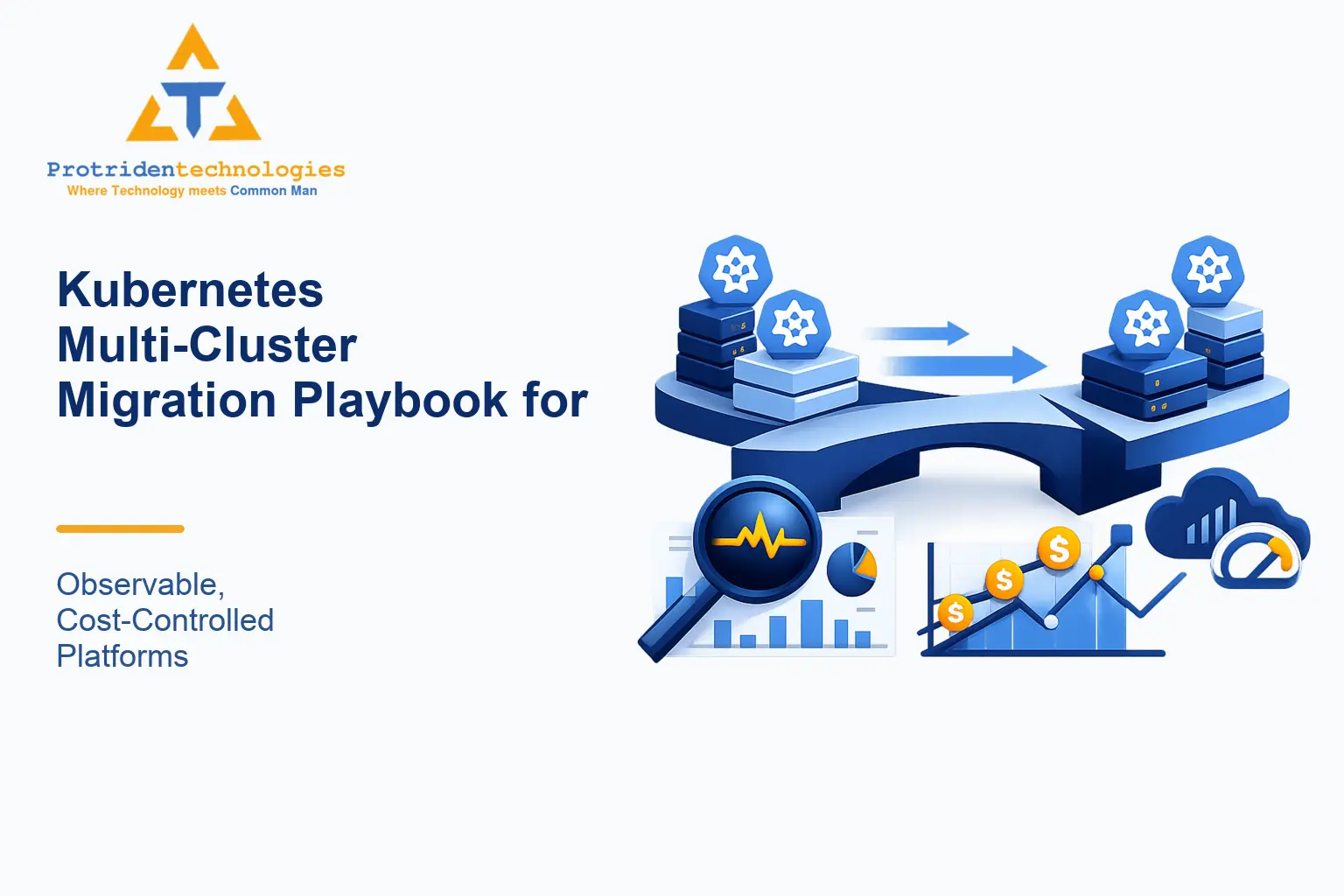
Engineering teams planning to move production workloads into a multi-cluster Kubernetes topology face two linked risks: operational sprawl that multiplies Day-2 complexity, and runaway cloud spend when resource governance and observability are missing. These risks make vendor selection and migration planning critical.
Successful migrations require a clear inventory, dependency mapping and a Day-2 control plane so teams can prevent uncontrolled provisioning and troubleshoot cross-cluster incidents.
Platform owners want a migration partner that can deliver a multi-phase engagement—assessment, architecture and observability design, FinOps controls, and a phased cutover playbook—without creating long-term tooling lock-in.
Why This Topic Matters
Multi-cluster Kubernetes architectures are widely adopted to isolate failure domains, satisfy regional compliance and improve availability. However, without centralized Day-2 control and cost governance, operational complexity and cloud spend can grow quickly. Industry reviews of migration engagements show that many projects fail to capture the expected operational or cost benefits when teams lack platform engineering capability and a clear cost-control plan.
For teams choosing a migration partner, the difference between a successful and a failed migration often comes down to upfront inventory and dependency audits, convergence on a multi-cluster control model, and tightly integrated observability and cost allocation from day one. A phased, transparent engagement reduces risk by aligning platform design with operational readiness.
- Multi-cluster patterns reduce blast radius and support regional compliance but increase Day-2 control requirements.
- Observable platform design and cost allocation dashboards are essential to prevent post-migration over-provisioning.
- Disposal or disposition strategy for legacy clusters should be planned early to avoid lingering technical debt.
Research references: Kubernetes Migration Services; Kubernetes Multi-Cluster Part 5: Cost Optimization; Disposition strategy and planning for migrating Kubernetes clusters | Migration & Modernization; Kubernetes Migration: Strategies, Tools | Dysnix.
Common Mistakes Businesses Make
Many organizations underestimate Day-2 operational work and over-rely on default cloud scaling and provisioning settings. That causes unexpected resource growth when applications are migrated and developers adopt self-service provisioning without enforced quotas or autoscaling limits.
Another frequent error is adopting proprietary cluster extensions or CRDs at fleet scale without a migration plan. Proprietary resources accumulate and make future consolidations or vendor changes costly and risky.
- Skipping a complete inventory and dependency map leads to broken cutovers and rollbacks.
- Failing to deploy centralized observability and cost allocation before cutover lets runaway costs appear only after systems are live.
- Allowing unchecked self-service provisioning without enforced resource quotas or admission controllers multiplies cloud spend.
- Locking into proprietary CRDs and management agents early makes future migrations or consolidation harder.
Practical Checklist / Steps
Below is a practical checklist you can use when evaluating partners and planning your migration. The playbook maps to four engagement phases: assessment, multi-cluster design, observability & FinOps, and phased cutover.
- Inventory and dependency audit: Create a complete list of clusters, workloads (stateless and stateful), storage, network flows, ingress rules, and third-party services. Capture current resource usage patterns and peak behaviours to inform placement and sizing decisions.
- Define disposition and consolidation strategy: Decide which legacy clusters will be retired, consolidated, or replatformed. For each cluster, define retention, migration, or decommissioning steps and data migration strategies for stateful services.
- Select the multi-cluster control model: Evaluate control plane patterns (federated control plane, central control plane with cluster agents, or GitOps-driven fleet management). Prioritize models that minimize proprietary CRD usage and support future portability.
- Design for Day-2 centralized control: Specify RBAC, namespaces, admission controllers, resource quotas, and cluster lifecycle automation. Plan cluster tagging and labels to enable chargeback and cost allocation.
- Implement observability and cost allocation: Deploy distributed tracing, metrics aggregation, centralized logging, and a cost allocation dashboard tied to cluster and namespace labels. Ensure alerts map to clear runbooks and escalation paths.
- Establish FinOps guardrails: Configure resource requests/limits, HPA, cluster autoscaler policies, and spot/low-priority pools where appropriate. Create budget alerts and integrate cost reports into CI/CD pipelines and platform dashboards.
- Plan a phased cutover playbook: Define criteria for canary and progressive cutovers, data sync approaches for stateful apps, rollback procedures and runbooks. Test cutover steps in staging and run game days for failure scenarios.
- Training and knowledge transfer: Deliver runbooks, GitOps patterns, and platform onboarding for developers and SREs. Include hands-on sessions and shadowing during the first production cutovers.
Cost, Timeline, or Decision Factors
Cost and timeline for a multi-cluster migration vary by application complexity, number of clusters, stateful vs stateless workloads, required compliance/regional constraints, and the degree of automation you want. A vendor-selection decision should weigh technical experience with fleet-scale Kubernetes, observability and FinOps capability, and a clear plan for disposition of legacy clusters.
Rather than fixed prices or delivery guarantees, evaluate partners on the basis of proposed milestones, measurable deliverables (inventory, architecture diagrams, observability dashboards, tested cutover steps) and clear acceptance criteria for each phase.
- Application complexity: Stateful databases, legacy networking, and vendor-managed services require more migration effort and testing.
- Fleet size: Number of clusters and geographic regions increases coordination and Day-2 automation needs.
- Observability and FinOps scope: The depth of telemetry and cost allocation you require affects integration work and time.
- Change control and compliance: Security reviews, compliance audits and data residency checks add time to planning and approvals.
- Team readiness: In-house platform engineering and SRE maturity will shorten the timeline if teams can adopt new runbooks and GitOps patterns quickly.
Local Relevance: India, Karnataka, and Udupi
In India, cloud adoption and containerisation continue to accelerate across startups and traditional enterprises. Partners with local presence can reduce coordination overhead, timezone friction and on-site engagement costs for complex cutovers.
Protriden Technologies is based in Kundapura, Udupi, Karnataka, India, and offers on-the-ground engineering capacity for AWS and DigitalOcean deployments, monitoring, Docker, CI/CD and post-launch support—useful when teams prefer a local partner for regulatory or operational reasons.
- Local partners can help navigate India-specific compliance, data residency preferences and regional networking considerations.
- Karnataka has a strong engineering talent pool; working with a regional partner in Udupi or Kundapura can accelerate knowledge transfer and reduce travel logistics during cutovers.
- Onsite or nearshore collaboration supports intensive phases—like final cutover windows and game-day testing—where real-time coordination reduces risk.
How Protriden Technologies Can Help
Protriden Technologies provides cloud infrastructure and application services that align with each phase of the migration playbook: inventory and assessments, AWS and DigitalOcean cluster deployments, monitoring and observability implementation, Docker and CI/CD automation, application security hardening, and post-launch maintenance and support. The firm can act as a hands-on implementation partner or as an augmentation to your internal platform team.
When evaluating Protriden or similar partners, ask for delivery milestones that map to tangible artefacts: dependency inventory, multi-cluster architecture diagrams, observability and cost dashboards, tested cutover runbooks, and a knowledge-transfer plan.
- Assessment and inventory: workload mapping, resource usage baselines and disposition plans.
- Platform engineering: cluster provisioning, RBAC, admission controllers, and GitOps pipeline setup.
- Observability and FinOps: central metrics, traces and cost dashboards tied to namespaces and cluster labels.
- Cutover support and post-launch: phased cutovers, rollback runbooks, and ongoing maintenance and security updates.
Final Thoughts
A successful multi-cluster migration is less about a single tool and more about the combination of clear inventory, a non-proprietary control model, integrated observability, and FinOps guardrails. Selecting a partner who can deliver those outputs as measurable milestones reduces the chance of surprises after cutover.
Design your vendor engagement around demonstrable artefacts and staged acceptance criteria. That gives your organisation a predictable path to a resilient, observable and cost-controlled Kubernetes fleet without locking you into long-term proprietary constraints.
FAQs
How do I know if we need a multi-cluster architecture?
Typical drivers are isolation of failure domains, regional compliance or latency requirements, and scale across distinct operational teams. If you need strict fault isolation, data residency or independent upgrade windows, multi-cluster architectures are worth evaluating.
Will multi-cluster always increase my cloud costs?
Not necessarily. Multi-cluster architectures can increase surface area for cost growth if Day-2 controls are missing. With proper autoscaling, resource quotas, spot/low-priority pools and cost allocation dashboards, you can control and attribute spending. Planning observability and FinOps before cutover is key.
What is the role of observability in a migration?
Observability provides the telemetry you need to verify functional parity, performance and error rates during cutover. It also powers capacity planning and cost allocation so you can detect inefficiencies and tune autoscaling policies post-migration.
How should we handle stateful workloads during cutover?
Stateful workloads require explicit data migration and sync strategies, well-tested rollback plans and extended validation windows. Use staged syncs, read-only switchover tests, and database replication where possible; include these specifics in your cutover runbook and rehearsal plans.
What deliverables should we expect from a migration partner?
Ask for a clear list of deliverables: inventory and dependency reports, multi-cluster architecture diagrams, observability and cost dashboards, tested cutover runbooks, training sessions and a documented disposition plan for legacy clusters.
If you’re evaluating partners for a multi-cluster migration, request a phased engagement proposal from Protriden Technologies that includes an inventory, multi-cluster design, observability and FinOps deliverables, and a tested phased cutover plan.
Explore our software development services or discuss your requirements with the Protriden Technologies team.