
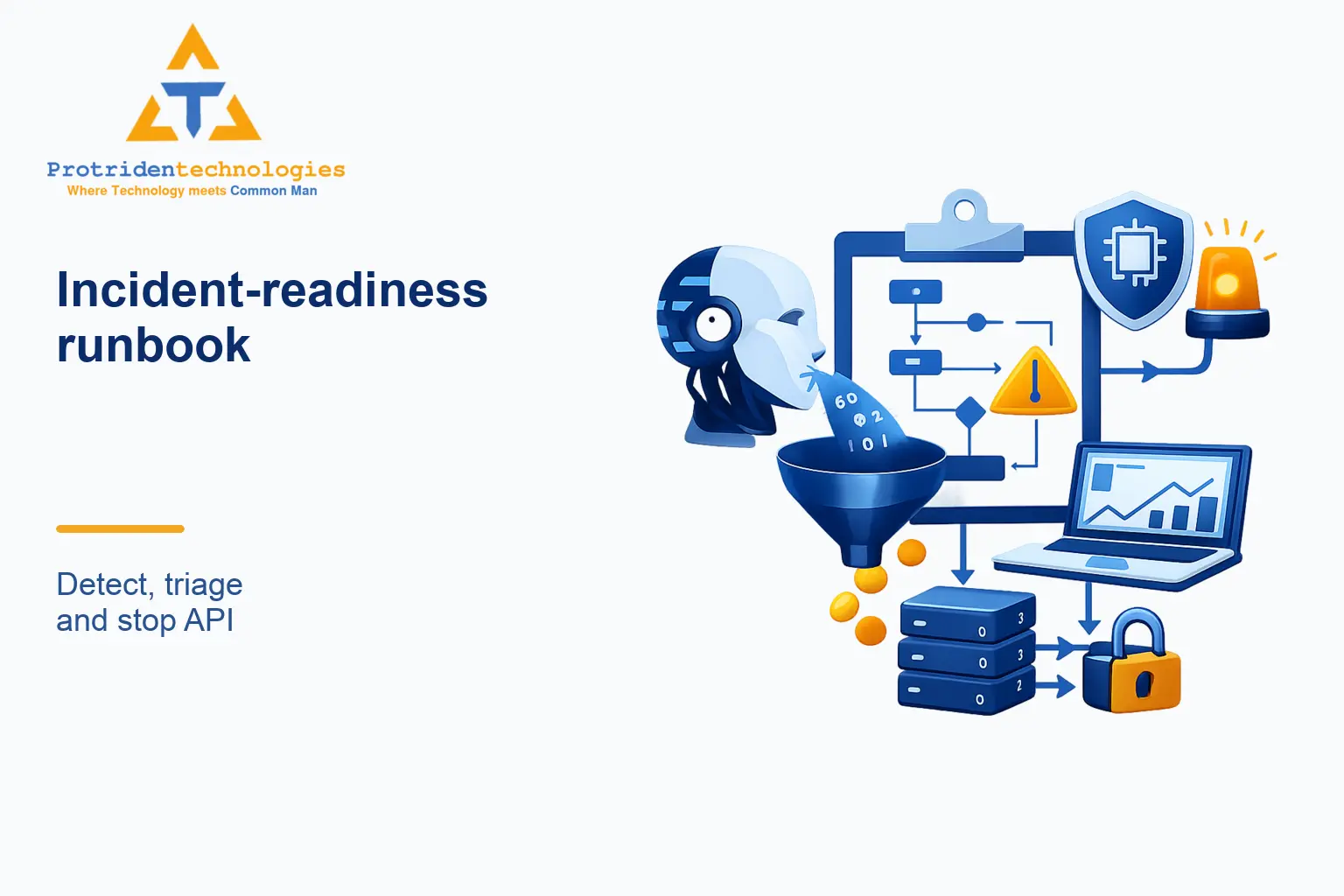
Platform teams increasingly face sudden, unexplained cloud or API bills and unusual traffic spikes that indicate credential leakage, abuse or automated scraping. These events generate direct financial loss from unbilled AI usage and pose data-exfiltration risk when attacker-controlled keys access sensitive endpoints.
Engineering and security leads need a compact, executable runbook that preserves evidence, contains active abuse and rotates secrets without disrupting legitimate traffic. Fast, repeatable steps reduce dwell time and cost exposure.
When internal capacity is limited, a short remediation sprint focused on triage, telemetry gaps and key rotation can stop ongoing abuse while delivering an updated runbook for future incidents.
Why This Topic Matters
API abuse incidents—credential stuffing, leaked API keys, or automated consumption—can quickly translate into runaway usage and cost. Beyond billing, abuse can be a vector for data exfiltration or collateral service degradation. Effective response depends on precise telemetry, predefined containment steps, and clear ownership for each action during the incident.
Incident-readiness runbooks codify that sequence: preserve volatile evidence, contain active sessions, rotate credentials, and restore safe operations. Runbooks succeed when they are concrete (which logs to query, what commands to run) and iterated after each incident instead of remaining generic or stale.
Operational guidance for API abuse emphasizes three pillars: detect with actionable telemetry, triage with containment playbooks, and remediate with secrets rotation and policy hardening. These pillars reduce time-to-contain and enable faster recovery of cost and data exposure.
- Concrete checks and metrics: specify exact logs, query locations and thresholds to avoid vague commands.
- Preserve evidence early: capture relevant request IDs, headers and full telemetry before rotating keys to support forensic analysis.
- Containment-first: short-term throttles, gateway blocking and circuit breakers limit ongoing cost while a longer remediation is planned.
Research references: Incident response runbooks: templates and examples; What is an Incident Response Runbook? Best Practices & Examples; What is API Abuse? Meaning, Architecture, Examples, Use Cases, and How to Measure It (2026 Guide) - DevSecOps School; API Abuse and Credential Stuffing Attack Response – IR Playbook | Cost Nimbus.
Common Mistakes Businesses Make
Teams often start by rotating secrets without preserving telemetry, which destroys evidence needed to understand attack scope and prevents accurate post-incident fixes. Another common failure is ‘check the logs’ advice that is too generic—runbooks must point to exact log files, dashboards and query strings.
Delaying containment while chasing root cause prolongs exposure and cost. Conversely, overly broad revocation of credentials can disrupt production customers. Both mistakes arise when roles and escalation paths are not preassigned in the runbook.
- Leaving runbooks generic rather than listing exact tools, log paths and queries.
- Rotating keys immediately without capturing attacker-controlled request samples.
- Not assigning specific owners for containment, communications and billing review.
- Failing to apply short-term throttles or gateway-level controls as a first containment layer.
Practical Checklist / Steps
The checklist below is a compact, operational runbook for an active API abuse incident that causes unbilled usage or suspicious activity. Execute steps in sequence: detect, preserve, contain, remediate, and validate. Adapt commands to your stack and document every action in the incident log.
- Confirm the incident and scope: Validate the anomaly with telemetry: cloud billing alerts, API gateway spikes, error-rate changes and unusual user-agent patterns. Record timestamps, service names, request IDs, and sample request headers. Correlate with recent deployments or credential changes.
- Preserve evidence: Capture full request samples, associated logs, and any ephemeral traces to a secure, access-controlled location. Export relevant SIEM search queries and snapshot dashboards. Do not rotate secrets yet if forensic capture requires live requests tied to current keys.
- Assign incident roles and communication channels: Declare a lead incident responder, a billing reviewer, an on-call engineer for the affected service, and a communications owner. Establish a dedicated channel for realtime updates and a timestamped incident log to track actions taken.
- Apply immediate containment controls: Implement gateway-level mitigations: increase authentication checks, enable stricter rate limits, enforce per-key quotas, and block suspicious IP ranges or user-agents. Prefer short maintenance windows or dynamic throttles to avoid blanket outages.
- Throttle suspicious keys and sessions: Identify high-volume API keys or tokens and apply targeted throttles or temporary revocation. Use feature flags or policy rules to limit the affected keys rather than global key revocation when possible.
- Rotate and revoke compromised credentials: After evidence collection, rotate service credentials, API keys and any associated secrets. Use automated secret-management tooling where available to minimize human error and to ensure all dependent services receive updated credentials.
- Patch and harden access controls: Review scopes and permissions associated with rotated keys. Reduce rights to the minimum necessary. Add short-lived credentials, stronger mutual authentication or signed requests where feasible.
- Close telemetry gaps and enhance detection: If the incident revealed missing telemetry, instrument request IDs, full header capture (where privacy allows), enhanced gateway logs and dashboard alerts. Add SIEM rules and anomaly detectors for the observed patterns.
Cost, Timeline, or Decision Factors
Estimating cost and timeline for a remediation sprint depends on factors such as the size of the affected surface (number of keys, services and endpoints), the completeness of telemetry, whether secrets are centrally managed, and legal or compliance needs for forensic preservation. Typical focused remediation sprints are scoped to 2–4 weeks, but scope controls and telemetry quality drive actual duration.
When telemetry is sparse, additional time is required to reconstruct events and instrument missing logs before confident containment. When secrets are spread across many deployments or third-party systems, rotation and validation require careful sequencing to avoid production outages.
- Scope and scale: more services and keys increase remediation effort.
- Telemetry quality: missing request IDs or logs lengthens investigation time.
- Secrets management maturity: centralized secrets stores shorten rotation work.
- Regulation and legal preservation: forensic requirements can add time and constrain immediate actions.
Local Relevance: India, Karnataka, and Udupi
Protriden Technologies is based in Kundapura, Udupi, Karnataka, India and delivers application security, cloud deployment, monitoring and CI/CD services. Organizations in India that run cloud platforms and machine-learning APIs can engage locally for runbook creation, on-site or remote remediation sprints and follow-up instrumentation.
Choosing a local partner can simplify time-zone coordination, onsite validation and post-incident knowledge transfer. Protriden’s service set includes cloud deployment and monitoring on AWS and DigitalOcean, plus application security and CI/CD—capabilities applicable to API abuse containment and secrets rotation.
- Local engagement reduces coordination friction for teams in Karnataka and broader India.
- On-the-ground knowledge transfer helps internal teams adopt improved runbooks and telemetry.
How Protriden Technologies Can Help
Protriden Technologies offers practical assistance aligned to the runbook and remediation sprint model: fast triage to contain active abuse, targeted secrets rotation, telemetry gap analysis, and incremental hardening. Our offering matches the tasks that bring immediate risk reduction while transferring runbook ownership back to your team.
Engagements typically begin with a remediation assessment that inventories affected keys and services, identifies telemetry shortfalls, and proposes a 2–4 week sprint plan. Work can include implementation of gateway throttles, secrets rotation automation, CI/CD checks, and updated incident runbooks for future readiness.
- Runbook creation and runbook review: concrete, executable playbooks with exact log paths and commands.
- Remediation sprint: focused triage, containment and secrets rotation scoped to your environment.
- Telemetry and monitoring improvements: dashboards, SIEM rules and request-ID instrumentation.
- Cloud and deployment support: AWS and DigitalOcean deployment, container and CI/CD adjustments to enforce new secrets and limits.
Final Thoughts
API abuse that drives unbilled AI usage or data exposure is a high-priority incident type that requires a practical, rehearsed response. The combination of a concrete runbook and a short, focused remediation sprint dramatically reduces dwell time and cost exposure while preserving the evidence needed to prevent recurrence.
Investing in precise telemetry, role-based incident steps and automated secrets tooling converts a reactive scramble into a predictable, auditable process that your engineers can run with confidence.
FAQs
How quickly can a remediation sprint stop ongoing unbilled API usage?
The sprint's first goal is containment; targeted gateway throttles, per-key quotas or temporary revokes often reduce ongoing consumption within hours. The total time to full remediation depends on scope, number of affected keys and the need to validate rotated credentials across deployments.
Should we rotate all API keys immediately when we detect abuse?
Rotate keys after you capture the necessary telemetry for forensic analysis. For high-risk keys causing immediate cost, apply targeted throttles or temporary revocation first, then rotate with an automated process to re-provision dependent services safely.
What telemetry is essential for an effective runbook?
Actionable telemetry includes request IDs, full headers, timestamps, client IPs, user-agents, API key identifiers, and application logs correlated with gateway logs. The runbook should name exact log files or queries to run to avoid ambiguity during incident work.
Can an external partner work with our CI/CD and secrets tooling?
Yes—engagements commonly include integrating secrets rotation into CI/CD pipelines and adjusting deployment configurations so rotated credentials propagate correctly. Partners should work with your existing secret-management tools and deployment process to avoid production disruption.
What outcomes should we expect after a remediation sprint?
Expected outcomes include stopped or reduced abusive consumption, rotated and scoped credentials, documented runbooks updated by the incident lessons, and prioritized telemetry or policy changes. Exact timelines and results depend on environment complexity and the completeness of initial telemetry.
Request a remediation assessment from Protriden to scope a 2–4 week sprint and an executable runbook to stop active API abuse.
Explore our software development services or discuss your requirements with the Protriden Technologies team.