
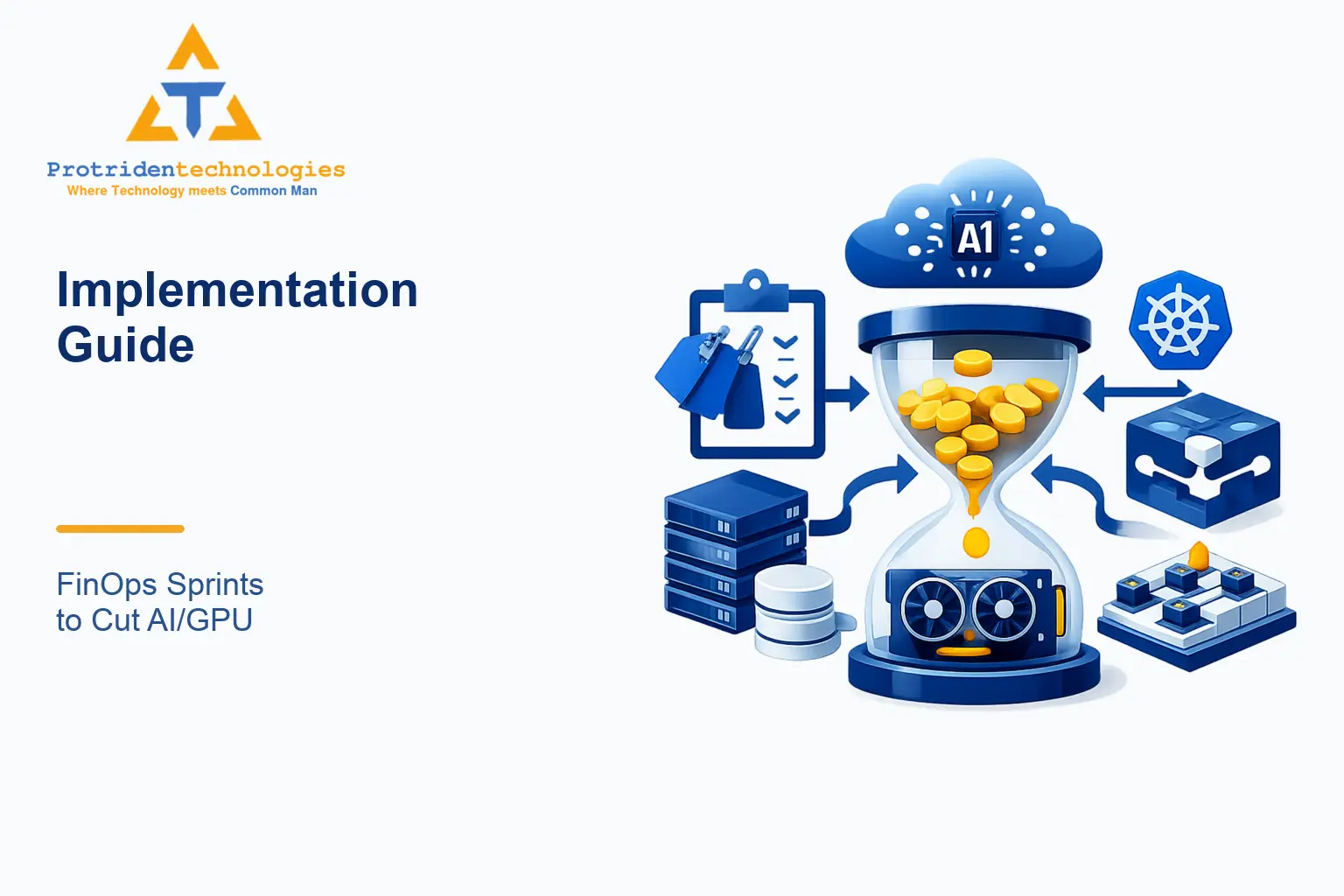
Cloud bills for AI projects often balloon because teams run training or serving without clear cost attribution, controls or workload-specific practices. Token-based inference, long-lived GPU instances and ad-hoc experiments can create recurring high spend that finance and engineering struggle to reconcile.
Engineering teams need an actionable, repeatable sprint-based playbook that converts GPU telemetry into chargeback, batching and rightsizing decisions. Buyers at the vendor-selection stage want measurable short pilots before committing to a full FinOps program.
This guide lays out the decision-useful steps for a short health check and follow-on implementation: what to tag, how to batch and queue inference, when to substitute CPU for GPU, and how to evolve governance so AI costs behave more like other cloud spend.
Why This Topic Matters
AI workloads behave differently from traditional cloud services: token-based APIs, GPU-accelerated training, and unpredictable experiment cycles break assumptions that underlie classic FinOps. Without tailored controls, teams face month-to-month volatility and weak cost accountability. Implementing focused FinOps sprints builds transparency, aligns engineers and finance, and unlocks practical operational changes that reduce spend without blocking developer velocity.
Practical, sprint-based work—tagging for allocation, batching to control token costs, GPU rightsizing and orchestration for elasticity—lets teams move from ad-hoc mitigation to governance that matches how AI consumes resources. These are the levers that produce measurable reductions in GPU-driven invoices when applied with the right KPIs and controls.
- AI/GPU spend is driven by different levers than standard cloud CPU/RAM workloads; token consumption, batch size and model choice matter as much as instance type.
- Tagging and cost-allocation are prerequisites for meaningful optimization and chargeback to teams or projects.
- Rightsizing GPUs, batching requests and leveraging orchestration/auto-scaling convert visibility into repeatable savings opportunities.
- A short, instrumented FinOps sprint makes tradeoffs visible and documents policy decisions for recurring governance.
Research references: FinOps for AI Overview; Scaling Kubernetes for AI/ML Workloads with FinOps; FinOps for AI: The Practitioner's KPI Playbook (2026); GPU Cloud FinOps for AI Teams: Cost Allocation, Per-Project Chargeback, and Tag-Based Budgeting (2026) | Spheron Blog.
Common Mistakes Businesses Make
Teams often try piecemeal cost cuts—turning off instances, switching instance families or buying commitments—without first measuring where cost originates. Common fixes miss the full operational impact: halting a long-running experiment might stop a bill for a week but won’t address systemic issues like tokenmaxxing or untagged shared services.
Another frequent error is applying traditional FinOps rules without adapting KPIs to AI. For example, measuring utilization only by GPU attachment ignores token throughput, model concurrency and the cost per inference or training epoch—metrics central to AI value and expense.
- Optimizing only at the VM/instance level without measuring per-model or per-token cost.
- Waiting for a ‘single' architectural change (e.g., reserved instances) instead of running iterative sprints to gather data and validate impact.
- Not enforcing tag propagation across Kubernetes, job schedulers and shared vLLM services, leading to blind spots in cost allocation.
- Applying CPU-era KPIs like raw CPU utilization without AI-specific KPIs such as cost per 1k tokens or cost per inference.
Practical Checklist / Steps
This checklist is a practical FinOps sprint template you can run in 2–6 weeks. The objective is to deliver measurable metrics and a prioritized list of remediation actions: tagging completeness, high-cost workloads identified, batching/serving options evaluated, and orchestration rules enacted. Each step produces artifacts—dashboards, runbooks, and policy drafts—for stakeholders to approve.
- Establish scope and stakeholders: Identify projects, models and teams in scope. Appoint an engineering lead, a FinOps sponsor and a finance observer. Define sprint success criteria (visibility thresholds, target KPIs to measure). Document where GPUs and tokenized APIs are billed today.
- Inventory resources and telemetry: Collect where GPUs run—VMs, Kubernetes nodes, managed inference endpoints and external API costs. Ensure cloud billing exports and GPU telemetry (utilization, memory, vGPU allocation) are available to the sprint. Capture token-based API spend separately and map to projects where possible.
- Implement tag and label hygiene: Create a minimal tag/label taxonomy that maps to cost centers, models and environments. Enforce propagation in CI/CD, Kubernetes manifests and job schedulers. Add tags to shared services like vLLM endpoints and inference queues. Validate completeness with a daily diff report.
- Define AI-specific KPIs & dashboards: Track cost per 1k tokens, cost per inference, training cost per epoch, GPU-hours per project, and concurrency vs latency. Build dashboards that join billing data to GPU telemetry and token usage so decisions are traceable to dollars.
- Run rightsizing and substitution experiments: Identify low-value GPU jobs for testing CPU-only runs or smaller GPU SKUs. Run A/B experiments with model batch sizes, precision (FP16/INT8 where supported) and micro-batching to measure cost-latency tradeoffs. Record performance degradation thresholds acceptable to product teams.
- Batching, queuing and request shaping: Prototype batching or queueing for inference to reduce per-inference token costs. Introduce client-side or gateway-side request shaping (rate limiting, adaptive batching) and measure the effect on cost per inference and on user-facing latency.
- Orchestration and autoscaling rules: Implement spot/interruptible instances where acceptable, autoscaling to zero for non-critical endpoints, and GPU node pools by workload class. Use Kubernetes scheduling and GPU-aware binpacking to improve utilization for bursty workloads.
- Governance, chargeback and runbook: Produce a chargeback model for showback or billing teams for model training and inference. Draft approval gates for expensive training runs and a runbook for reclaiming orphaned GPUs. Recommend policy changes for provisioning and model publication.
Cost, Timeline, or Decision Factors
Exact cost and timeline depend on factors such as the number and variety of models, whether workloads run on Kubernetes or VMs, the maturity of existing telemetry and tagging, and how much governance change the organization can accept in a short sprint. Rather than promising fixed outcomes, use the sprint to quantify potential monthly savings and the operational change required to realize them.
Key decision criteria include the availability of billing export, the proportion of spend tied to tokenized inference versus training, and whether engineers can implement tag enforcement and CI/CD changes during the sprint.
- Telemetry maturity: richer GPU and token metrics accelerate identification of low-value spend.
- Workload mix: inference-heavy workloads benefit more from batching and request shaping; training-heavy portfolios need rightsizing and scheduling.
- Engineering bandwidth: teams must be able to implement tags, deploy autoscaling rules and run substitution experiments during the sprint.
- Governance appetite: willingness to introduce approval gates for expensive runs and to adopt chargeback affects long-term sustainability.
Local Relevance: India, Karnataka, and Udupi
India’s growing AI adoption means startups and SMBs face the same tokenmaxxing and GPU cost dynamics as global peers. In Karnataka—particularly tech centers and smaller hubs around Udupi and Kundapura—businesses often use cloud providers like AWS or DigitalOcean for GPU instances and benefit from local vendors who understand both cloud operations and regional business constraints. Local teams may prefer pilots that integrate with commonly used stacks and that minimize disruption to product roadmaps.
Protriden Technologies is based in Kundapura, Udupi, and offers cloud deployment, monitoring and automation services that align with the practical FinOps actions in this guide. Regional customers can run a short, instrumented health check with Protriden that maps cloud bill items to projects and proposes prioritized remediation tailored to local development practices.
- Local cloud patterns: Many Karnataka teams use managed Kubernetes or VM-based GPU instances; tagging and Kubernetes label propagation are common levers.
- Regulatory and business cadence: Indian teams may coordinate cost controls with sprint planning or release cycles—short 2-week pilots fit regional product cadences.
- Local support advantage: Onshore engineering and post-launch support from a firm in Kundapura/Udupi helps translate sprint recommendations into lasting operational changes.
How Protriden Technologies Can Help
Protriden Technologies can run the recommended 2-week FinOps health check as a paid pilot: instrument billing and telemetry, deliver dashboards and a prioritized remediation roadmap, and provide a scoped plan for a following sprint to implement tagging, batching and orchestration changes. Protriden’s cloud deployment, monitoring and automation services are aligned to the practical steps in this guide.
The goal of a pilot is to surface measurable opportunities and a realistic operational plan. Protriden focuses on producing artifacts—dashboards, runbooks, a chargeback model and a prioritized task list—that your engineering and finance teams can act on.
- Health check deliverables: billing-to-project mapping, KPI dashboards, tag completeness report and prioritized remediation list.
- Implementation support: CI/CD and Kubernetes label enforcement, autoscaling and scheduling rule templates, and support for substitution experiments (CPU-only runs, precision changes).
- Post-pilot options: scoped implementation sprints, monitoring and maintenance, and local support from Protriden’s Kundapura/Udupi-based team.
Final Thoughts
Controlling AI/GPU costs requires both visibility and operational levers specific to AI workloads: token consumption, batching, model choice, and GPU orchestration. A short, instrumented FinOps sprint produces the data needed to make these tradeoffs visible and durable. Don’t treat FinOps as a one-time cost-cutting exercise—use sprint artifacts to build recurring governance.
Start with a small, measurable pilot that focuses on tagging, KPIs and a few high-impact experiments. That approach reduces risk, creates shared language between engineering and finance, and generates the evidence required for larger investments in reservations, committed use or organizational change.
FAQs
What exactly is a 2-week FinOps health check pilot?
A 2-week pilot instruments billing and GPU telemetry, validates tagging completeness, builds KPI dashboards and identifies the highest-cost workloads and quick remediation options. It produces a prioritized remediation roadmap and estimated operational changes; it does not promise a fixed savings amount, but quantifies where savings are likely.
Will batching always reduce inference costs?
Batching can reduce cost per inference by amortizing overhead, but its effectiveness depends on latency requirements, model concurrency, and request patterns. The sprint tests batching tradeoffs and measures cost versus acceptable latency impact rather than assuming universal benefit.
Can we replace GPUs with CPUs for training or inference?
Some experiments and lightweight models can run on CPUs or smaller GPU SKUs, which the sprint will identify. Whether substitution is acceptable depends on model size, latency constraints and developer tolerance for performance impact; the sprint quantifies these tradeoffs before broad changes.
How do you attribute token-based API costs to projects?
The health check maps token usage where possible by instrumenting request metadata, integrating API billing exports and tagging front-end or service layers. For shared services where per-request attribution is difficult, the sprint proposes practical allocation rules and showback models to maintain accountability.
What organizational changes are typically needed for sustained AI FinOps?
Sustained change usually requires tag enforcement in CI/CD, approval gates for expensive training runs, agreed chargeback or showback models, and routinely updated KPIs. The sprint produces runbooks and governance recommendations to help accelerate adoption.
Schedule a 2-week FinOps health check with Protriden to map your AI/GPU bill to projects and get a prioritized remediation roadmap tailored to your stack and governance.
Explore our software development services or discuss your requirements with the Protriden Technologies team.