
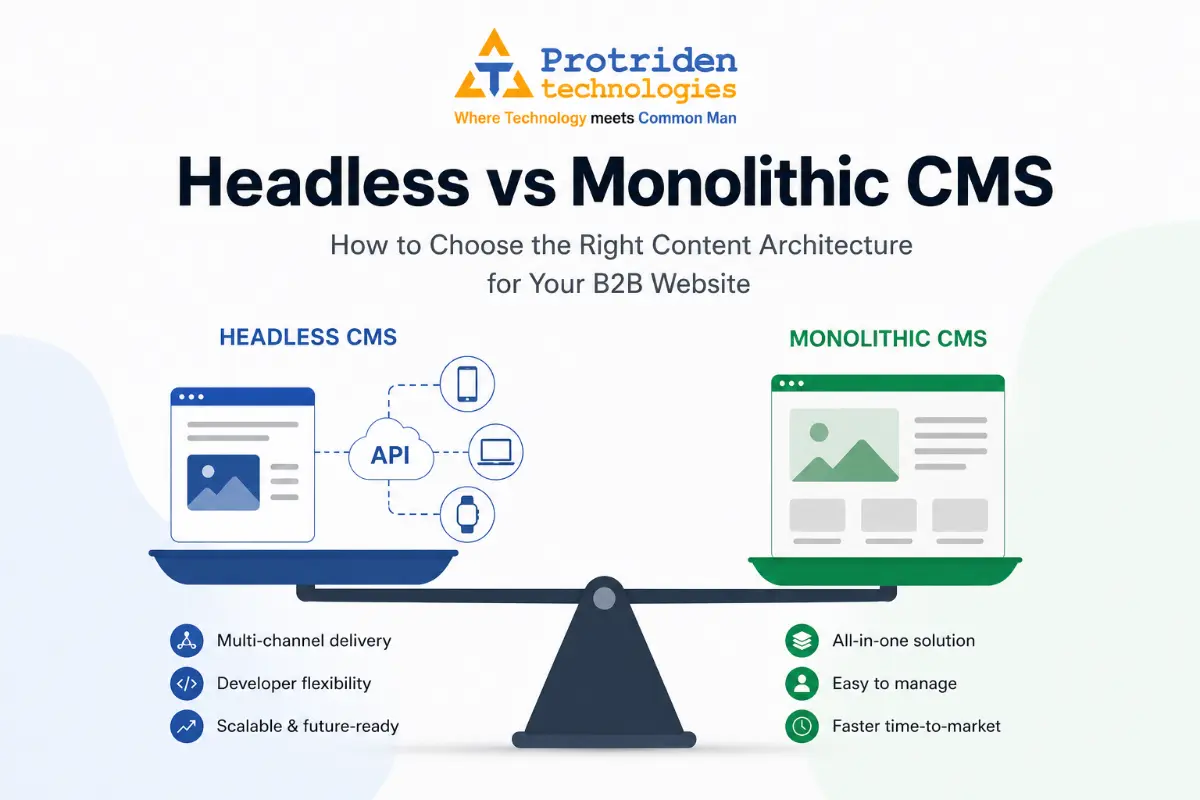
Choosing the right content architecture is a practical, business-driven decision for B2B websites. The debate between headless (API-first or decoupled) CMS and traditional, monolithic platforms is often framed as a technical preference, but for most B2B buyers the right choice follows from use cases, team skills, integration needs and operational constraints.
This article helps B2B product managers, marketing leads and engineering managers evaluate when headless is the right fit, what trade-offs to expect, how editorial workflows and content modeling must change, and what implementation steps reduce risk. The guidance draws on current platform shortlists used by enterprises and B2B SaaS teams and practical hosting and integration considerations for production websites.
When headless makes sense for a B2B website
Headless CMS is valuable when a company needs to publish the same authoritative content to multiple channels and touchpoints beyond a single marketing website. Typical scenarios are a company that must serve website pages, mobile apps, an authenticated partner portal, an internal knowledge base, and third‑party integrations from one content source. Several industry guides and platform lists highlight this multi-channel reuse as the primary rationale for headless adoption.
Headless can also be appropriate when you need tight separation between frontend delivery and content ownership because multiple teams or technology stacks build user experiences in parallel. For example, engineering teams building a custom React storefront or a single-page app benefit from an API-first content store that does not impose presentation constraints.
On the other hand, many B2B companies—especially those whose primary requirement is a single marketing site—do not need headless. Platform assessments for B2B SaaS commonly call out tools like Webflow or WordPress as faster, lower-cost ways to ship typical marketing sites where editorial needs and channel scope remain limited. The decision should therefore start with a clear inventory of channels and anticipated content reuse.
Practical step: create a channels matrix early. List present and planned destinations for content, and map whether each destination requires structured content, personalization, or integration with commerce and CRM. If more than a couple of destinations need structured, API-accessible content, headless is worth evaluating.
Trade-offs: cost, time-to-market and operational complexity
Choosing headless introduces trade-offs compared with traditional, integrated CMS platforms. Headless platforms often increase initial engineering effort because the frontend must be built or integrated separately. This can translate into longer time-to-market for a new site unless you reuse starter templates or hire experienced frontend developers.
Costs differ across SaaS headless vendors and self-hosted options. Industry shortlists include commercial headless SaaS such as Contentful, Sanity, Storyblok, Prismic and Hygraph, and self-hosted or developer-centric solutions such as Strapi and Payload. SaaS headless reduces operational overhead but may carry licensing costs and potential vendor lock-in; self-hosted solutions reduce vendor dependency but shift responsibility for reliability, scaling and security to your team.
Operational complexity also rises: you must plan for CDNs, caching strategies, preview environments, and more elaborate CI/CD pipelines. Protriden Technologies provides experience in cloud deployment, Docker and CI/CD, which are practical capabilities to factor into the decision when projects require resilience and predictable release automation.
Risk mitigation steps: start with a focused pilot, budget engineering time for integration with analytics and SEO, and choose a provider that matches your tolerance for managed services versus self-managed infrastructure.
Designing content models and editorial UX for B2B
A common source of project delays is an under-specified content model. B2B content frequently mixes marketing copy, technical product specs, datasheets and localized legal text—each with different structure and lifecycle. Headless CMS platforms encourage designers to model content as structured entities with discrete fields; this is powerful but requires deliberate planning up front.
Good practice is to involve editors and marketing early in content modeling workshops so the models reflect real publishing flows. Include templates for pages, product entries, case studies and knowledge articles, and define authoring fields, validation rules and localization behavior. Several platform guides recommend onboarding editors to the new model with training and documentation to avoid pushback from non-technical users.
Editorial UX must also address previewing and in-context editing. Not all headless systems provide equivalent visual editing experiences; some headless vendors have built-in visual editors or live preview support, while developer-first platforms lean mostly on structured APIs. If real-time preview and WYSIWYG composition are necessary for marketing velocity, ensure your chosen system supports those features or that you can implement preview bridges.
Practical steps: map editorial roles and permissions, define content lifecycle states, and pilot authoring with a representative group of editors. Where preview is necessary, plan the preview URL architecture and staging environments as part of the content model.
Integrations, hosting and production deployment choices
A headless approach treats content as an API product that must integrate with search, personalization, authentication, analytics and other services. Plan integrations early: CRM and marketing automation, site search engines, and login systems are common integration points for B2B websites. Platform guides and vendor shortlists describe native connectors and third-party ecosystems—choose a CMS with proven integrations that match your stack.
Hosting and performance are essential considerations. Regardless of headless or monolithic choice, production delivery needs CDN caching, cache invalidation strategies, and monitoring. For headless sites serving pre-rendered static pages or server-side rendered frontends, edge CDNs and incremental build/ISR patterns are common approaches to maintain fast page loads. Protriden’s services include cloud deployment and monitoring on providers such as AWS and DigitalOcean and can help operationalize these practices.
Security and compliance are also operational risks to manage. Self-hosted CMS options require active patching and security controls; managed SaaS headless vendors handle platform security but you remain responsible for data flows, API access control and secrets management. Include security and access controls in your vendor evaluation and deployment checklist.
Concrete implementation advice: define your expected traffic and caching requirements, enumerate necessary integrations, and choose a hosting and deployment model aligned with your operational capacity. If you lack internal DevOps resources, prioritize managed services or partner with a development agency experienced in cloud deployments and CI/CD.
Migration and a phased implementation roadmap
Migrating to a headless architecture is best executed as a phased program rather than a big-bang rewrite. Start by auditing existing content: inventory pages, templates, media, and structured data. Use that inventory to prioritize content types that will deliver immediate business value when made available via an API—such as product pages, documentation, or developer resources.
Phase the migration so that the marketing site can continue to operate while backend work progresses. Typical first steps include building a canonical content model, exporting and cleaning source content, and implementing a frontend prototype that consumes the headless API for a subset of routes. This limits scope and provides an early proof point for editorial workflows and SEO impacts.
Plan for SEO and redirects from the beginning. URL structure, metadata, sitemaps and canonical tags must be preserved or improved during migration. Because search visibility is business-critical for B2B sites, include SEO validation in each release iteration and test staging builds with realistic content.
Finally, account for team ramp-up and handover. Training for editors and an operations playbook for site ownership reduce long-term friction. If internal teams lack specific skills, consider partnering with a vendor experienced in both frontend development and cloud operations to bridge gaps and accelerate delivery.
Deciding between headless and monolithic CMS for a B2B website is not a binary technical choice but a business alignment exercise. Headless brings clear advantages when you need multi-channel reuse, independent frontend delivery, or granular content APIs. For single-channel marketing sites with limited integration needs, traditional platforms often deliver faster outcomes and lower initial cost.
Practical decision steps are to inventory channels and reuse, model content with editors early, compare managed versus self-hosted options for operational fit, and adopt a phased migration plan that protects SEO and editorial workflows. Match the platform shortlist to your team’s capacity and the integrations you must support.
If your team needs help translating these recommendations into a concrete technical plan—content models, platform shortlists, or a phased migration roadmap—working with an experienced development partner can reduce risk and speed delivery.
How Protriden Technologies Can Help
If you want a short, practical assessment of whether headless is right for your B2B site, contact Protriden Technologies for a focused content-architecture review and a phased implementation plan.
Explore our software development services or discuss your requirements with the Protriden Technologies team.
Sources