
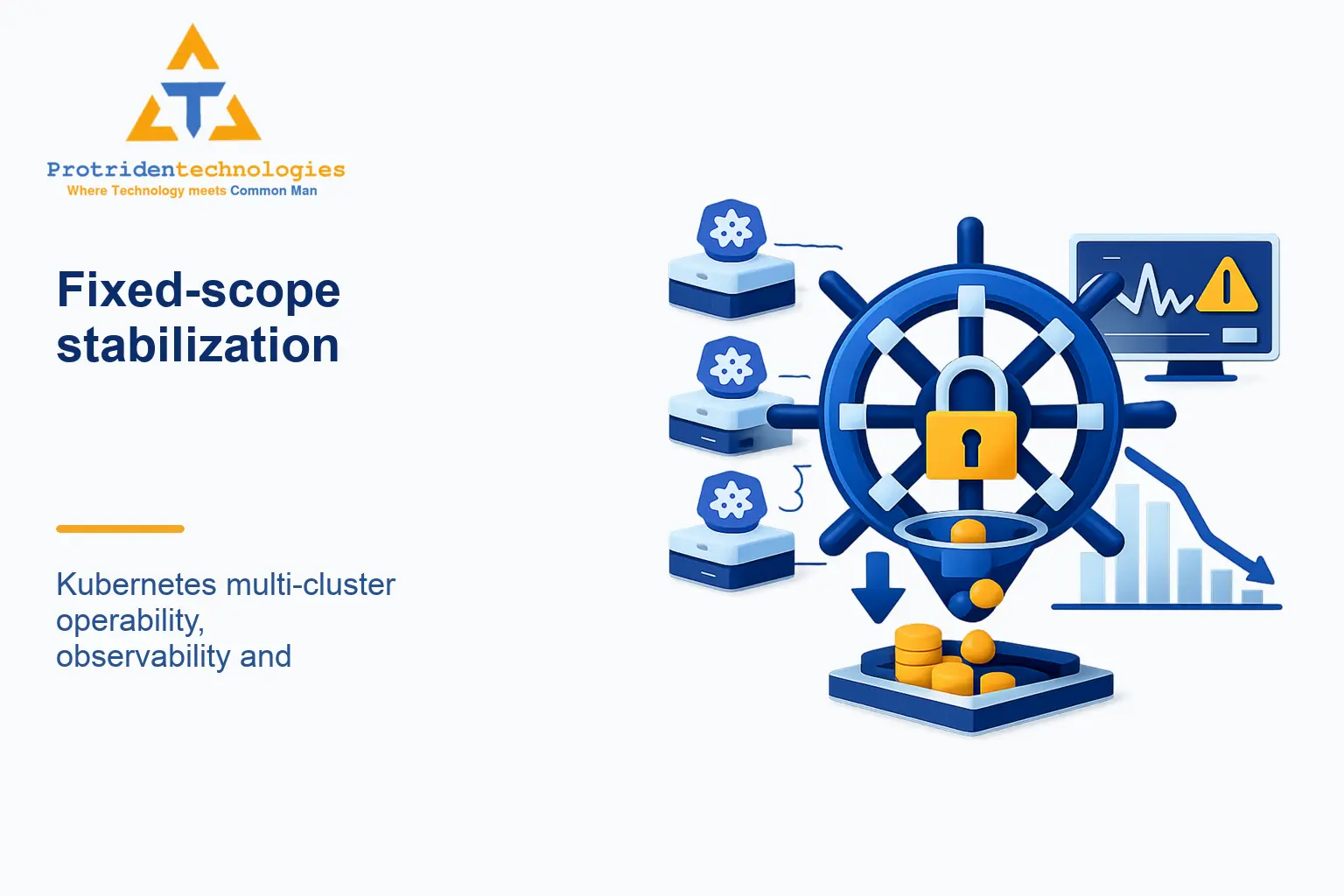
Your organisation runs multiple Kubernetes clusters and the result is intermittent outages, slow deployments and unexplained cloud bills. Teams struggle to know which cluster or workload caused an incident, engineers fire-fight with ad‑hoc fixes, and cost growth outpaces feature delivery.
Multi-cluster setups are common for resilience, compliance and team autonomy, but they create operational fragmentation unless a management and visibility layer is established. Without a short, focused remediation effort, problems compound and delivery velocity falls.
A fixed-scope stabilization engagement targets the highest-impact issues — operability, observability and cost controls — so your platform team regains control quickly and hands off repeatable guardrails to internal engineering. Protriden delivers this as a sprint with clear deliverables and knowledge transfer.
Why This Topic Matters
Running Kubernetes across many clusters is a strategic choice for resilience, environment isolation and multi-cloud strategies, but it demands coordinated policy, visibility and automation. Centralized cluster management and consistent controls reduce blast radius, improve deployment predictability and make cost attribution possible. Sources explain that coordinated multi-cluster approaches enable predictable performance, stronger isolation and simplified scaling across teams and regions (S1, S5, S7).
When clusters are managed independently, teams lose centralized visibility into workloads, security posture and spend. That opacity prevents timely incident response, slows root-cause analysis and allows inefficient resource usage to go unchecked. Establishing consistent observability and FinOps practices is therefore an operational priority for any organization with a multi-cluster footprint (S1, S7).
- Multi-cluster models support resilience, compliance and team autonomy but require centralized policies to avoid operational fragmentation (S5).
- Centralized visibility and management make it possible to track performance, security posture and cloud spend across clusters (S1, S7).
- A short, focused stabilization sprint can shore up immediate risks—outages and runaway costs—while creating repeatable controls for long-term platform health (S1).
Research references: Kubernetes Multi Cluster Management: Expert Guide — Portainer; Multi-Cluster Kubernetes Explained; What is Kubernetes Multi-Cluster and How to Use it | Mirantis.
Common Mistakes Businesses Make
Platform teams often fall back to ad-hoc, cluster-by-cluster fixes when incidents happen. That creates inconsistent configurations, duplicated effort and gaps in monitoring. Other frequent errors include under-investing in cross-cluster observability, treating cost as an afterthought, and failing to enforce access and configuration policies consistently across clusters.
These mistakes escalate operational risk: privilege sprawl increases security exposure, missing telemetry delays incident resolution, and unallocated resource spend results in unpredictable budgets. Correcting these demands both technical changes and process alignment across teams.
- Managing clusters independently without a governance layer leads to inconsistent controls and configuration drift.
- Relying on partial or siloed telemetry prevents fast root-cause analysis across clusters.
- Treating cost as a monthly reconciliation instead of embedding FinOps in platform tooling allows waste to accumulate.
- Skipping RBAC, network and admission controls at the platform layer increases blast radius during incidents.
- Delaying automation and CI/CD hygiene causes manual recovery steps and slows mean time to repair.
Practical Checklist / Steps
Use this checklist when planning a fixed-scope stabilization engagement. Each step is focused on rapid risk reduction and handover: gain visibility, triage the largest operational gaps, apply high-impact controls, and hand the platform back to your teams with runbooks and training.
- Establish scope and success criteria: Define which clusters, namespaces and business services are in scope. Agree measurable success criteria such as reduced incident MTTR, baseline telemetry coverage for critical services, and a FinOps reporting baseline for the scoped clusters.
- Inventory clusters and critical workloads: Produce an asset map of clusters, node pools, control-plane access, connected cloud accounts, namespaces and critical workloads. Identify owners, compliance boundaries and any cross-cluster dependencies that affect availability or data locality.
- Run an operability triage: Collect recent incident logs, SRE runbooks and deployment failures. Prioritize quick remediation for the top causes of outages—misconfigured deployments, resource starvation, RBAC errors or misapplied admission policies—and create immediate mitigations.
- Baseline observability: Ensure end-to-end telemetry for scoped workloads (metrics, logs, traces). Configure centralized collection so teams can query across clusters. Define alerting for service-level indicators and establish incident channels and playbooks for the most common failure modes.
- Perform a FinOps baseline and tagging audit: Collect cost and usage data by cluster, account or namespace where possible. Audit resource tagging, idle resources, and oversized node pools. Identify the highest-cost services and their cost drivers so targeted controls can be applied in the sprint.
- Apply high-impact platform guardrails: Implement cluster-level policies—admission controls, namespace quotas, resource requests/limits, RBAC tightening and network segmentation. Use tooling or policy engines to enforce these consistently across in-scope clusters to prevent regressions.
- Automate deployment and rollbacks: Ensure CI/CD pipelines have safe deployment patterns (canary, rollout strategy) and automated rollback triggers tied to observability signals. Reduce manual steps for incident mitigation and recovery to shorten mean time to repair.
- Implement cost controls and governance: Introduce quota limits, autoscaling profiles, spot-instance guidelines and instance sizing recommendations. Configure alerts for anomalous spend and set up periodic FinOps reviews tied to platform changes.
Cost, Timeline, or Decision Factors
Exact cost and timeline for a stabilization sprint depend on factors such as how many clusters and cloud accounts are in scope, the state of existing telemetry and CI/CD, the number and complexity of workloads, and the level of access and automation already present. Because environments vary widely, vendors should evaluate these inputs during an initial assessment before providing estimates.
A typical fixed-scope sprint is structured to deliver maximum operational improvement within limited time; scope decisions should prioritise the most business-critical clusters and services to keep cost and timeline predictable. Ongoing platform ownership, training and follow-on automation work may be recommended after the sprint depending on outcomes.
- Number and distribution of clusters (on-prem, cloud, multi-cloud) increases complexity and time required.
- State of existing observability and CI/CD: more mature telemetry shortens the baseline step; absent telemetry requires more work to reach visibility.
- Workload heterogeneity and compliance constraints: stateful services, regulatory isolation or complex networking take longer to stabilize.
- Access and stakeholder availability: vendor needs platform-level access and engaged owners to validate changes and accept handover.
Local Relevance: India, Karnataka, and Udupi
Organizations in India face the same multi-cluster operational challenges as global peers, but procurement cycles, cost sensitivity and time-zone alignment matter for vendor selection. Protriden Technologies operates from Kundapura in Udupi, Karnataka, and can provide regional proximity and India-focused engagement models to mid-market SaaS teams who prefer vendors with local presence.
Karnataka hosts a large technology ecosystem and many companies value a partner who understands Indian cloud cost pressures, local labour markets and the need for clear knowledge transfer. For teams in Udupi, Kundapura or nearby Karnataka hubs, an onshore partner can make coordination, workshops and handover easier while respecting local regulatory and business practices.
- Protriden’s location in Kundapura, Udupi, Karnataka offers local timezone alignment and India-focused engagement practices.
- Local mid-market SaaS teams often prioritise predictable fixed-scope work and transparent handover to internal platform teams.
- Language, procurement and on-site or hybrid workshops are practical considerations when planning stabilization work in Karnataka and neighbouring regions.
How Protriden Technologies Can Help
Protriden Technologies provides fixed-scope stabilization engagements that align with the practical checklist above. The company’s service mix includes cloud deployment, monitoring and performance work, application security, Docker and CI/CD pipeline improvements—capabilities that directly map to operability, observability and cost-control remediation steps.
A Protriden sprint focuses on quick wins plus durable controls: visibility across your clusters, prioritized incident remediation, baseline FinOps reporting and a set of automated and enforceable platform guardrails. The output is both technical deliverables and knowledge transfer so your team can operate independently after handover.
- Assessment and scope definition for a fixed-scope sprint aligned to business-critical clusters.
- Inventory and mapping using platform and cloud account access plus stakeholder interviews.
- Observability baseline: centralized metrics, logs and tracing for scoped services (hands-on configuration and playbooks).
- FinOps baseline and tagging/cost audit, plus pragmatic cost-control rules and alerts.
- Platform guardrails: RBAC, admission controls, resource quotas and CI/CD safe-deployment patterns.
- Handover materials: runbooks, playbooks, training sessions and recommendations for follow-on automation.
Final Thoughts
Kubernetes multi-cluster deployments deliver resilience and autonomy, but without coordinated management they create operational debt that shows up as outages, slow delivery and runaway cloud spend. A tightly scoped stabilization sprint that combines platform triage, observability and FinOps work can arrest that debt quickly and deliver repeatable controls.
Choose a partner that conducts a clear assessment, prioritises business-critical clusters, and hands over tooling and runbooks so your platform team can sustain gains. For teams in Karnataka and across India, a regional partner can shorten communication loops and align the engagement with local business realities.
FAQs
What is covered in a fixed-scope stabilization sprint?
A fixed-scope sprint focuses on a defined set of clusters and services and delivers inventory and mapping, operability triage, a baseline observability setup, a FinOps baseline with tagging and cost insights, high‑impact platform guardrails, and handover documentation and training.
How long does a typical stabilization engagement take?
Timelines vary with complexity. The sprint duration depends on the number of clusters, maturity of existing telemetry and CI/CD, and stakeholder availability. A vendor should perform an initial assessment to convert scope into a reliable timeline.
Will the engagement change my production environments?
Stabilization work emphasizes safe changes: configuration hardening, policy enforcement, and automation that reduce risk. Changes are planned, reviewed with owners and applied with rollback plans and monitoring to avoid unintended impact.
How does the sprint improve cloud cost control?
The sprint produces a FinOps baseline by collecting cost and usage data, auditing tagging and idle resources, and applying immediate controls such as quotas, autoscaling tuning and alerts for anomalous spend. These measures help arrest waste and make cost attribution possible.
What happens after the sprint ends?
Deliverables include configuration changes, monitoring, cost reports, runbooks and training. Teams often choose further follow-on work—automation, additional integrations or ongoing platform support—based on the sprint outcomes and recommendations.
Request a stabilization assessment to scope a fixed-scope Kubernetes multi-cluster sprint and regain operational visibility and cost control.
Explore our software development services or discuss your requirements with the Protriden Technologies team.