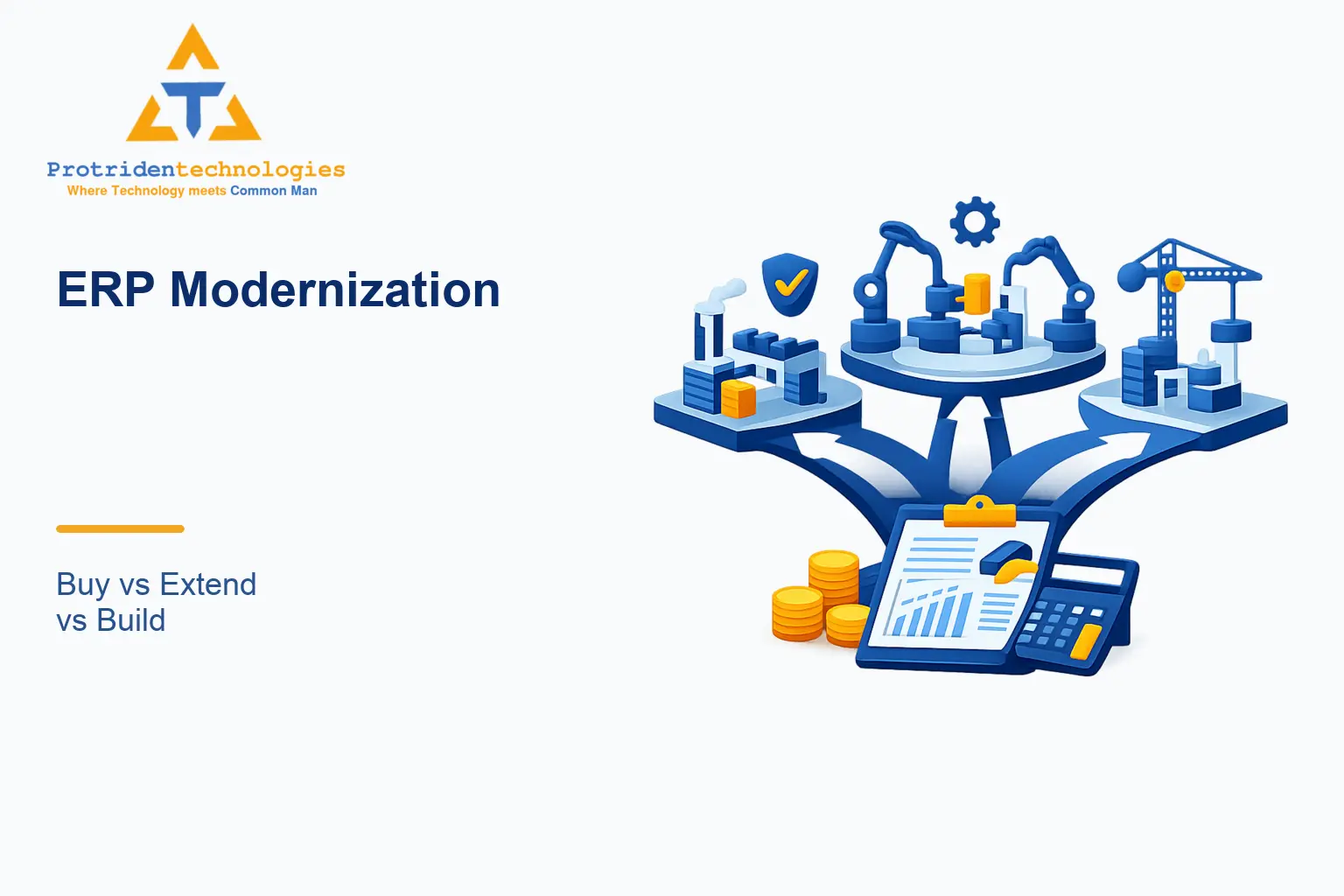
Growing mid-market firms with legacy ERP face a common crossroads: keep patching aging systems, extend with bolt-on modules, or replace with a commercial ERP. Each path has hidden costs and operational risks, and leaders need a clear, evidence-based way to compare total cost, timeline and business impact before choosing.
This workbook-style guide pairs a technical-debt audit with procurement and vendor-selection checklists so you can qualify options objectively and prepare a phased modernization roadmap.
The framework suits companies preparing a procurement shortlist, validating vendor proposals, or building a business case for CIOs and finance sponsors. It maps cost buckets, integration risk and tactical pilots into a decision-ready output.
Why This Topic Matters
ERP modernization decisions shape operations, reporting and future innovation. With leading platforms approaching functional parity, selection and execution now depend on integration strategy, technical debt, and an executable roadmap rather than feature lists alone.
A repeatable workbook and an objective technical-debt audit help teams quantify trade-offs between speed, control and long-term cost. This reduces procurement bias and clarifies whether a buy, extend or build path best supports growth and AI enablement goals.
- Modernization aligns ERP with current business processes and intended growth trajectories, reducing operational friction and manual work.
- A structured audit translates hidden technical debt into scope and cost estimates that drive realistic timelines and procurement priorities.
- Vendor selection driven by integration, TCO and partner execution capability reduces the risk of mid-project scope creep and budget overruns.
- Phased modernization preserves business continuity: prioritize high-impact modules and low-risk pilots before full-scale migration.
Research references: Considerations for Modernizing Your ERP | Clarkston Consulting; ERP selection and vendor criteria for core financials; ERP modernisation playbook for scalable growth; CTO's Guide to ERP Modernization Strategy – Software Modernization Intelligence.
Common Mistakes Businesses Make
Companies commonly treat ERP selection as a feature checklist and underestimate integration complexity, leading to scope creep and missed benefits. Another frequent error is failing to measure technical debt: undocumented customizations, brittle interfaces and poor data quality multiply migration work.
Procurement often prioritizes headline license costs without modeling implementation, cloud run costs, and change-management expenses. Finally, teams sometimes pursue a full rip-and-replace when a phased extend or hybrid approach would deliver faster ROI with less disruption.
- Selecting on feature parity alone, ignoring integration and automation needs.
- Skipping a documented technical-debt audit and underestimating data migration effort.
- Overlooking ongoing cloud run, monitoring and DevOps costs when comparing options.
- Failing to plan phased pilots and organizational change management before large cutovers.
- Choosing partners without structured diligence on execution risks and domain specialization.
Practical Checklist / Steps
Use this checklist as the backbone of the workbook and vendor-selection process. Each step produces a deliverable that feeds the cost model, risk register and procurement shortlist.
The checklist is organized so you can produce a decision pack for leadership: technical-debt scorecard, module TCO, migration roadmap, vendor evaluation matrix and an implementation pilot plan.
- Run a technical-debt audit: Catalog customizations, integrations, undocumented scripts, data quality issues and platform version gaps. Produce a technical-debt score and estimate remediation effort per module to feed migration scope.
- Map core business processes and dependencies: Document current end-to-end processes that ERP supports (finance, order-to-cash, procure-to-pay, inventory) and list upstream/downstream systems, APIs and manual workarounds that must be preserved or redesigned.
- Define business and innovation objectives: Set measurable goals: reduce month-end close time, improve OTIF, enable inventory optimization, or prepare for AI-driven forecasting. Use these to prioritize modules and pilot candidates.
- Build a phased TCO model: Create cost buckets for license/subscription, implementation, customization, integrations, cloud run and ongoing support. Include change-management and training as recurring or one-time line items.
- Shortlist vendors and partners: Apply objective criteria—fit-to-process, integration capability, partner execution history, support model and local presence. Score vendors against the business and technical priorities to narrow the field.
- Design a pilot or proof-of-concept: Select a high-value, low-risk process to validate chosen path (buy, extend or build). Define success criteria, timeline, and data subset to minimize disruption.
- Prepare a migration and cutover plan: Define data-migration approach, reconciliation steps, fallbacks, and stakeholder responsibilities. Include a rollback plan and a post-cutover stabilization window.
- Evaluate cloud run and DevOps readiness: Assess whether chosen solution requires managed cloud services, containerization, CI/CD pipelines or external monitoring. Capture run-rate assumptions for capacity, backups and security.
Cost, Timeline, or Decision Factors
Choosing buy, extend or build depends on clear trade-offs between time-to-value, long-term control and cost. Exact budgets and timelines vary widely; use the workbook to convert technical-debt scores, integration count and business priorities into realistic procurement decisions.
Key decision levers include how many custom processes are non-negotiable, the number and complexity of integrations, expected volume growth, and the organization’s internal delivery capability versus the need for an implementation partner.
- Scope complexity: more bespoke processes and integrations increase implementation time and favor build or high-customization vendors.
- Technical debt: high undocumented customization raises migration effort and cost—sometimes favoring a phased extend approach to avoid disruptive rip-and-replace.
- Time-to-value: buying a SaaS ERP can deliver faster baseline functionality; building gives control but usually requires longer delivery cadence.
- Operational ownership: building demands sustained internal engineering and DevOps investment; buying transfers more run responsibility to vendors.
- Cloud run costs: pricing models differ (subscription vs. infra consumption). Model expected transactions, storage and peak capacity rather than only monthly subscription.
Local Relevance: India, Karnataka, and Udupi
In India, CIOs are balancing rapid cloud adoption and cost-control objectives. Industry guidance emphasizes aligning modernization to business KPIs and incremental pilots rather than all-or-nothing replacements.
For companies in Karnataka—especially the Udupi and Kundapura region—choosing partners with local presence or a hybrid delivery model can improve responsiveness during pilots and cutover windows. Local teams also simplify vendor coordination for time-zone and regulatory matters.
Regional considerations include access to local implementation partners, availability of skilled engineers for custom development, and cloud-region choices that affect latency and compliance. Use the workbook to include India-specific cloud run assumptions and local partner evaluation criteria.
- SAP and other industry playbooks recommend KPI-driven roadmaps and innovation pilots to make modernization achievable and aligned to AI readiness. (See S6)
- Ensure vendor due diligence includes partner execution capability in India and references for mid-market implementations. (See S7)
- Adapt the TCO model for regional cost drivers such as local implementation rates, regional cloud prices and support SLAs.
How Protriden Technologies Can Help
Protriden Technologies helps mid-market firms with end-to-end ERP modernization workstreams that feed directly into the workbook deliverables: technical-debt audit, custom integration development, cloud deployment and phased migration support.
We combine advisory with implementation: preparing the decision pack for procurement, building pilots, and supporting cloud run, monitoring and post-launch maintenance to reduce operational risk during transition.
- Technical-debt audits and custom ERP assessments to quantify migration scope.
- Custom ERP and backend API development for integration and module extension.
- Cloud deployment and monitoring on AWS and DigitalOcean, plus performance tuning and CI/CD setup.
- UI/UX and admin panels to accelerate user adoption and simplify change management.
- Post-launch support, application security hardening, Dockerization and ongoing maintenance.
Final Thoughts
ERP modernization is a strategic, multi-year decision best handled as a series of prioritized projects rather than a single big-bang event. Use the workbook and audit to convert opinions into measurable trade-offs and to structure vendor conversations.
A disciplined procurement process—driven by technical-debt evidence, pilot validation and transparent TCO—reduces execution risk and produces a modernization path aligned to business outcomes.
FAQs
How do I decide between buying a commercial ERP and building a custom system?
Compare time-to-value, number of non-negotiable custom processes, and internal delivery capacity. Use the technical-debt audit to quantify migration scope and the TCO model to compare license/subscription, implementation, integration and long-term run costs. When control of unique processes is critical and you have engineering capacity, building can make sense; when fast standardization and predictable costs matter, buying is typically quicker.
What is a technical-debt audit and why is it important?
A technical-debt audit catalogs undocumented customizations, brittle scripts, integration points and data quality issues. It converts hidden maintenance liabilities into remediation estimates that determine migration scope, schedule and cost—preventing surprises during implementation.
Can I modernize ERP in phases to avoid business disruption?
Yes. A phased approach—starting with a pilot for a high-value, low-risk process—validates assumptions and reduces cutover risk. Phases commonly follow module priority (e.g., finance first, then inventory) and include stabilization windows with reconciliation and rollback steps.
How do cloud run costs affect the buy vs build decision in India?
Cloud run costs depend on transaction volumes, storage, backups, monitoring and regional cloud pricing. They can shift long-term TCO materially. Model consumption assumptions and compare subscription models against self-managed infra costs to understand ongoing run-rate differences for your Indian operations.
What should I look for when shortlisting implementation partners?
Evaluate partner execution history, domain specialization, local presence, delivery model, testing and cutover approach, and post-launch support capabilities. Use a structured due-diligence checklist and ask for references from comparable mid-market projects.
Download our ERP Buy/Extend/Build workbook and technical-debt audit template, then schedule a short advisory call with Protriden to review your decision pack and shortlisted vendor options.
Explore our software development services or discuss your requirements with the Protriden Technologies team.