
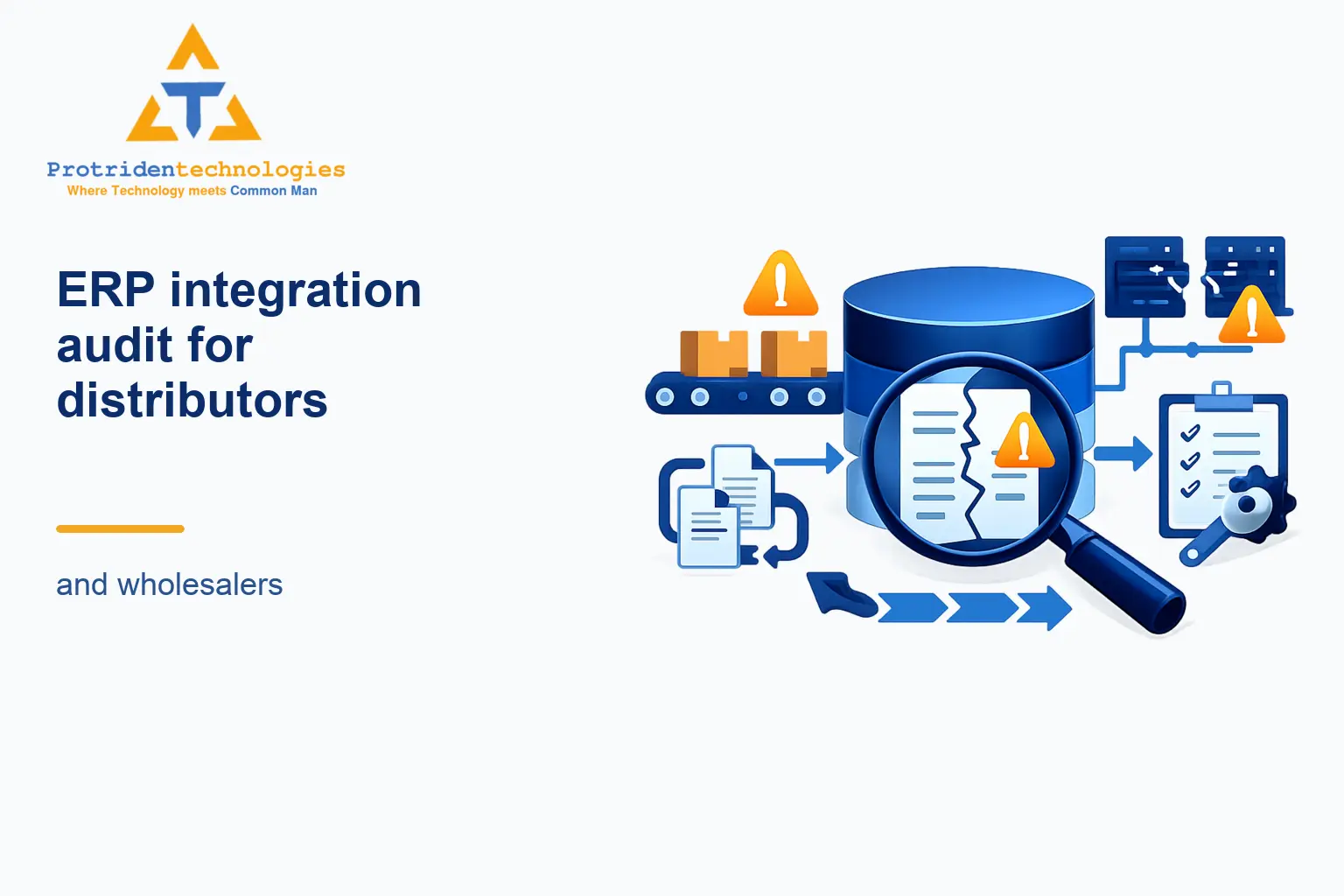
Distributors and wholesalers often run legacy ERPs that do most financial and inventory work, while multiple integrations (marketplaces, e‑commerce, logistics and billing tools) are bolted on. When those integrations are inconsistent or undocumented, businesses see duplicated orders, reconciliation gaps and delayed cash collection — problems that frustrate operations and harm working capital.
Audit and remediation work requires tracing events across systems, verifying message integrity and adding tamper‑evident logs where the ERP lacks them. Internal teams are usually focused on day‑to‑day support, leaving integration for later despite its impact on O2C.
An external integration audit maps end‑to‑end order flows, scores integration risk and prioritizes quick remediation to restore reliable order processing and faster reconciliation. This approach follows integration‑first guidance for distributors that want to keep core ERP investment while closing data gaps.
Why This Topic Matters
Distributors depend on predictable order‑to‑cash (O2C) flows. Integration faults between sales channels, middleware and the ERP create duplicates, mismatched inventory and missing audit trails that multiply manual reconciliation work and delay cash collection. An integration audit surfaces where automated flows break, whether due to idempotency gaps, missing timestamps, or unlogged retries, and produces a prioritized fix plan.
Modern ERP practices emphasise a single source of truth, tamper‑evident logging and role‑based controls so financial and operational teams can reconcile quickly and pass audits. Audit-led remediation reduces operational risk and improves cash flow predictability by restoring reliable, traceable integrations across all sales and logistics endpoints.
- Improves O2C predictability and reduces manual reconciliations
- Creates an auditable single source of truth across sales, inventory and finance
- Identifies idempotency and duplicate-order causes within integration flows
- Prioritizes fixes with business impact and risk scoring
Research references: [ERP Audits: What, How, And When Explained [2026] | DCKAP](https://www.dckap.com/blog/erp-audit/); ERP Software for Distributors: Your Roadmap to Seamless Order-to-Cash; Integrated ERP: 2026 Definition, Benefits & What to Look For.
Common Mistakes Businesses Make
Many distributors react to symptoms rather than root causes: they fix duplicated orders ad hoc, add manual reconciliation steps, or patch incoming API clients without auditing the ERP endpoints, which leaves deeper integration flaws in place. Other common errors include assuming the ERP is the authoritative log even when integrations drop events, and neglecting tamper‑evident logging for financial traces.
Teams often underestimate the complexity of legacy integrations: undocumented middleware, custom connectors, multiple environments and divergent error handling produce surprises during fixes. Security and role controls are frequently overlooked, causing ambiguous approval trails and audit gaps.
- Treating duplicates as isolated incidents instead of tracing source events
- Relying on fragmented spreadsheets for reconciliation instead of source logs
- Not validating idempotency and retry semantics for inbound order APIs
- Failing to create tamper‑evident logs or consistent timestamps across systems
- Skipping a prioritized remediation plan — leading to repeated firefighting
Practical Checklist / Steps
Use this practical checklist to run an ERP integration audit that produces clear, prioritized remediation work. Each step maps to technical artifacts or outcomes an operations or IT lead can review or request from a vendor. The checklist assumes access to system logs, integration endpoints and a test environment where possible.
- Map end‑to‑end order flows: Document every step from order creation to cash receipt: which systems start orders, what middleware transforms data, and which ERP endpoints receive transactional updates. Capture webhooks, APIs, batch jobs, and manual touchpoints.
- Collect and normalise logs: Gather application, middleware and database logs for representative periods. Normalize timestamps to a single timezone and standard format so events can be correlated across systems.
- Verify event integrity and idempotency: Check whether inbound messages include unique IDs and whether receivers enforce idempotency to prevent duplicates from retries or replay. Flag endpoints that reprocess the same request without safeguards.
- Audit audit‑trail coverage: Identify where financial or inventory transactions lack immutable, tamper‑evident logging. Review approval workflows and role‑based audit fields in the ERP; note gaps requiring supplements (e.g., append‑only logs or external ledgering).
- Reconcile data at transaction granularity: Perform reconciliations that match individual order IDs and financial entries across systems rather than batch totals. Document the reconciliation failure modes and sample records that fail to match.
- Test error and retry paths: Simulate common failure scenarios—network timeouts, duplicate webhook delivery, partial updates—and trace how each component behaves. Confirm whether retries create duplicates or inconsistent states.
- Assess security and access controls: Review API keys, user roles and approval workflows tied to integrations. Ensure that integration accounts are scoped, and that audit fields record the initiating principal and timestamp.
- Prioritize fixes by business impact: Score each finding by likelihood, operational impact (e.g., revenue at risk or reconciliation hours saved), and remediation effort. Produce a roadmap with quick wins, medium fixes and larger platform changes.
Cost, Timeline, or Decision Factors
Costs and timelines for an ERP integration audit and remediation depend on the number of integrated systems, the availability of logs and documentation, and whether the ERP requires code changes or only peripheral middleware fixes. Complexity rises when integrations are custom, undocumented, or when changes must pass finance or compliance reviews.
A phased approach is pragmatic: an initial 4–6 week discovery and risk assessment engagement produces a prioritized list and effort estimates; remediation can then be scoped into fixed‑scope sprints or a time‑and‑materials program depending on risk tolerance and internal bandwidth.
- Number and heterogeneity of connected systems (marketplaces, portals, logistics, payment gateways)
- Quality and retention of logs and ability to correlate events across systems
- Need for ERP customisation vs. middleware fixes (custom ERP changes take longer)
- Regulatory or audit constraints that require tamper‑evident logging or external ledgering
- Availability of a test environment and business stakeholder time for validation
Local Relevance: India, Karnataka, and Udupi
Protriden Technologies is based in Kundapura, Udupi, Karnataka, India, which enables local teams to run on‑site workshops and quicker on‑ground discovery for distributors in the region. Local presence matters because many distributors prefer vendor teams who can work directly with operations and accounting stakeholders during discovery and user‑acceptance testing.
Indian distributors and wholesalers often operate multi‑channel sales and regional warehouses; resolving integration gaps locally reduces coordination friction. A nearby partner can also help with on‑site training and phased rollouts that respect business cycles and peak inventory periods.
- Protriden’s Kundapura location supports on‑site discovery and stakeholder workshops in Udupi and Karnataka
- Local teams can coordinate faster with finance and operations during reconciliation testing
- Phased remediation can be scheduled around regional peak seasons to avoid disruption
How Protriden Technologies Can Help
Protriden Technologies offers services that support an ERP integration audit and staged remediation: mapping O2C flows, building tamper‑evident logging, creating dashboards for reconciliation, and implementing middleware fixes or ERP customisation where needed. Our team combines cloud deployment, security practices and CI/CD to make changes safer and repeatable.
We don’t claim one‑size‑fits‑all outcomes; instead we deliver a prioritized, auditable remediation plan after discovery and estimate effort for fixed‑scope sprints or longer engagements depending on your needs.
- Discovery and mapping of order‑to‑cash flows across integrations
- Log collection, normalization and event correlation for audit trails
- Implementation of tamper‑evident logging and reconciliation dashboards
- Middleware fixes, API hardening and ERP customisations as needed
- Cloud deployment, containerisation and CI/CD for safe builds and rollouts
- On‑site workshops and stakeholder training in Kundapura/Udupi/Karnataka
Final Thoughts
An integration audit is a high‑leverage investment for distributors. It stops recurring O2C failures, reduces manual reconciliation overhead, and restores confidence in financial and inventory records. The objective is to make integrations observable, idempotent and auditable so operational teams can focus on growth rather than firefighting.
Start with a limited discovery engagement that produces risk scores, prioritized fixes and clear effort estimates. That reduces initial risk and lets you chase quick wins before larger ERP changes are scheduled. If you need a structured engagement, request an audit that fits your organisation’s timelines and compliance needs.
FAQs
What exactly does an ERP integration audit cover?
An audit maps end‑to‑end flows from order creation through payments, collects and normalises logs, tests error and retry behaviour, verifies idempotency and checks for missing audit trails. The output is a prioritized list of findings with remediation estimates.
How long does the discovery phase usually take?
Discovery durations vary with environment complexity, but a focused discovery and risk assessment is commonly scoped for four to six weeks to collect logs, map flows and produce risk‑scored findings for prioritisation.
Will remediation require changes to my ERP core?
Not always. Many fixes are middleware or API hardening work. Whether ERP core changes are needed depends on the nature of the audit findings—missing audit fields or workflows often require ERP customisations, while many duplicate‑order causes can be fixed in middleware or at integration edges.
How do you ensure audit trails are tamper‑evident?
Tamper‑evident approaches include append‑only logging, cryptographic hashes over log batches, external ledgering of key events, consistent timestamping and strict role‑based recording of the initiating principal. The chosen approach is matched to compliance needs and operational constraints.
What prerequisites should we prepare before an audit?
Provide access to integration documentation, system logs (or procedures to extract them), API specifications and a list of connected systems. Designate business stakeholders for O2C, finance and operations to validate findings and approve priorities.
Request an ERP integration audit to get a prioritized risk report and remediation estimate. Contact Protriden Technologies to schedule a 4–6 week discovery engagement and learn how quick wins can reduce duplicate orders and reconciliation effort.
Explore our software development services or discuss your requirements with the Protriden Technologies team.