
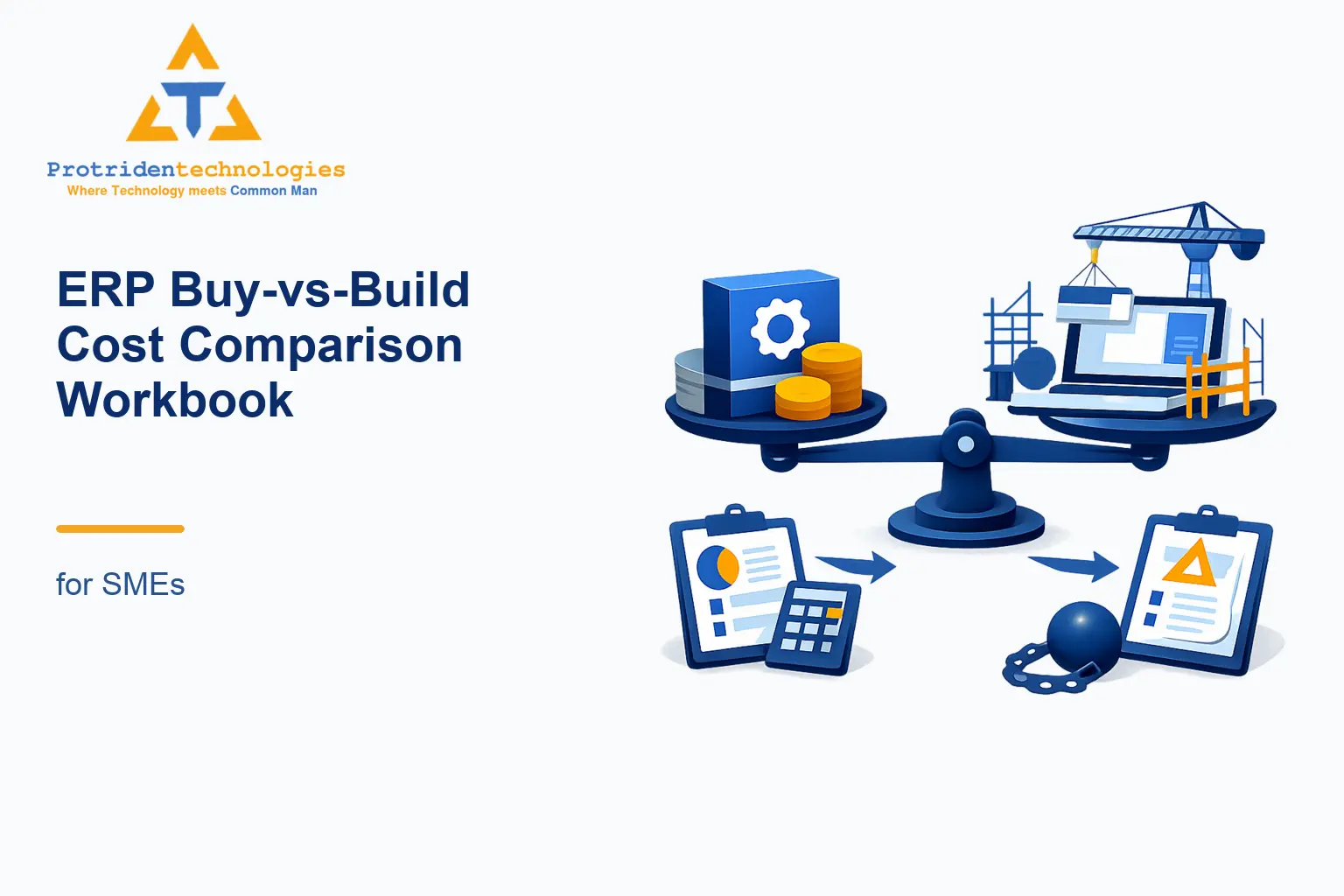
SME finance and operations leaders face an urgent question: should we buy a commercial ERP or build custom software? The wrong decision can lock a business into ballooning maintenance, misfit workflows, or delayed launches that hamper growth and cash flow.
ERP modernization projects compete for limited capital and the attention of senior staff. Decision-makers need a repeatable, transparent way to compare total cost, time to value, and technical debt risks before committing.
This article explains a structured buy-vs-build cost comparison approach, describes common mistakes, and offers a practical checklist and workbook to help CFOs and CTOs scope vendor selection and implementation planning.
Why This Topic Matters
ERP replacement is a strategic investment that affects finance, inventory, procurement, production and reporting. A buy-versus-build analysis surfaces trade-offs in upfront cost, recurring fees, technical debt, time to market and the ongoing burden on in-house teams. Without a structured comparison, organizations underestimate hidden costs—vendor lock-in, extensive customization, and internal maintenance—that drive lifetime spend far above initial projections.
For SMEs, predictability and staff focus are often more valuable than perfect fit. Commercial ERP and cloud SaaS can lower upfront cost and accelerate deployment, while custom builds preserve unique competitive processes but demand engineering capacity and ongoing support. The right choice hinges on a clear understanding of business-critical workflows, the cost of diverted staff time, and the governance plan for future changes.
A cost-comparison workbook combined with a technical-debt audit converts qualitative risks into quantitative inputs for decision-making. It helps CFOs and CTOs evaluate scenarios—buy with configurable modules, buy with heavy customization, or build a staged cloud-native solution—so procurement and executive teams can select a path aligned with cashflow, growth plans and talent availability.
- Clarifies total cost of ownership including implementation, customizations, hosting and maintenance (supports buy and build trade-offs)
- Translates technical debt and internal maintenance burden into cash and resource estimates
- Enables consistent vendor comparison and procurement scoring across functional and technical criteria (licensing, integrations, uptime SLAs)
Research references: Build vs. Buy Software: A Decision Guide for ERP Software; ERP Software Development Cost: Full 2026 Budget Breakdown; How Much Does ERP Cost in 2026? A Pricing Guide for All Business Sizes.
Common Mistakes Businesses Make
SMEs often pick a path based on sales demos or lowest upfront price rather than total cost and operational fit. Underestimating the staff time required for building or customizing systems is a frequent error. Implementation scoping that ignores integration complexity, testing effort and regulatory reporting needs leads to budget overruns.
Another common mistake is treating customization as a one-time cost. Custom features increase long-term maintenance and slow future upgrades, creating a mounting technical-debt liability. Conversely, rejecting off-the-shelf software because of a few unwanted workflows can force an expensive and slower custom build for marginal benefit.
- Ignoring hidden costs such as data migration, training, testing and change management
- Failing to quantify technical debt impact on future agility and upgradeability
- Relying on anecdotal vendor demos instead of scored requirement-fit and cost comparisons
- Under-resourcing internal product ownership when choosing to build, which delays delivery and increases operational risk
Practical Checklist / Steps
Use this checklist alongside a downloadable workbook to create scenario-based cost models and to produce a scored vendor-selection short-list. Each step feeds numbers and risk ratings into the workbook so decision-makers can compare realistic timelines and maintenance burdens.
- Define business-critical processes and success metrics: Document the core workflows that must be delivered day one (e.g., order-to-cash, inventory accuracy thresholds, GST reporting or statutory obligations). Convert each into measurable acceptance criteria and user story summaries to avoid ambiguous scope.
- Inventory current technical debt and integrations: Run a technical-debt audit: list bespoke modules, undocumented fixes, unsupported DB schemas, and third-party integrations. Capture the effort to replace, refactor or migrate each item and note dependencies on internal SMEs.
- Estimate build effort and schedule: Break custom development into modules and estimate engineering hours using historical team velocity or vendor benchmarks. Include architecture, API development, security, testing, and deployment. Add contingency for discovery and scope creep.
- Estimate buy costs and customization needs: Collect license/subscription pricing, implementation fees, partner consultancy rates, and per-user costs. Identify vendor configuration that meets each acceptance criterion versus areas requiring custom extensions and estimate those extension costs.
- Calculate hosting and operations costs: Model cloud hosting, backups, monitoring, patching and SLA costs for both purchased SaaS and self-hosted custom solutions. Include costs for staging environments, CI/CD pipelines and third-party services used in production.
- Quantify training, change management and transition costs: Estimate internal and vendor-led training hours, documentation effort, go-live hypercare support and productivity loss during transition. Include the cost of attention from senior operators who will support testing and acceptance.
- Score vendor-fit and build feasibility: Use a weighted scoring approach to rank candidates across functional fit, technical fit, total cost of ownership, vendor stability, and time to value. For ‘build’, score internal capability, hiring needs and long-term support plans.
- Model multi-year TCO and sensitivity scenarios: Project three- and five-year total cost of ownership under optimistic, base and pessimistic scenarios. Capture maintenance inflation, increased user counts, additional module needs and the cost of deferred technical debt.
Cost, Timeline, or Decision Factors
Cost and timeline depend on several variables: scope complexity, number of integration touchpoints, regulatory reporting needs, whether you require offline or multi-site capability, and the availability of internal engineering resources. Buy options typically offer faster time to value and predictable subscription models; build options shift cost from licensing to engineering and ongoing maintenance.
When exact figures are not available, use scenario modelling in the workbook. Create low, medium and high estimates for key line items: development hours, vendor implementation fees, migration effort and annual hosting/support. Use contingency buffers—industry sources commonly recommend adding contingency for underestimated implementation work.
- Scope complexity and custom workflows raise build costs and timelines significantly
- Number and quality of integrations (legacy databases, machines, banking/GST reports) increase migration risk and effort
- Internal capacity: existing engineering and operations staff reduce vendor dependency but increase opportunity cost
- Recurring vendor fees vs internal maintenance: buy trades recurring subscription for lower in-house effort, build trades one-off capitalized development into ongoing support obligations
Local Relevance: India, Karnataka, and Udupi
Protriden Technologies is based in Kundapura, Udupi, Karnataka, and provides onshore services for custom ERP, cloud deployment, monitoring and post-launch support. For SMEs in India, having a local partner reduces coordination friction, facilitates on-site workshops and eases compliance conversations with finance teams familiar with Indian statutory reporting needs.
Regional delivery advantages include easier access to developer talent for AWS/DigitalOcean deployments, and the ability to schedule in-person scoping sessions and technical-debt audits. Use the workbook to capture local constraints—network bandwidth, multiple-site retail or manufacturing footprints, and offline operations common in some regional SMEs—so vendor proposals remain realistic.
- Onsite scoping and audits from a local firm in Kundapura/Udupi can speed requirements validation and reduce miscommunication
- Local experience with Indian SME workflows and tax reporting helps accurately scope integrations and acceptance criteria
- Cloud deployment and monitoring expertise (AWS/DigitalOcean) reduces migration risk for both buy and build options
How Protriden Technologies Can Help
Protriden Technologies can help SMEs run the technical-debt audit and populate the buy-vs-build workbook with realistic, defendable estimates. Our services include requirements scoping workshops, integration mapping, cloud deployment planning and staged implementation roadmaps. We focus on turning operational priorities into measurable procurement criteria to support procurement, finance and IT alignment.
Using our local presence in Kundapura and Udupi, we provide on-site workshops where needed, remote engineering for custom builds, and vendor-selection support to score and negotiate proposals. We do not promise fixed prices here; instead, we translate discovery findings into clear options with cost ranges, timelines and maintenance models to inform board-level decisions.
- Technical-debt audit templates and hands-on scoping workshops
- Populate and validate buy-vs-build workbook estimates and scenarios
- Vendor-selection scoring and negotiation support, plus staged implementation roadmaps
Final Thoughts
A disciplined buy-vs-build process reduces surprises. The combination of a technical-debt audit and a scenario-based cost workbook gives CFOs and CTOs the evidence they need to choose a path that matches cashflow, competitive advantage and available talent. Prioritize measurable acceptance criteria, realistic contingency, and a plan for managing technical debt whether you buy or build.
FAQs
What does the cost-comparison workbook include?
The workbook captures module-level estimates, license and subscription lines, implementation and customization costs, hosting and operations, training and change management costs, and multi-year TCO scenarios with sensitivity ranges.
How long does a technical-debt audit take?
Duration depends on system size and complexity. For a small SME ERP footprint it may take a few days; for larger legacy systems with many integrations it can take multiple weeks. The audit is scoped to produce actionable estimates and migration risk ratings.
Will the workbook tell me whether to buy or build?
The workbook does not make the decision for you; it produces quantitative scenarios and risk-adjusted costs so your finance and engineering leaders can compare options against strategic priorities, cashflow constraints and talent availability.
Can Protriden help implement both purchased ERPs and custom builds?
Protriden provides custom ERP development, cloud deployment, integration work and post-launch support. For commercial ERP implementations we assist with scoping, customization, integrations and deployment planning, based on the discovery findings.
How should we budget for unknowns and scope creep?
Use contingency in the workbook and model optimistic/base/pessimistic scenarios. Industry guidance recommends buffers for underestimated implementation work; the exact contingency should reflect your organization’s appetite for risk and the maturity of requirements discovery.
Download the ERP Buy-vs-Build cost-comparison workbook and request a free scoping call with Protriden to run a technical-debt audit and vendor-selection scorecard tailored to your SME.
Explore our software development services or discuss your requirements with the Protriden Technologies team.