
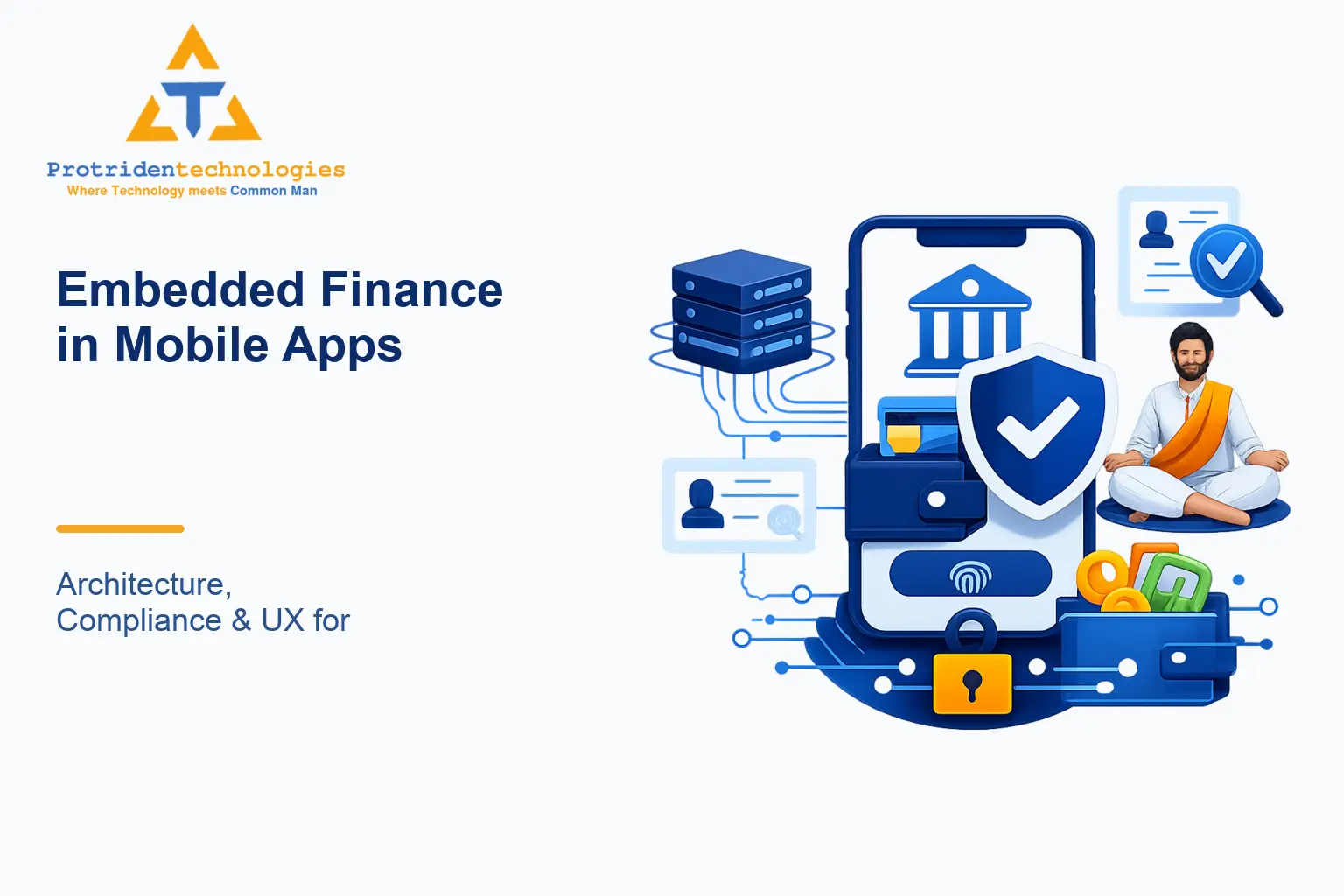
Embedded finance—adding payments, wallets, lending or insurance features directly inside a non-bank mobile app—changes how customers interact with services and how businesses capture revenue. Rather than sending users to a bank or a separate portal, apps keep financial journeys inside a familiar interface, increasing convenience for users and monetization options for product owners.
For product and engineering leaders in India, the decision to embed finance requires trade-offs across architecture, regulatory compliance, security and user experience. This guide translates common industry patterns into practical steps: how to choose an integration approach, what core infrastructure you need, a focused compliance and KYC checklist, how to harden security while preserving UX, and how to operate the service reliably after launch.
Why embed finance now and how to frame the product decision
Embedding financial services into a consumer app is a strategic decision, not only a technical integration. The product team must define the business outcomes first: increase conversion at checkout, reduce friction for recurring payments, offer microloans to increase average order value, or add a savings feature to improve retention. Each objective carries different technical and compliance implications—payments and wallets are operationally lighter than lending or deposit-like services, which typically require tighter regulatory oversight.
Start by mapping the customer journey end-to-end. Identify the precise moments where a financial flow would remove friction or create value. This mapping helps you choose a minimum viable embedded feature set and avoids overbuilding complex financial modules before market validation. It also clarifies which third-party partners you must evaluate: payment processors, PSPs, KYC providers, card networks, or lending platforms.
Trade-offs are inevitable. Integrating via a third-party embedded finance platform accelerates time-to-market and reduces compliance burden but may limit product differentiation and control over pricing or data. Building direct integrations with banks and payment rails gives greater control and potential margin but increases operational complexity and regulatory responsibility. Document those trade-offs and include them in your implementation decision criteria so that product, legal and engineering align before implementation starts.
Practical first steps: run a short feasibility sprint that lists eligible partners, required API capabilities, expected latencies, and the compliance scope for each target feature. Use that sprint to prepare a two-track plan: a fast, compliant pilot with a partner and a longer-term architecture that supports direct integrations if needed.
- Define business outcomes and minimal financial features for an MVP.
- Map the customer journey to identify insertion points for finance features.
- Create a partner short-list and capture API, security and compliance requirements.
- Run a feasibility sprint before committing to full development.
Core architecture and integration patterns
A reliable embedded finance architecture typically separates responsibilities into clear layers: mobile client UI, an orchestration/API gateway layer, a core financial ledger/service layer, and external connectors to banks, payment processors and identity providers. The ledger or core infrastructure is the single source of truth for balances, transaction state and business rules; orchestration routes requests, manages retries and implements idempotency for financial operations.
When choosing integration patterns, decide between direct integrations and platform-as-a-service partners. Direct integrations require building and maintaining connectors to banking APIs and payment processors. Using a fintech platform or PSP offloads connector and compliance work, allowing teams to focus on UX and product flows. The architectural trade-off is control and margin versus speed and operational burden.
Technical design choices that materially affect implementation include synchronous versus asynchronous flows, event-driven reconciliation, and how to model transaction states in the system. Asynchronous flows and events improve resilience and scalability but increase complexity in the client UX and error handling. Implement clear state machines for critical flows (payments, disbursements, refunds) and expose precise status to the mobile client so users are never left guessing.
Practical steps to implement the architecture: design a small set of stable API contracts for mobile clients, standardize error and retry semantics, implement an orchestration layer that shields mobile from third-party variability, and create a reconciliation pipeline that routinely compares ledger state against partner reports. Instrument every layer with observability so operational teams can quickly surface issues and trace customer-impacting incidents.
- Separate responsibilities into client, orchestration, ledger and connector layers.
- Choose platform partner vs direct integration based on control, time-to-market and operational capacity.
- Prefer event-driven reconciliation and idempotent APIs for financial operations.
- Instrument tracing and monitoring across the stack for fast incident resolution.
Compliance and KYC checklist for Indian mobile apps
Regulatory compliance and KYC are central constraints for embedded finance. While specific obligations depend on the feature (payments, wallets, loans or insurance) and the regulator involved, a practical checklist helps engineering and product teams prepare the implementation. The checklist should be owned jointly by product, legal and engineering and treated as input to the architecture decisions.
Start with data minimization and privacy-by-design. Only collect data that is necessary for the financial flow, and design retention and deletion policies into the system from day one. Maintain auditable logs of consent and transaction events; these logs support dispute resolution and regulator requests while preserving user privacy when possible through pseudonymization or tokenization.
For KYC flows, integrate with trusted identity verification providers and model both instant (API-driven) and manual-review paths. Decide which KYC attributes are mandatory for each product action and how the client will surface failure states or request additional documentation from users. Include rate limits and fraud-detection signals that can suspend flows pending review to reduce operational and regulatory risk.
Operationalize compliance: keep a living compliance matrix that maps each feature to required controls, the responsible service owner and the evidence needed for audits. Test these processes before launch with simulated audits or tabletop exercises so the team knows how to respond to regulator queries and customer disputes.
- Adopt privacy-by-design: minimize collection, define retention and deletion policies.
- Integrate certified identity/KYC providers and provide manual review fallbacks.
- Log consents and transaction events with appropriate pseudonymization.
- Maintain a compliance matrix and run simulated audits to validate processes.
Security, data protection and risk controls
Security for fintech features must be prioritized from the first sprint. Core measures include transport encryption, server-side data encryption, hardened authentication, and secure storage of keys and secrets. Beyond these basics, consider multi-factor authentication or device-bound biometrics for sensitive flows, and use tokenization to avoid storing raw payment credentials in your systems.
Implement layered defenses: client hardening (obfuscation, tamper detection, certificate pinning) reduces opportunistic attacks; server-side controls (rate limiting, anomaly detection, strong RBAC) mitigate misuse after compromise. Ensure secrets and certificates are stored in secure key management systems and rotate them regularly. Incorporate security into CI/CD so builds are scanned and dependencies are validated before deployment.
Threat modeling and regular penetration testing are practical controls that reveal design weaknesses early. Prioritize tests against financial flows and reconciliation paths where logic bugs can directly cause loss. Include monitoring for fraud indicators and automated throttling to limit blast radius of attacks that leverage stolen credentials or synthetic identities.
Trade-offs include user friction from stricter authentication versus the potential for fraud. Use risk-based authentication: apply stronger checks only when transaction risk or behavioral signals exceed thresholds. Provide clear customer support paths when security controls block legitimate users to avoid churn while maintaining protection.
- Encrypt data in transit and at rest; use tokenization for payment credentials.
- Harden mobile clients and secure secrets with managed key stores.
- Integrate automated security checks into CI/CD and run periodic pentests.
- Adopt risk-based authentication to balance security and UX.
UX, performance and operational readiness
Embedded finance fails or succeeds in the moments users interact with money; UX decisions matter for conversion and trust. Keep flows simple: progress indicators, clear language on charges and timelines, and explicit consent screens reduce support load and disputes. For asynchronous processes (payment verification, loan approvals), surface intermediate statuses and next steps so users are not left waiting without context.
Performance and reliability matter more than feature count. Design for graceful degradation: if a third-party payment API is slow, the app should fallback to cached options or a queued retry with clear user messaging. Instrument end-to-end latency from the mobile client to downstream partners and set operational thresholds that trigger alerts before users are impacted.
Operational readiness requires playbooks, monitoring dashboards and clear runbooks for common incidents: payment failures, KYC rejections, reconciliation mismatches, and partner outages. Automate routine operational tasks like settlement reconciliation where possible and make manual escalation paths explicit. Regularly review incidents to refine SLAs, runbooks and product behaviors.
When planning scale, focus first on predictable, repeatable processes: robust logging, observability across partners, and a capacity plan for peak loads. Prioritize the product flows that generate revenue and design separate scaling strategies for those critical paths so you do not over-engineer lower-impact features prematurely.
- Design clear status messaging and consent screens for money flows.
- Implement graceful degradation and client-side fallbacks for partner slowness.
- Create operational playbooks for payment, KYC and reconciliation incidents.
- Prioritize observability and capacity planning for high-value flows.
Embedding finance in a mobile app is a multi-dimensional program involving product choices, architecture, compliance and security. Start small with a tightly scoped MVP, choose integration partners to manage early complexity, and build a robust ledger and orchestration layer that can scale when you take more services in-house.
Operationalize compliance and security from the start, instrument end-to-end observability, and prepare playbooks for the most frequent incidents. Balancing user experience and risk is an ongoing process—apply risk-based controls and iterate based on operational telemetry and customer feedback.
Protriden Technologies helps teams build and operate mobile apps with secure backend APIs, cloud deployment and application security. If your roadmap includes embedded payments, wallets or lending features, plan the pilot with clear acceptance criteria and a short feasibility sprint before committing to a full build.
How Protriden Technologies Can Help
If you need a practical architecture review, integration plan or a compliance checklist tailored to your Indian mobile app, contact Protriden Technologies to start a feasibility sprint and pilot plan.
Explore our software development services or discuss your requirements with the Protriden Technologies team.
Sources
- [Embedded Finance Guide: Architecture, Use Cases [2026]](https://sdk.finance/blog/embedded-finance-solutions-how-businesses-are-integrating-financial-services/)
- How to Build a Fintech App in 2025: A Step-by-Step Development Guide
- How to Develop a Fintech App in 2026: The Complete Guide
- Complete Guide To Fintech Mobile App Development