
“We should build an app.”
It sounds like the natural next step for a growing business.
Competitors have apps. Customers use smartphones. App-based businesses are everywhere.
But building a mobile app simply because it feels modern can become an expensive mistake.
The honest answer is:
Not every business needs an app.
Some businesses may get better results from improving their website, creating a customer portal, adding a booking system or automating internal operations.
An app becomes valuable when it solves a repeated problem for customers or the business.
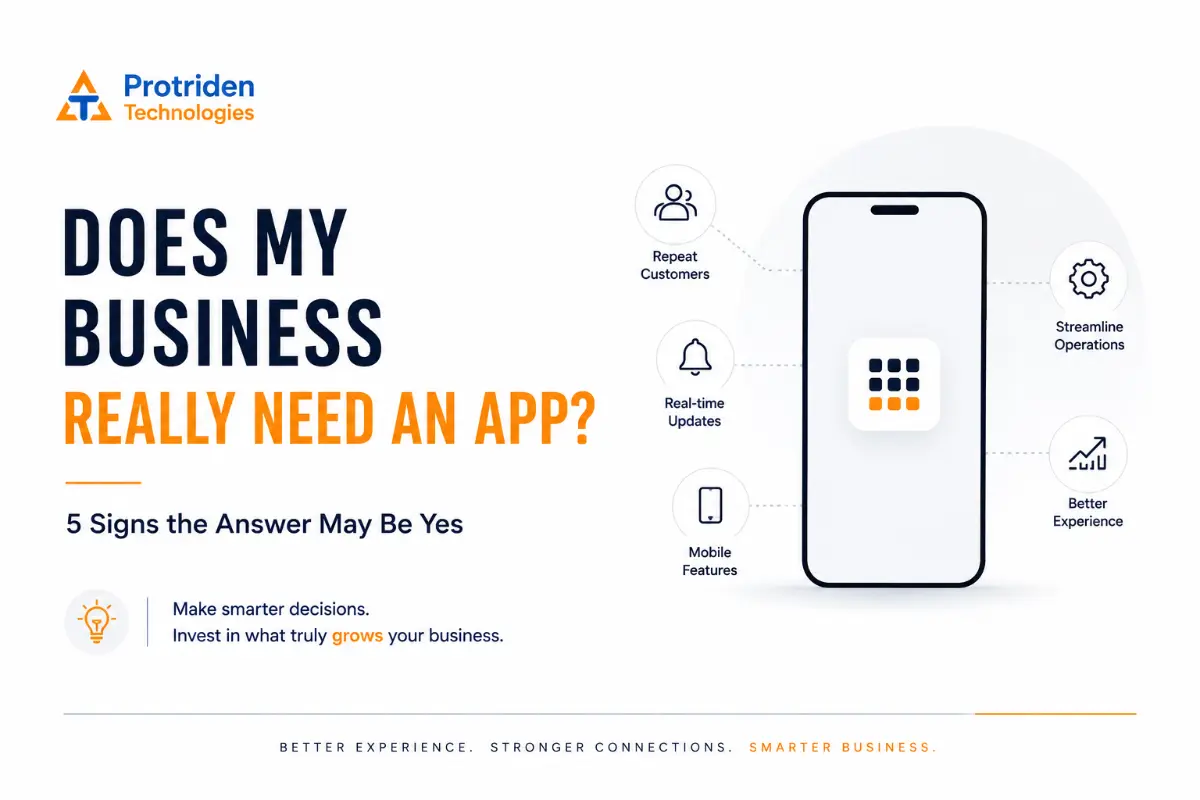
Before spending money on development, look for these five signs.
1. Customers Use Your Service Repeatedly
A mobile app works best when customers need to return regularly.
Examples include:
- Booking rides
- Ordering food or products
- Scheduling appointments
- Tracking deliveries
- Managing subscriptions
- Accessing courses
- Monitoring fitness activities
- Paying bills
- Booking vehicle services
- Managing loyalty rewards
Consider a customer who uses your service once every two years.
They may not want to install an app.
But if they use the service every week or every month, an app can make the experience faster and more convenient.
Ask yourself
- How frequently do customers interact with us?
- Do they repeat the same steps each time?
- Would saved preferences make the process easier?
- Would customers benefit from faster login, payments or booking?
If customers regularly return, an app may reduce friction and improve retention.
2. Your Customers Need Real-Time Updates
Websites are useful for providing information.
Apps become more valuable when customers need timely, personalised updates.
For example:
- A taxi customer needs driver and trip updates.
- A service customer needs booking-status notifications.
- An ecommerce customer wants order tracking.
- A healthcare user needs appointment reminders.
- A delivery customer wants location updates.
- A fitness user wants workout reminders and progress tracking.
Mobile apps can support push notifications, live location, in-app alerts and personalised communication.
But notifications should provide genuine value.
Sending too many promotional alerts can cause users to disable notifications or uninstall the app.
An app may help when customers frequently ask:
- Where is my order?
- Has my booking been confirmed?
- When will the service provider arrive?
- Has my payment been received?
- Is there an update on my request?
- What should I do next?
When real-time communication is central to the service, an app can provide a better experience than email or manual WhatsApp follow-ups.
3. Your Business Depends on Mobile-Specific Features
Some business ideas need capabilities that work especially well on smartphones.
These may include:
- GPS and live location
- Camera access
- QR-code scanning
- Biometric login
- Push notifications
- Offline access
- Bluetooth integration
- Background tracking
- Contact integration
- Device sensors
- Mobile wallets
- App-based payments
A responsive website can handle many business requirements.
However, when the product depends heavily on location, camera, sensors or real-time mobile interaction, an app may offer a smoother and more reliable experience.
Example
A basic service company may only need a website with an enquiry form.
A service-booking business may need an application where customers can:
- Select a service
- Choose a location
- Book a time
- Make a payment
- Track service status
- Receive notifications
- Review the completed service
The right choice depends on the actual workflow—not on what looks more impressive.
4. Manual Processes Are Slowing Down Your Team
A mobile app does not always have to be customer-facing.
Many businesses need internal applications for employees, sales teams, delivery staff, technicians or field workers.
Your business may need an internal app when employees are managing work through:
- WhatsApp messages
- Phone calls
- Paper forms
- Spreadsheets
- Separate applications
- Manual attendance
- Repeated data entry
- Unstructured status updates
An internal business app can help teams:
- Assign tasks
- Update job status
- Record field visits
- Upload photos
- Track inventory
- Capture customer signatures
- Generate reports
- Manage approvals
- Access customer information
- Record payments
- Check in and check out
Warning signs
Your business may need a digital system when:
- Staff repeatedly ask for the same information.
- Managers cannot see work status in real time.
- Reports take hours to prepare.
- Information is spread across different WhatsApp groups.
- Employees enter the same data in multiple places.
- Customers regularly call for status updates.
In some cases, the right solution may be an ERP, admin panel or web application rather than a public mobile app.
A proper requirement analysis should determine which system fits the problem.
5. Your Website Cannot Deliver the Experience Customers Expect
A website is often the right starting point.
It is easier to discover through Google, does not require installation and can work across devices.
But a website may become limiting when customers need:
- Faster repeat access
- Personalised dashboards
- Saved preferences
- Frequent transactions
- Offline functionality
- Location tracking
- Push notifications
- Complex user accounts
- Continuous interaction
- Device-specific features
Imagine a customer who must repeatedly open the browser, search for your business, log in and enter the same information.
An app could simplify that journey.
However, an app will not automatically solve a weak customer experience.
If the process itself is confusing, putting it inside an app will not make it better.
The workflow must be simplified before development begins.
When Your Business Probably Does Not Need an App
An app may not be the right investment when:
Customers Use Your Service Rarely
A one-time or occasional service may work better through a mobile-friendly website.
Your Main Goal Is Google Visibility
Websites and landing pages are generally more suitable for SEO and attracting new users through search.
App-store visibility is not a substitute for a strong web presence.
You Only Need Basic Enquiries
A clear website with a call button, WhatsApp option and enquiry form may be sufficient.
The App Has No Clear Repeat Use
Users are unlikely to keep an application installed if it provides no ongoing value.
You Have Not Validated the Business Idea
Start with research, prototypes or a smaller MVP before building a complete platform.
You Cannot Support the App After Launch
An app needs:
- Server infrastructure
- Bug fixes
- Security updates
- App-store maintenance
- Operating-system compatibility
- User support
- Analytics
- Feature improvements
Development is only the beginning.
Website, Web App or Mobile App: Which One Do You Need?
Choose a Business Website When You Need:
- Online presence
- Google visibility
- Service information
- Lead generation
- Contact forms
- Portfolio pages
- Location information
- Basic ecommerce
Choose a Web Application When You Need:
- Customer login
- Admin dashboards
- Internal workflows
- Reports
- Inventory management
- Booking management
- CRM or ERP functionality
- Browser-based access
Choose a Mobile App When You Need:
- Frequent customer use
- Push notifications
- GPS or location tracking
- Camera and QR-code features
- Offline access
- Personalised user experiences
- Field-staff operations
- Fast repeat transactions
Some businesses need a combination:
- Website for discovery and SEO
- Mobile app for customers
- Admin panel for management
- Backend and cloud infrastructure for operations
Five Questions to Answer Before Building an App
1. What Exact Problem Will the App Solve?
Avoid answers such as:
- “Our competitors have one.”
- “Apps are the future.”
- “It will make our business look bigger.”
Use a specific answer:
Customers currently call us to book appointments. The app will allow them to view availability, book, pay and receive reminders
2. Who Will Use the App?
Define the users clearly:
- Customers
- Employees
- Vendors
- Delivery partners
- Service providers
- Managers
- Administrators
Different users may need different interfaces
3. How Often Will They Use It?
Daily and weekly use cases usually provide stronger app value than rare interactions.
4. What Is the Minimum Useful Version?
Do not begin with every possible feature.
An MVP may only need:
- Registration
- Core service
- Payments
- Notifications
- Basic profile
- Admin panel
Additional features can be developed after real users provide feedback.
5. How Will the App Generate Business Value?
The value may come through:
- More bookings
- Faster operations
- Better customer retention
- Reduced manual work
- Improved service tracking
- Subscription revenue
- Product sales
- Lower support workload
The app should have a clear business purpose.
Do Not Forget the Admin Panel
Many founders focus entirely on the customer app.
But someone must manage:
- Users
- Orders
- Bookings
- Payments
- Content
- Notifications
- Support requests
- Reports
- Offers
- Permissions
- Service providers
That is why most serious mobile applications also need an admin panel or business dashboard.
Without it, the app may create more manual work instead of reducing it.
How Protriden Technologies Helps Businesses Plan an App
At Protriden Technologies, we do not recommend an app simply because a client asks for one.
We first try to understand:
- The business problem
- Target users
- Customer journey
- Existing manual process
- Required features
- Admin-panel requirements
- Integrations
- Budget range
- Launch timeline
- Future growth plan
Depending on the requirement, the right recommendation may be:
- A mobile-friendly website
- A progressive web application
- A customer portal
- A mobile app
- An internal staff app
- An ERP or admin panel
- A phased MVP
Protriden has experience working on applications and business platforms across ride booking, two-wheeler service booking, ERP workflows, ecommerce and other custom use cases.
The goal is to build the right digital system—not the most complicated one.
Final Answer: Does Your Business Need an App?
Your business may need an app when:
- Customers interact with you frequently.
- They need real-time or personalised updates.
- The service depends on mobile-specific capabilities.
- Manual operations are limiting the team.
- A website can no longer provide the required experience.
But an app is not automatically the right answer.
The investment makes sense only when the app solves a clear problem, creates repeat value and supports a measurable business goal.
Start with the problem.
Then choose the technology.
Frequently Asked Questions
Does Every Small Business Need a Mobile App?
No. Many small businesses can grow effectively with a well-designed website, Google Business Profile and clear enquiry process. An app is useful when there is frequent interaction, repeated transactions or a specialised workflow.
Is a Mobile App Better Than a Website?
Neither is always better. A website is generally stronger for search visibility and first-time discovery. An app may be better for repeat users, notifications, personalisation and mobile-specific features.
How Much Does It Cost to Build a Business App?
The cost depends on the number of user types, features, design complexity, backend, admin panel, integrations, security, testing and maintenance. A clear requirement document is necessary before estimating accurately.
Should a Startup Build an MVP First?
In many cases, yes. An MVP helps test the core idea with fewer features before investing in a complete product.
Does My App Need an Admin Panel?
Most applications need an admin panel to manage users, bookings, transactions, content, reports and support operations.
Can One App Work on Android and iOS?
Yes. Cross-platform technologies such as Flutter can be suitable for many products. The technology should be selected based on functionality, performance and integration requirements.
How Long Does App Development Take?
The timeline depends on scope, design, integrations, testing and approval requirements. A simple MVP may take considerably less time than a multi-user platform with complex workflows.
Still Unsure Whether Your Business Needs an App?
Request a Free App Idea Consultation from Protriden Technologies.
We will help you evaluate:
- Whether an app is necessary
- Website versus web-app versus mobile-app options
- Core MVP features
- User roles
- Admin-panel requirements
- Technical feasibility
- Approximate development phases
- Recommended next step
Bring your business problem—not a complete technical document.