
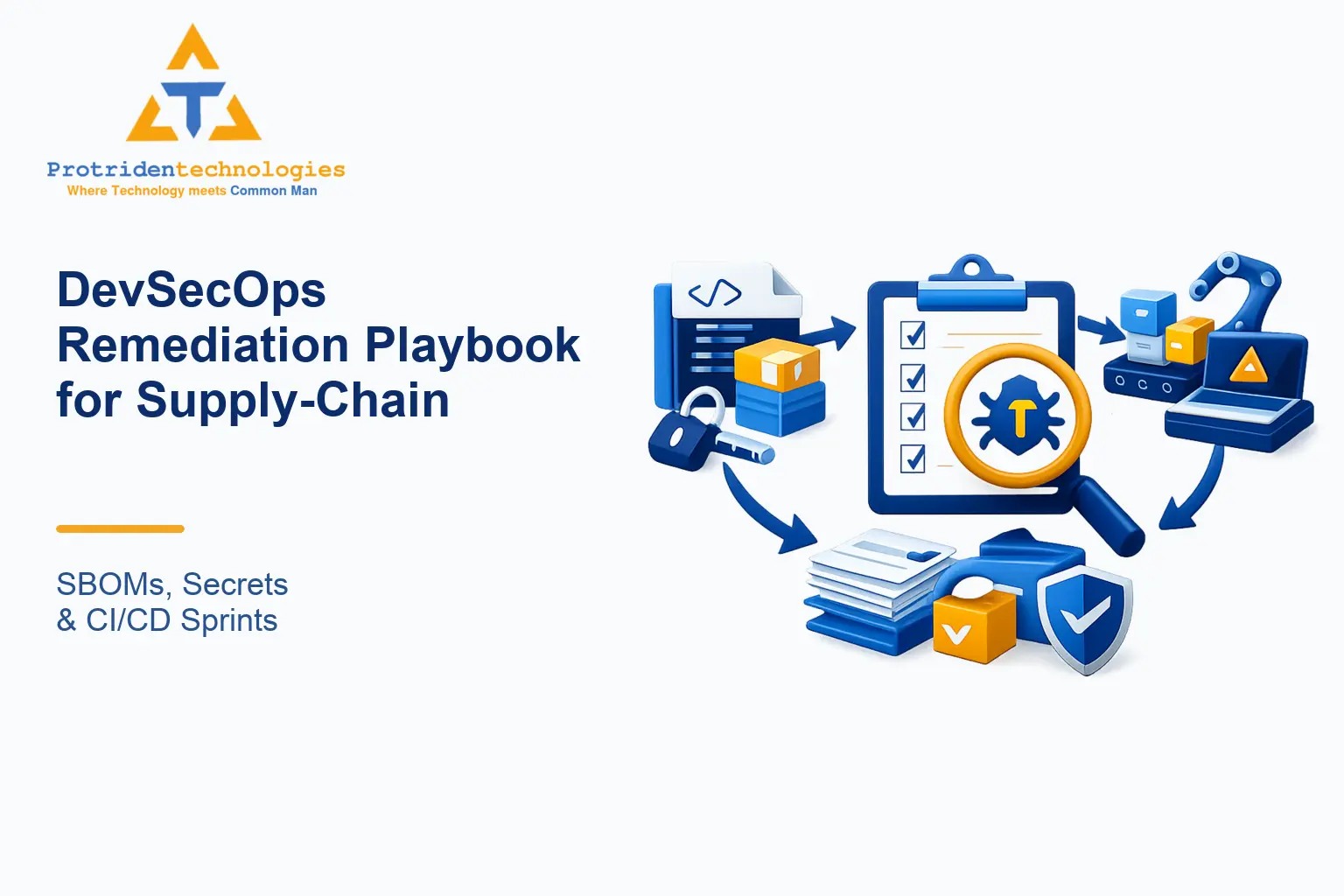
Security and engineering teams often inherit long lists of SBOM findings, secret detections and CI/CD misconfigurations with no clear order of execution, audit trail or business context. The result: remediation drifts, blockers for releases, and compliance gaps when regulators or customers request evidence of fix progress.
Organizations need a remediation approach that packages fixes into a time‑boxed sprint with prioritized tickets, verification steps and audit artifacts so leadership and auditors can see progress.
This playbook explains how to run a focused 3–4 week DevSecOps remediation sprint that converts SBOM and secret scan outputs into clear ownerable work, CI/CD hardening tasks and evidence suitable for compliance reviews.
Why This Topic Matters
In 2026 the industry treats SBOMs not as static files but as living inventory that must feed triage and fix loops inside CI/CD. Standards like CycloneDX and SPDX and VEX guidance are increasingly expected in machine‑readable formats to support automated decisions (see sources). A practical sprint reduces time to remediate by creating a repeatable pipeline from detection to verified fix.
Risk signal fusion — combining EPSS, CISA/KEV flagged CVEs and contextual factors such as exposure scope — lets teams prioritize work that reduces actual operational risk rather than chasing score inflation. Instrumenting this logic into the sprint ensures scarce engineering time is spent where it matters.
Secret detection and CI/CD hardening are common root causes of successful supply‑chain incidents. Putting these activities into a coordinated remediation sprint ensures fixes include not only code changes but also CI policies, pipeline attestations and traceable evidence that auditors require.
- SBOMs as live inputs: machine‑readable formats and signed artifacts enable automated triage (S2, S8).
- Risk‑first prioritization using EPSS and Known Exploited Vulnerabilities reduces focus on low‑impact CVEs (S4).
- Sprint artifacts such as ticket lists, test evidence and pipeline attestations create an audit trail for compliance reviews (S2, S8).
Research references: [SBOM Standards & Remediation Cheat Sheet [DevSecOps 2026]](https://techbytes.app/posts/sbom-standards-remediation-cheat-sheet-devsecops-2026/); SBOM Analysis: A Complete Guide for DevSecOps Teams | Kiuwan; The ultimate guide to SBOMs.
Common Mistakes Businesses Make
Treating the SBOM as a one‑off deliverable. Many teams produce an SBOM file and then file issues into the backlog without wiring that inventory back into CI or governance. Without automated re‑generation and signed artifacts, SBOMs diverge from reality quickly.
Using raw CVSS scores as the sole prioritization signal. CVSS alone can overstate or understate operational urgency; ignoring EPSS, exploit telemetry and business exposure leads to inefficient remediation queues.
Siloed fixes lacking verification steps. Developers may patch a dependency, but without CI attestation, SBOM re‑generation and an evidence artifact, auditors and security teams cannot confirm the vulnerability is closed across the build pipeline.
- Building remediation lists without mapping owners, test cases and deployment gates.
- Failing to sign or version SBOMs and VEX outputs so artifacts are unusable for audit purposes.
- Neglecting pipeline policy updates (e.g., preventing secrets in commits or enforcing SBOM generation) as part of the remediation scope.
Practical Checklist / Steps
Use this stepwise checklist to plan and execute a focused 3–4 week remediation sprint. Each step is meant to create ownerable work, verification criteria and at least one audit artifact per remediation item.
Customize sprint length based on team capacity and business risk: dense, high‑risk inventories may require parallel tracks or follow‑on sprints.
- Establish sprint scope and stakeholders: Define the sprint objectives (SBOM triage, secret fixes, CI/CD hardening), identify engineering owners, security lead and product or release manager, and set the sprint length and acceptance criteria.
- Ingest and normalize SBOM and scan outputs: Collect SBOMs (CycloneDX/SPDX), dependency scan results, secret scan findings and CI policy reports. Normalize formats into a single triage view for consistent filtering and ticket creation.
- Apply risk filters and tagging: Enrich findings with EPSS probabilities, CISA/KEV flags and internal exposure tags (public internet-facing, critical service). Tag each item by impact domain to prioritize work.
- Prioritize and create ownerable tickets: Convert triaged items into concise tickets with acceptance tests, rollback criteria, and a definition of done that includes SBOM re‑generation and signed artifact creation.
- Define verification gates and artifact requirements: For each ticket, specify verification steps: unit/integration tests, CI pipeline checks, SBOM diff showing the component update or remediation, and a signed VEX or attestation where applicable.
- Protect CI/CD with policy hardening tasks: Include pipeline tasks such as enforcing secret scanning, blocking builds with unresolved high‑risk findings, adding SBOM generation and signing steps, and ensuring reproducible builds where feasible.
- Schedule daily standups and weekly checkpoint demos: Run short daily syncs for blockers and a weekly demo to show progress against acceptance criteria and to accumulate audit evidence for stakeholders.
- Collect audit artifacts continuously: Store signed SBOMs, VEX decisions, pipeline logs, commit references and test outputs in a versioned artifact repo or compliance workspace so auditors can follow the remediation chain.
Cost, Timeline, or Decision Factors
Deciding whether to run an internal sprint, engage a specialist partner, or combine approaches depends on team capacity, the criticality of exposed services, and compliance deadlines. The key decision drivers are remediation velocity, traceability needs and integration work to automate SBOM generation and attestation.
Costs and timelines vary by inventory size, codebase complexity and the extent of CI/CD changes required. A small service with a handful of high‑risk dependencies can often be addressed in a single sprint; mature platforms that need pipeline redesign or multi‑team coordination may need follow‑on sprints.
- Engineering capacity and availability of component owners determine parallelization and sprint length.
- The depth of required CI changes (adding signing, policy enforcement, or reproducible builds) increases effort and testing time.
- Regulatory or customer audit windows influence whether evidence must be delivered within the sprint or staged for later validation.
Local Relevance: India, Karnataka, and Udupi
Indian organisations face rising attention on software supply‑chain hygiene from regulators and customers; practical, evidence‑based remediation sprints help teams respond quickly. Running a focused, auditable sprint in India requires aligning artifact storage and governance with local compliance expectations and internal audit practices.
For teams in Karnataka — including Kundapura and Udupi — local engineering talent and regional operations often mean hybrid delivery models: coordinate sprint ceremonies across time zones and ensure artifact repositories comply with the organisation's data governance rules.
- Local engineering and DevOps teams in Kundapura/Udupi can run rapid on‑site scoping workshops to accelerate owner identification and acceptance criteria.
- Proximity to regional offices makes in‑person kickoff and demo sessions feasible, which helps gather sign‑offs and collect audit evidence faster.
How Protriden Technologies Can Help
Protriden Technologies offers hands‑on remediation sprints that combine SBOM triage, secret scanning remediation and CI/CD hardening with a focus on audit‑ready artifacts. Our approach emphasizes ownerable tickets, pipeline attestations and signed SBOM outputs so you can present verifiable evidence to auditors or customers.
We match sprint work to your existing toolchain and can assist with automating SBOM generation, integrating risk signals and creating CI gates that prevent regressions. Protriden supports end‑to‑end deliverables: prioritized tickets, verification scripts, signed artifacts and a sprint closure package.
- Sprint planning and scoping workshops to set objectives and acceptance criteria.
- SBOM and scan normalization, risk enrichment and prioritized remediation queue creation.
- CI/CD hardening tasks, pipeline attestations, and artifact capture for audit traceability.
- Sprint closure package with signed SBOMs, VEX/decision notes, and verification evidence.
Final Thoughts
A time‑boxed remediation sprint transforms a noisy backlog of SBOM and secret scan findings into traceable, ownerable work with verifiable outcomes. The emphasis should be on prioritized risk reduction, CI/CD policy changes that prevent regressions, and producing artifacts suitable for audit review.
Adopt an iterative sprint model: solve the highest‑risk items first, automate repeatable tasks into CI, and use subsequent sprints to close medium‑ and low‑risk gaps. Over time this approach reduces incident response friction and strengthens supply‑chain resilience.
FAQs
What is the typical duration of a remediation sprint?
Sprint length depends on scope and capacity; a focused remediation sprint is often 3–4 weeks. If your inventory is very large or CI changes are extensive, plan for follow‑on sprints or parallel tracks.
Will the sprint create evidence for audits and compliance reviewers?
Yes. The sprint should produce audit artifacts such as signed SBOMs, VEX decision notes, pipeline logs showing attestation, ticket closure records and verification test outputs that together form a traceable remediation chain.
Which risk signals should we use to prioritize SBOM findings?
Combine CVE data with EPSS probabilities and Known Exploited Vulnerability signals where available, and add business exposure tags (internet‑facing, business critical) to ensure prioritization reduces operational risk rather than just addressing high scores.
Do we need to change our CI/CD platform to run an effective sprint?
Not necessarily. Many remediations can be executed with pipeline policy changes, additional pipeline steps for SBOM generation and signing, and secret scanning integrations. Major platform redesigns are only required if reproducible builds or deep platform refactors are in scope.
How should organisations in India prepare for regulator or customer evidence requests?
Maintain versioned artifacts in an access‑controlled compliance workspace, include signed SBOMs and VEX decisions, and schedule stakeholder demos during the sprint so auditors and customers can review progress with clear ownerable evidence.
If you need a pragmatic 3–4 week remediation sprint that produces prioritized tickets and audit‑ready artifacts, contact Protriden to arrange a scoping call and sprint proposal tailored to your codebase and CI environment.
Explore our software development services or discuss your requirements with the Protriden Technologies team.