
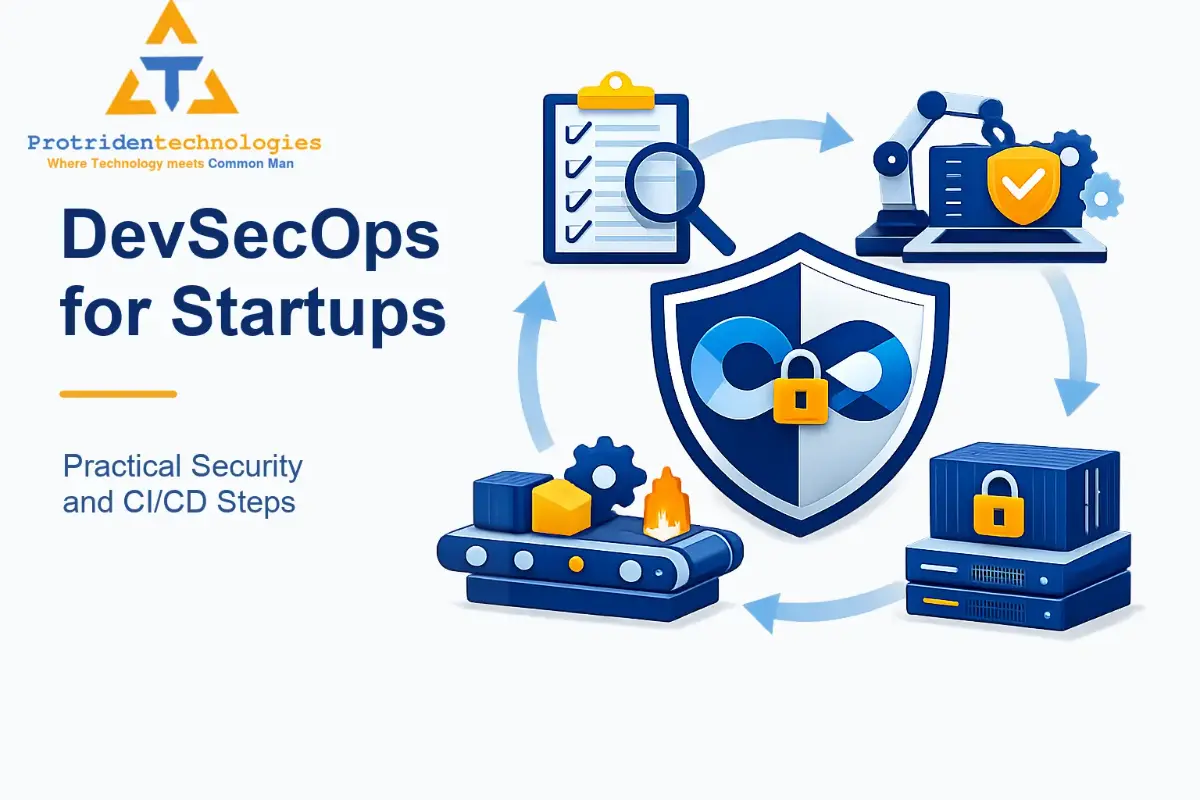
Startups must move fast, but speed without basic security controls increases risk of costly incidents and rework. DevSecOps reframes security as part of the development lifecycle so you can keep delivering while lowering risk.
This article gives a pragmatic, quarter-focused checklist for small engineering teams: how to pick the most effective controls, where to automate first, and what governance you can keep lightweight yet effective. Each section explains practical steps, trade-offs and implementation guidance so you can choose what to adopt this quarter.
1. Define scope, assets and a simple risk model
Before adding tools or gates, decide what you actually need to protect this quarter. For many startups that means prioritizing web and API services, CI/CD credentials, container images, and key third-party dependencies. Limiting scope keeps the work achievable and lets you measure improvement.
Practical first steps: create an inventory of applications and their deployment pipelines, identify sensitive data flows (authentication, payment, PII), and map who can deploy or change production. Use this inventory to classify each app as high, medium or low business impact so you can apply controls proportionally.
Trade-offs and risks: a narrow scope reduces immediate effort but increases the chance of blind spots. Avoid scope so narrow that you miss obvious exposure (for example, a sidecar service or build artifact repository). Revisit the inventory monthly as the product and team evolve.
- Inventory top 5 production services, their deploy paths, and owners.
- Classify each service by business impact and frequency of change.
- Log which repositories and CI pipelines have write access to production.
2. Secure your CI/CD pipeline with focused controls
CI/CD is a high-value target because it touches build artifacts and deployment credentials. Prioritize making CI/CD tamper-resistant and observable: lock down who can modify pipeline definitions, require pipeline runs to be auditable, and enforce least privilege for runner credentials and deploy keys.
Concrete implementation steps: use branch protection and required status checks so only reviewed code is merged to deployment branches; store secrets in the CI system's secret store or a dedicated secrets manager rather than environment files; and give runners minimum permissions (for example, read-only access to artifact storage unless a deploy step needs more).
Trade-offs: stricter CI controls can slow down developers if approvals and gating are heavy. Start with automated gates (tests, basic security scans) and a lightweight peer review policy; iterate to add manual approvals only for high-impact releases. Maintain clear rollout and rollback steps so deployment friction doesn't drive teams to bypass controls.
- Enable branch protection and required pipeline checks on production branches.
- Move secrets to an encrypted secrets manager and rotate deploy credentials regularly.
- Limit CI runners' scope and avoid embedding long-lived credentials in pipeline scripts.
3. Add automated security testing where it yields most value
Automation gives the biggest security uplift for little recurring effort. Focus on three automated checks early: dependency scanning (software composition analysis), static analysis for common coding issues (SAST), and container image scanning. These catch common, high-impact problems that are otherwise easy to miss under rapid iteration.
Practical integration: run dependency scans and SAST during pull requests so developers get fast feedback. Schedule container image scans as part of build pipelines and fail builds only for critical vulnerabilities that you decide are unacceptable. Consider lighter severity rules as warnings so teams can triage without blocking delivery.
Tools and limitations: open-source scanners and lightweight commercial tools can be integrated into GitLab/GitHub/GitHub Actions or other CI systems; a number of community playbooks recommend Trivy for container image scanning as a pragmatic starting point. Be aware that static analysis can produce false positives; tune rules gradually and assign ownership for triage to avoid alert fatigue.
- Run dependency (SCA) and SAST checks on pull requests with fast thresholds.
- Scan built container images before pushing to registries; treat critical CVEs as fails.
- Keep a short feedback loop: prefer failing PR checks only for critical issues and surface medium/low results to a dashboard.
4. Harden containers and runtime posture
Containers concentrate risk in images and orchestration configuration. Start by using minimal, maintained base images, removing build-time tools from runtime images, and ensuring images are reproducible and versioned. Apply image signing or provenance tracking if feasible to verify what actually runs in production.
Runtime controls: enforce resource and capability limits (drop CAP SYS ADMIN, set read-only filesystem where possible), use network policies to restrict inter-service communication, and enable container runtime security features available in your orchestration platform. Regularly scan running workloads for configuration drift or misconfigurations that scanners miss.
Trade-offs and operational impact: tighter runtime policies reduce blast radius but can break poorly designed apps (for example, apps expecting write access to /tmp). Introduce enforcement gradually in staging, with clear rollbacks and a developer runbook for required permissions. If you need help implementing container hardening and CI/CD integration, platform or security specialists can accelerate the hardening while keeping delivery velocity.
- Use minimal base images and remove build-time files from final images.
- Scan images pre-push and enable runtime policies (resource limits, dropped capabilities).
- Test enforcement in staging and provide a developer rollback/runbook for permission exceptions.
5. Lightweight governance, secrets management and team practices
Startup teams succeed with simple, documented processes that scale. Implement lightweight governance by codifying a small set of accepted controls: required pipeline tests, dependency scanning policy, secret handling rules, and a release owner for production deploys. Keep governance to one page per application so it is used rather than ignored.
Secrets management is critical and commonly mishandled. Use a central secrets store with audit logs and short-lived credentials where possible. Avoid committing secrets to repos; add pre-commit hooks or repository scanning to detect accidental leaks. Combine technical controls with clear team norms and incident response steps for leaked secrets.
Monitoring, metrics and continuous improvement: instrument deployments and security checks so you can measure time-to-fix and recurring categories of issues. Regularly review top findings from automated scans and set modest remediation SLAs per severity. The balance of speed versus security is a business decision — monitor metrics so trade-offs are explicit and negotiable with product and leadership.
- Publish one-page security playbooks per app: owners, deploy process, and required checks.
- Use a central secrets manager; scan repos and CI config for accidental secrets.
- Track security check failures and mean time to remediate as simple KPIs.
DevSecOps for startups is about selecting a few high-leverage controls, automating where it reduces human work, and keeping governance lightweight enough that the team will follow it. Start with scope and risk classification, harden your CI/CD pipeline, add automated scanning for dependencies and images, and apply container runtime protections.
Adopt these changes incrementally: prioritize what protects your highest-impact services this quarter, measure results, and iterate. If you need hands-on support to implement secure CI/CD, container hardening or automated security scans, Protriden Technologies provides cloud, application security and CI/CD implementation services tailored to small teams.
How Protriden Technologies Can Help
If you'd like a short scoping call to convert this checklist into an implementation roadmap for your stack, contact Protriden Technologies to schedule a practical next step.
Explore our software development services or discuss your requirements with the Protriden Technologies team.