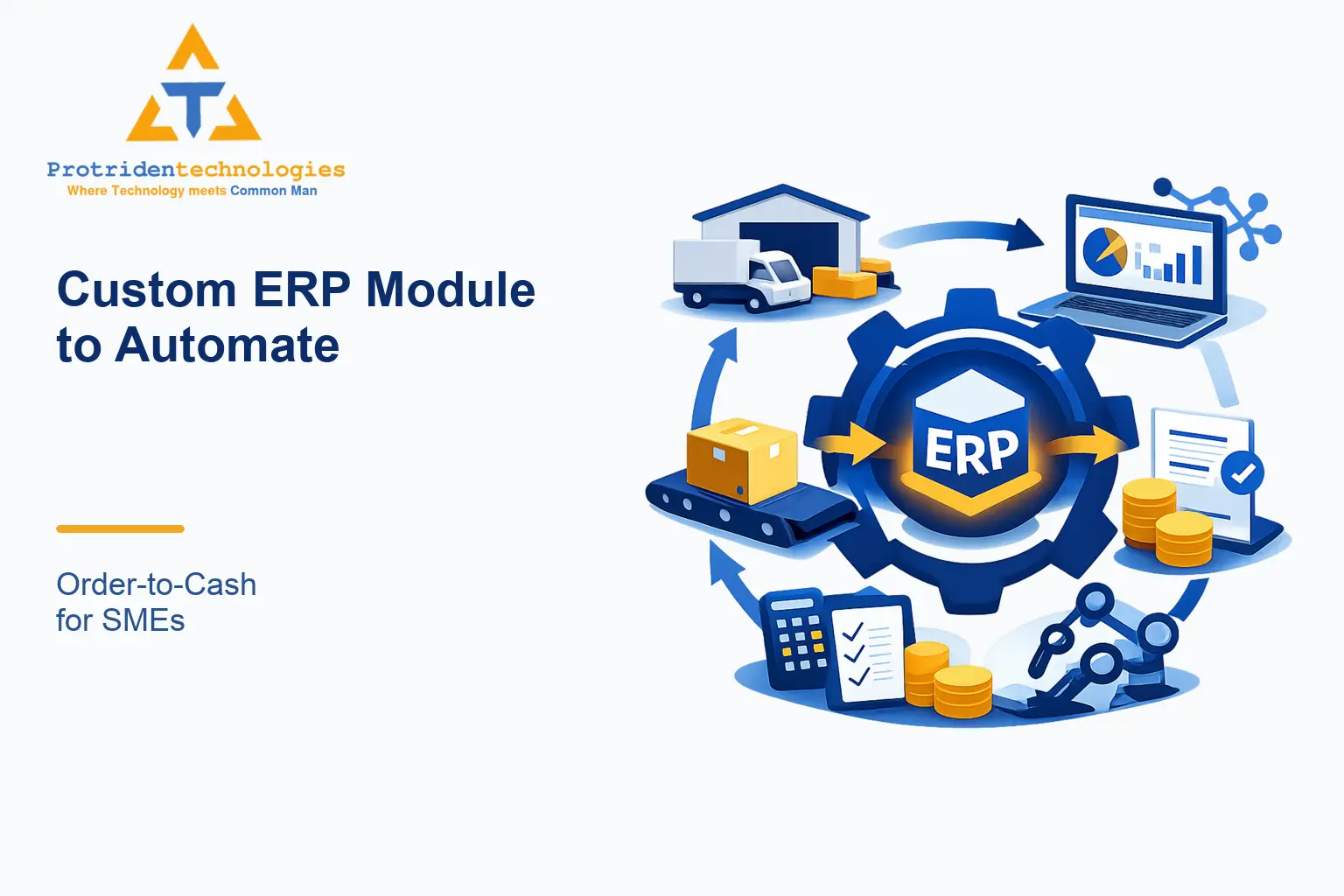
Many SMEs still run order-to-cash on spreadsheets, email threads and isolated systems. This creates frequent billing errors, manual reconciliation work and late invoices that extend days sales outstanding (DSO) and pressure cash flow. Finance heads and operations leaders need a focused, practical automation path that reduces errors and speeds collections without a disruptive full ERP replacement.
A custom ERP module that integrates orders, invoicing, credit checks, payment updates and cash application can close the gaps between CRM, e‑commerce and finance systems, giving teams one reliable source of truth.
SMEs often lack in-house engineering resources or ERP expertise to build this safely; partnering with a technology provider for requirements workshops, phased delivery and integration reduces implementation risk while keeping the solution aligned to business priorities.
Why This Topic Matters
Order-to-cash (O2C) is the commercial heartbeat of most SMEs: it converts sales activity into recognized revenue and banked cash. Manual O2C steps — order entry, pricing checks, invoice generation, dispute handling and cash application — create friction that increases errors and slows collections. Automating these steps with a targeted ERP module reduces manual touchpoints and makes performance visible to finance and commercial teams.
A focused O2C module is easier to scope and deliver than replacing an entire ERP, and it can integrate with existing ERP or CRM systems so you don’t disrupt core accounting or master data. Specialist providers and software patterns for O2C automation show that visibility across billing, cash application and collections, plus automated prioritization of exceptions, materially improves throughput and response times.
- Improves invoice accuracy by removing manual data re-entry and mismatched pricing checks (supports faster billing cycles)
- Makes collections predictable through automated payment updates and prioritized collection tasks
- Reduces time spent searching across disconnected systems by centralizing order, invoice and payment status
- Enables better dispute resolution workflows and faster exception handling, lowering reconciliation load and write-offs
Research references: Order-to-Cash Software | Esker Order to Cash Automation; Understanding Order-to-Cash Automation Process in ERP; CRM to ERP Integration for Order-to-Cash Automation (O2C).
Common Mistakes Businesses Make
Teams often underestimate the operational complexity of O2C: billing rules, product pricing exceptions, credit limits, taxes and third-party payment notifications are all routine sources of surprises. Building an incomplete module or skipping integration points leaves teams with new shadow processes.
Another common error is trying to automate everything at once. Big-bang implementations that attempt full workflow automation without a pilot or staged deliveries create user resistance and integration errors that slow adoption.
- Automating only invoice generation without integrating cash application or payment notifications
- Failing to map and automate exception paths (returns, deductions, disputes) before go-live
- Not validating source-of-truth data so the module writes back inconsistent records to the ERP
- Skipping a pilot phase or phased rollout that would validate assumptions with real transactions
Practical Checklist / Steps
Use this checklist to translate the problem into an executable scope that a development partner can estimate. The steps are ordered to reduce risk: start with discovery, then deliver the smallest useful slice and iterate based on measured benefits.
- Define business outcomes and KPIs: Agree measurable goals (invoice cycle time, reduction in manual reconciliations, target DSO improvement as a direction) and which systems define authoritative records (ERP, CRM or e‑commerce). Tie outcomes to a short list of must-have capabilities.
- Map the current order-to-cash workflow: Document each step from order capture through payment posting. Include exceptions, who owns them, where data is rekeyed and which documents trigger downstream actions.
- Identify integration touchpoints: List the systems to integrate (ERP finance module, CRM, payment gateway, bank statement feed) and the data elements required (order IDs, invoice numbers, payment references, tax codes). Note any proprietary or legacy systems.
- Scope the minimum viable module: Choose the smallest set of features that delivers value: e.g., automated invoice generation + electronic delivery + payment status update + cash application for a subset of customers, or credit checks + automated holds for new orders.
- Select data validation and exception rules: Define validation checks (pricing, tax, shipping address) and the exception workflow: who is notified, allowable auto-resolutions and when to escalate to a human.
- Plan phased delivery and pilot: Deliver the MVP for a low-risk customer segment or product line, run a parallel pilot with real transactions, measure outcomes and iterate before wider rollout.
- Define governance and fallbacks: Agree roles, permissions and rollback paths if integrations fail. Ensure audit trails for invoice creation, edits and automated postings to satisfy accounting and compliance needs.
- Prepare change management and training: Create short role-based playbooks and run hands-on workshops for finance and sales users during the pilot to build trust and capture feedback.
Cost, Timeline, or Decision Factors
Cost and timeline for a custom O2C module depend on scope, integration complexity, data quality and compliance requirements. Integrating with a cloud-native ERP or modern payment gateway is generally faster than connecting to older, heavily customized ERP installations. The need to support multiple tax regimes or complex credit rules increases effort.
Selecting an external partner is often driven by available in-house engineering capacity, time-to-value expectations and the need for ERP integration experience. Ask potential vendors about prior integrations, how they mitigate data quality risk and their approach to phased delivery.
- Scope breadth: invoicing only vs full O2C (credit checks, collections, cash application)
- Number and complexity of integrations: CRM, ERP, payment gateways, bank feeds and third-party tax engines
- Data readiness: clean master data (customers, products, tax codes) reduces development time
- Compliance and audit needs: additional logging, approvals and retention policies add effort
- Change management: training and pilot iterations lengthen calendar time but reduce go-live risk
Local Relevance: India, Karnataka, and Udupi
In India, SMEs must factor in GST compliance, common payment methods (bank transfers, UPI, NEFT/IMPS) and diverse customer invoicing expectations. A custom O2C module should support electronic invoicing flows and be able to capture payment references used in local reconciliation practices. Local partners familiar with Indian tax and banking notifications shorten implementation time.
Protriden Technologies is based in Kundapura, Udupi, Karnataka, giving local SMEs the advantage of on-the-ground support and easier coordination for workshops, pilots and training.
- Design invoices and e-delivery to comply with Indian GST requirements and preferred formats used by customers
- Integrate payment status updates from common Indian channels (bank statements, UPI receipts) and allow manual reconciliation for mismatched references
- Plan for phased rollout by geography or product line to manage GST, state-level considerations and customer onboarding in Karnataka and nearby regions
How Protriden Technologies Can Help
Protriden Technologies builds custom ERP modules and integrations tailored to SME needs. We combine requirements workshops, phased development and post-launch support so teams can automate order-to-cash without replacing their existing ERP. Our services include API integrations, billing and inventory automation, admin panels and ongoing maintenance aligned to business KPIs.
Working from Kundapura, Udupi, our team can run remote or on-site workshops to capture workflow details, map integrations and deliver a pilot MVP. We offer cloud deployment, CI/CD, application security and post-launch monitoring so the solution scales reliably as transaction volumes grow.
- Requirements workshops to define O2C scope and KPIs
- Custom development for invoicing, collections workflows and cash application
- API integrations with ERP, CRM, payment gateways and bank feeds
- Phased delivery with pilot testing, user onboarding and support
- Cloud deployment, monitoring and routine maintenance
Final Thoughts
A targeted custom ERP module for order-to-cash is a high-impact, manageable automation project for SMEs that want immediate improvements in invoice accuracy and cash flow predictability. Prioritise clarity on outcomes, a narrow initial scope and proven integration approaches to reduce risk. Working with a local technology partner that understands your ERP and Indian payment environment shortens time to value and helps embed the solution into everyday operations.
FAQs
When should an SME choose a custom O2C module instead of buying a packaged O2C product?
Choose custom when your ERP, pricing rules, product catalogue or compliance needs are unique and off-the-shelf products can’t integrate without heavy customization. A custom module is also appropriate when you prefer incremental delivery tightly aligned to internal KPIs.
How long does it usually take to deliver a usable O2C MVP?
Delivery time varies by scope and integrations. Simpler scopes (automated invoice generation plus electronic delivery and basic payment updates) can be prototyped in a few weeks, while end-to-end O2C with complex integrations and exceptions will take longer. Use a phased pilot to measure results quickly and guide subsequent releases.
Can a custom module integrate with legacy ERPs?
Yes, but integration complexity depends on the ERP’s customization level and available APIs or data export mechanisms. Legacy systems often require adapters or scheduled synchronization which adds integration effort compared with modern ERP platforms with documented APIs.
Will automating O2C eliminate the need for finance staff?
Automation reduces repetitive work and errors but does not remove the need for skilled finance staff. Instead, teams shift from manual reconciliation toward exception handling, customer disputes and improving cash collection strategies.
What are the biggest risks during an O2C automation project and how are they mitigated?
Major risks are poor data quality, incomplete exception handling, and insufficient user buy-in. Mitigate by running discovery workshops, implementing strong data validation rules, piloting with a limited customer segment, and providing role-based training and fallbacks for early operations.
Request a project estimate and requirements workshop from Protriden to explore a phased order-to-cash automation plan tailored to your SME — no obligation.
Explore our software development services or discuss your requirements with the Protriden Technologies team.