
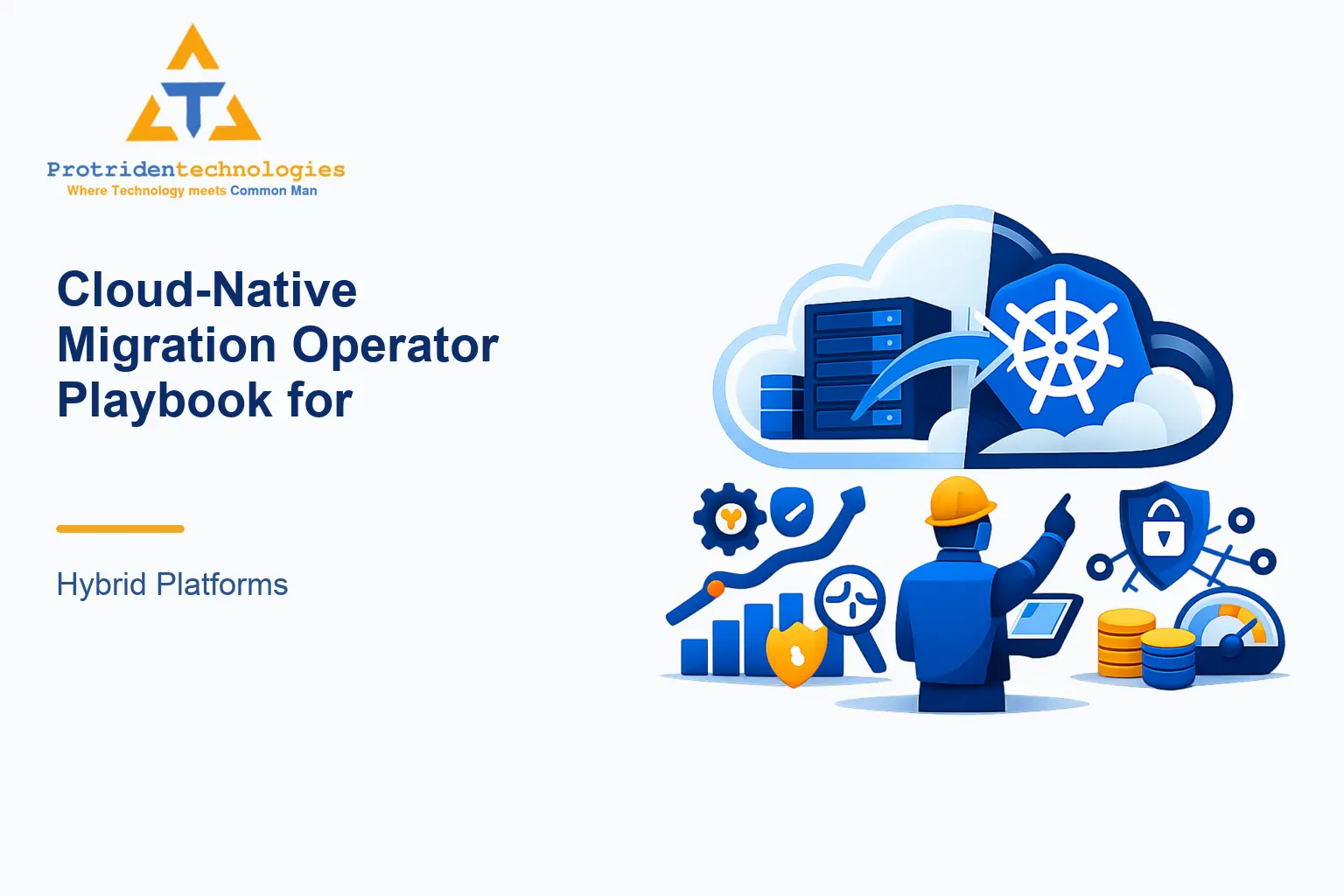
Platform teams tasked with moving applications from on-prem or monolithic stacks to hybrid cloud-native environments face three tightly coupled challenges: stability of production services, observable execution for operators, and cost control during and after migration. An operator-led migration model centers the runbook and automation around the team that will run the platform day-to-day, reducing handoffs and improving repeatability.
This playbook synthesizes practical, decision-focused guidance for teams designing an operator engagement: what to decide during planning, how to sequence a phased migration into an operator-run pipeline, how to embed observability and security through operators and controllers, and how to enforce FinOps guardrails to prevent surprise costs. The recommendations are informed by cloud-native operator patterns, migration guidance from platform vendors, and FinOps best practices.
Why an Operator-Led Hybrid Migration?
The operator pattern — encapsulating lifecycle logic in controllers that run inside Kubernetes — is a strong fit for hybrid migrations where repeatability and automation matter. Operators let teams codify complex tasks (backups, cutovers, config drift remediation) and trigger them reliably. For hybrid estates that combine on-premise systems and cloud services, a migration operator can surface the procedural knowledge operators need and reduce manual coordination across teams.
Choosing an operator-led approach changes the migration decision model. Instead of aiming for a single “big bang” cutover, the operator enables phased automation: repeated, auditable runs of migration steps with consistent prechecks, checkpoints and rollback gates. This reduces cognitive load on operators and shortens each migration window, at the cost of needing extra investment in operator development and test automation up front.
Decide to use operators when you need repeatability, ownership transfer to a platform team, or frequent migrations across similar workloads (for example, multiple database clusters or application families). If you have one-off, highly heterogeneous systems, the overhead of building and testing an operator may not be justified — in those cases a script-driven or vendor migration tool could be acceptable for a limited scope.
- Use operators when multiple, repeatable migrations or ongoing lifecycle tasks are expected.
- Expect higher upfront engineering effort for long-term reduction in manual intervention.
- Prefer operator codification where rollback, validation and observability gates are required.
Planning and Inventory: What the Operator Must Deliver
A migration starts with inventory and classification. An operator playbook requires a deterministic inventory format that maps each workload to metadata the operator will use: dependencies (databases, messaging), topology (stateful vs stateless), tolerance for downtime, compliance requirements, and cost-sensitivity. Use automated discovery tools where possible and validate with application owners.
From that inventory build a destination map for each workload: fully containerized on Kubernetes, containerized with external state, lift-and-shift to cloud VMs, or retained on-prem with network integration. The operator must be able to act on those destination choices: for example, orchestrate database replication, create target namespaces and secrets, manage ingress and service exposure, and update traffic routing.
Concretely, the planning deliverables for an operator engagement should include: a canonical inventory (CSV or API), migration classifications with acceptance criteria, security and compliance controls required per class, and FinOps categories (expected cost bucket and alert thresholds). These artifacts become inputs to operator policies and runbooks. Aligning stakeholders on these inputs up-front prevents scope creep during execution.
- Produce a canonical workload inventory and classification sheet as operator inputs.
- Define acceptance criteria for each workload class: latency, RPO/RTO, throughput.
- Capture FinOps categories to translate resource decisions into cost policies for the operator.
Phased Execution: Operator Runbooks for Kubernetes and On-Prem
Design the migration as a series of repeatable phases the operator will orchestrate: pre-migration validation, staged data replication, traffic cutover, post-cutover validation, and cleanup. Each phase should be codified as an idempotent operator action with explicit preconditions and observable success signals. This lets teams run a dry-run in non-production and re-execute phases safely if checks fail.
For Kubernetes-targeted workloads, the operator runbook typically handles: creating target namespaces and RBAC, injecting sidecars or agents for observability, deploying manifests or Helm charts, syncing configuration and secrets securely, and coordinating service mesh or ingress rules to manage traffic shifts. Vendor and open-source operators (for example, monitoring or database operators) can be used to manage specific lifecycle tasks rather than reinventing them.
On-prem migrations often require bridging components (VPNs, peering, ingress gateways) and handling stateful data differently. The operator should orchestrate safe data replication (logical replication for databases or file sync tooling), validate data integrity, and plan a cutover window with fallbacks. Operators can also manage routing changes by updating load balancer and DNS objects or by coordinating with service mesh routing rules to shift traffic gradually.
Practical steps for implementation: implement the operator to expose a migration custom resource (CR) per workload; include prechecks (schema compatibility, available capacity, network latency tests); create canary cutover patterns (shift low-volume traffic first); and ensure the operator emits structured events and metrics to your observability stack so operators can make informed go/no-go decisions.
- Codify migrations as idempotent operator phases with preconditions and rollback gates.
- Use vendor operators for specific services (databases, monitoring) to reduce custom work.
- Implement canary traffic shifts and measurable success criteria for each phase.
Observability, Security and FinOps Guardrails
Observability and security must be embedded in the operator workflow. Operators should ensure that monitoring agents or exporters are injected automatically during deployment or that metrics endpoints are exposed with clear labels. Monitoring operators (or the platform operator) can enforce consistent telemetry so runbook steps are visible in dashboards and alerts. This approach follows the operator pattern used by many monitoring solutions to automate deep instrumentation on container platforms.
Security controls belong to the operator too: automated secret rotation, policy enforcement (e.g., admission controllers or OPA Gatekeeper policies), and least-privilege RBAC generation for migrated workloads. Embedding these controls in the migration operator reduces the risk of insecure drift after cutover and helps satisfy compliance gates during the migration lifecycle.
FinOps guardrails reduce the chance of cost surprises. The operator can enforce resource request/limit templates, automatically tag resources with cost-center metadata, and incorporate prechecks that compare projected costs against thresholds. Cloud financial management guidance emphasizes governance during migrations — treat cost checks as first-class preconditions to prevent runaway sizing choices in the excitement of a successful migration.
Implementation guidance: integrate operator events with your logging and metrics stack, design standardized templates for security and resource sizing that the operator applies, and add a budget-check precondition that prevents provisioning if projected monthly spend would breach an agreed threshold. Log every provisioning decision with the associated cost estimate to support post-migration FinOps reviews.
- Automate telemetry injection and ensure migration steps emit structured events and metrics.
- Embed security policies and RBAC generation into operator actions to maintain compliance.
- Enforce cost prechecks and tagging to align migrations with FinOps governance.
Risks, Trade-offs and Post-Migration Stabilization
Every operator-based migration involves trade-offs. The primary trade-off is upfront engineering and testing time to build a robust operator versus the long-term reduction in manual toil. Another trade-off is complexity: operators can centralize logic but also introduce a new control plane component that itself requires testing, observability and disaster recovery planning.
Operational risks include the operator making irreversible changes if prechecks are incomplete, or causing cascading failures if rollback paths are not well-tested. Mitigate these risks by investing in staging environments that mirror production, running dry-runs on non-critical workloads, and building clear, manual abort paths that operators can invoke. Keep the operator’s authority limited by design — for example, require human approval for final cutover when migrating high-risk workloads.
Plan for post-migration stabilization explicitly. The operator should orchestrate an observation period where performance and error metrics are compared to baselines. Prepare a remediation toolkit (scaling policies, circuit breakers, database tuning steps) the operator can execute automatically or with operator approval. Capture lessons from each migration run to refine prechecks and automation in subsequent runs.
Finally, accept the limitations: not all legacy workloads are suitable for immediate containerization or full cloud-native refactor. For such cases, hybrid patterns (leave state on-prem, run stateless front-ends in cloud, or use managed cloud services for specific capabilities) are valid choices. The operator playbook should catalog these tolerated exceptions and include policies for revisiting them in later phases.
- Mitigate operator risk with rigorous staging, dry-runs, and manual approval gates for high-risk steps.
- Limit operator authority and provide human abort paths for critical cutovers.
- Use a structured stabilization window and lessons-learned backlog to iterate on the playbook.
An operator-led playbook converts migration knowledge into repeatable automation that platform teams can operate safely across hybrid estates. It shifts effort from one-off scripting and firefighting to disciplined engineering: inventory, policy-driven operator actions, observable runbooks and FinOps guardrails.
Adopting this approach requires upfront investment in operator design, testing and observability, but it yields faster, safer migrations at scale and hands ownership of lifecycle tasks to the platform team. If your organization anticipates multiple migrations, strict compliance needs or wants consistent FinOps control during movement to hybrid architectures, an operator engagement is a pragmatic path forward.
How Protriden Technologies Can Help
If your platform team needs a practical operator migration runbook, phased PoC or FinOps integration, contact Protriden Technologies for a scoped migration engagement and technical guidance.
Explore our software development services or discuss your requirements with the Protriden Technologies team.
Sources
- From Legacy to Cloud-Native: A Step-by-Step Enterprise Migration Playbook | HackerNoon
- Public to Private Cloud Migration: An Operator’s Playbook
- Migrations With Atlas and CloudNativePG | CloudNativePG - PostgreSQL Operator for Kubernetes
- Empowering operators on their cloud migration journey | Microsoft Azure Blog