Cloud and DevOps Guide: AIOps, FinOps, GitOps, Platform Engineering and Secure CI/CD
Cloud and DevOps are no longer only about servers, deployments and automation scripts.For modern software teams, especially B2B SaaS companies, DevOps vendors, enterprise IT consultants, security teams and cloud engineering teams, Cloud and DevOps now cover a much larger responsibility.
The new DevOps question is not only:
“How do we deploy faster?”
The better question is:
“How do we deploy faster, safer, cheaper and with better operational control?”
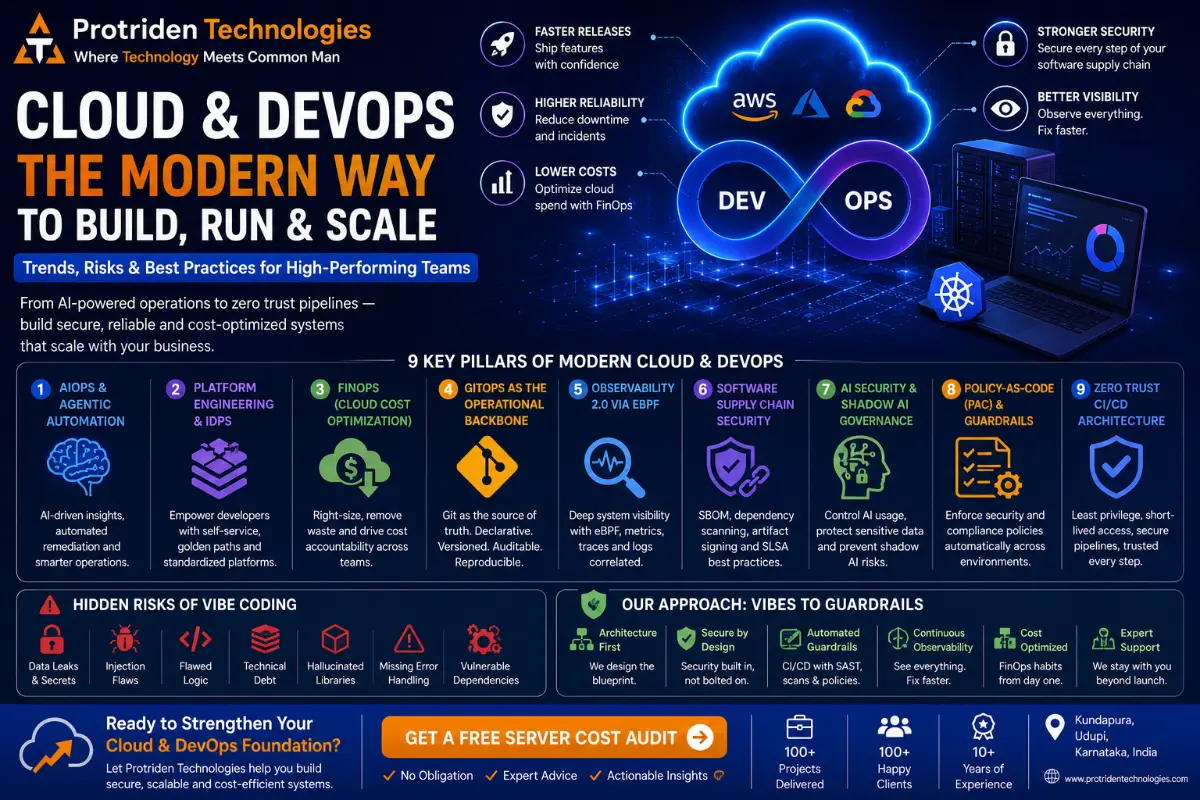
This is why modern DevOps is moving toward AIOps, agentic automation, platform engineering, internal developer platforms, FinOps, GitOps, eBPF-based observability, software supply chain security, AI governance, Policy-as-Code and Zero Trust CI/CD. These are not just buzzwords. They solve real operational problems:
- Rising cloud bills
- Slow deployments
- Manual release processes
- Too many tools
- Poor developer experience
- Weak visibility into production
- Security gaps in CI/CD pipelines
- Uncontrolled AI tool usage
- Vulnerable dependencies
- Lack of cost accountability
- Poor policy enforcement
- Downtime and incident pressure
For startups and SaaS companies, these issues can directly affect growth, customer trust and operating cost.
For enterprise IT teams, they affect compliance, security and delivery speed.
For developers, they affect productivity and confidence.
This blog explains the modern Cloud and DevOps practices that engineering teams should understand and how Protriden Technologies helps businesses build reliable, secure and cost-aware cloud systems.
Why Cloud and DevOps Matter More Than Ever
A growing software product needs more than code.
It needs a stable cloud foundation.
It needs automated deployment.
It needs monitoring.
It needs cost control.
It needs secure pipelines.
It needs backup and recovery.
It needs access control.
It needs predictable release processes.
It needs visibility when something breaks.
Without proper Cloud and DevOps planning, teams may face:
- Frequent downtime
- Slow release cycles
- High cloud bills
- Manual deployment errors
- Security misconfigurations
- Unclear ownership
- Poor incident response
- Uncontrolled infrastructure changes
- Vulnerable software supply chain
- Developer frustration
For early-stage startups, these issues may look small in the beginning. But as traffic, users, features, environments and team size grow, weak DevOps becomes a serious bottleneck. Good DevOps is not only about tools. It is about building a system where development, operations, security and business cost work together.
1. AIOps and Agentic Automation
AIOps means using AI and automation to improve IT operations. In simple terms, AIOps helps teams make better sense of logs, metrics, traces, alerts, incidents and system behavior. Traditional monitoring tells you what happened.
AIOps tries to help answer:
What is abnormal?
What caused the issue?
Which service is affected?
Which alert matters most?
Can this be remediated automatically?
Can we prevent this from happening again?
Agentic automation takes this further.
Instead of only alerting humans, AI agents may help with investigation, runbook execution, ticket enrichment, log analysis, root cause suggestions and self-healing workflows.
For example:
A service starts failing.
The system detects unusual error rates.
It checks recent deployments.
It compares logs and traces.
It identifies a database timeout.
It opens an incident ticket.
It suggests rollback or scaling.
In some cases, it can trigger approved remediation.
This can reduce response time. But there is also a risk. Automation without guardrails can make the wrong change faster.That is why AIOps should not replace human ownership. It should support engineers with better context, faster diagnosis and controlled remediation.
Practical AIOps use cases
AIOps can help with:
- Alert noise reduction
- Incident correlation
- Root cause analysis
- Capacity forecasting
- Anomaly detection
- Auto-remediation suggestions
- Deployment impact analysis
- Cloud cost anomaly detection
- Security event prioritization
- Operational reporting
For SaaS companies, AIOps is useful when systems become too complex for manual monitoring alone. But it should be implemented carefully with approvals, rollback plans, audit logs and clear limits.
2. Platform Engineering and Internal Developer Platforms
Platform engineering is one of the most important changes in modern DevOps. Earlier, developers often had to understand too many things before shipping software:
- Cloud accounts
- Kubernetes
- CI/CD files
- Secrets
- Monitoring
- Environments
- Ingress
- Networking
- Security policies
- Deployment commands
- Logs
- Build systems
This slows down delivery. Platform engineering solves this by creating an internal developer platform, also called an IDP.An internal developer platform gives developers self-service access to approved workflows. Instead of asking the DevOps team for every deployment, developers can use standardized templates and workflows.
For example, an IDP can provide:
- Create a new service
- Deploy to staging
- Deploy to production
- View logs
- Check build status
- Request database access
- Create infrastructure through approved templates
- Manage environment variables safely
- View service ownership
- Trigger rollback
- Access monitoring dashboard
The goal is not to hide everything from developers. The goal is to make the right path easy and the risky path difficult.
Why platform engineering matters
A good platform helps:
- Improve developer productivity
- Reduce repeated DevOps requests
- Standardize deployments
- Reduce configuration mistakes
- Improve security guardrails
- Speed up onboarding
- Improve visibility
- Reduce tool sprawl
- Improve release confidence
For engineering managers, platform engineering reduces chaos.
For developers, it improves experience.
For security teams, it creates stronger control.
For business leaders, it improves delivery speed without sacrificing governance.
3. FinOps: Cloud Cost Optimization
Cloud cost is one of the biggest problems for startups and SaaS teams. Many teams move fast in the beginning. They create servers, databases, storage buckets, logs, backups, Kubernetes clusters and third-party tools. At first, the cost looks manageable. Later, the monthly bill starts increasing.
Common cloud cost problems include:
- Oversized servers
- Idle resources
- Unused volumes
- Uncontrolled logging costs
- Overprovisioned databases
- No tagging
- No budget alerts
- Expensive data transfer
- Too many environments
- Poor scaling policies
- No ownership by team or product
FinOps solves this by bringing financial accountability into cloud operations. It connects engineering, finance, product and business teams. The goal is not simply to reduce cost. The goal is to improve cloud value. That means spending on the right infrastructure and removing waste.
FinOps practices for SaaS companies
A practical FinOps approach includes:
- Cloud cost tagging
- Team-wise cost allocation
- Budget alerts
- Idle resource cleanup
- Right-sizing servers
- Storage lifecycle policies
- Log retention control
- Reserved or committed usage planning
- Cost anomaly detection
- Monthly cloud cost review
- Cost visibility dashboards
- Cost-aware architecture decisions
For startups, FinOps should start early. If cost control is added too late, the cloud environment may already be messy. At Protriden Technologies, cloud cost optimization can include reviewing hosting architecture, oversized resources, logging and storage usage, backup strategy, caching, deployment patterns and monitoring setup.
4. GitOps as the Operational Backbone
GitOps means using Git as the source of truth for infrastructure and application deployment configuration. In traditional deployments, engineers may manually update servers or run commands. This creates risk because production state may not match what is documented. GitOps solves this by keeping the desired system state in Git. Then software agents continuously compare the actual system state with the desired state and reconcile differences.
In simple words:
Git stores what should run.
The cluster shows what is running.
GitOps tools make sure both match.
Why GitOps matters
GitOps helps teams improve:
- Change tracking
- Rollback
- Auditability
- Deployment consistency
- Environment control
- Security review
- Infrastructure visibility
- Disaster recovery
- Team collaboration
For Kubernetes environments, GitOps is very useful. It helps prevent manual changes that are not reviewed. It also makes deployments more predictable.
Practical GitOps examples
A GitOps workflow may include:
Developer opens a pull request.
Code review happens.
Security checks run.
Deployment configuration is updated.
GitOps controller detects the change.
Staging environment updates.
Tests pass.
Production deployment is approved.
Production state is reconciled.
If something breaks, rollback is done through Git.
This gives teams a cleaner operational backbone.
For Protriden Technologies, GitOps fits well with cloud, Kubernetes, CI/CD and deployment automation work.
5. Observability 2.0 Through eBPF
Traditional monitoring focuses on metrics, logs and traces. These are still important.
But modern systems are more complex:
- Kubernetes clusters
- Microservices
- Service meshes
- Containers
- Serverless systems
- Multiple cloud providers
- AI workloads
- API gateways
- Distributed databases
In these environments, teams need deeper visibility. This is where eBPF becomes important, eBPF allows safe, efficient observability from inside the Linux kernel without changing application code in many cases. This can help teams observe network traffic, system calls, process behavior, container activity and runtime events.
Why eBPF matters for modern DevOps
eBPF-based observability can help with:
- Network visibility
- Runtime security
- Packet-level troubleshooting
- Container behavior monitoring
- Service dependency mapping
- Performance debugging
- Policy enforcement
- Threat detection
- Low-level system insight
This does not replace OpenTelemetry. Instead, it complements it. OpenTelemetry helps collect telemetry from applications and services. eBPF can provide deep system-level visibility. Together, they support stronger observability.
Practical example
Imagine a microservice is slow.
Application logs show timeouts.
Metrics show increased latency.
Traces show dependency delay.
eBPF-level visibility may help identify whether the problem is network, DNS, kernel-level packet drops, process behavior or runtime issue.
This type of visibility is valuable for DevOps and security teams.
6. Software Supply Chain Security
Modern applications depend on many components:
- Open-source packages
- Container images
- CI/CD tools
- Build scripts
- Third-party APIs
- Infrastructure modules
- Helm charts
- Docker base images
- Internal libraries
- AI-generated code
- Deployment templates
Each component can introduce risk. Software supply chain security focuses on protecting the full path from code to production.
Common risks include:
- Vulnerable dependencies
- Malicious packages
- Unsigned artifacts
- Untrusted container images
- Compromised CI/CD pipelines
- Exposed secrets
- Unreviewed infrastructure code
- Weak build provenance
- No SBOM
- No dependency scanning
- No image scanning
- No deployment approval
For DevSecOps teams, supply chain security is now a core responsibility. It is not enough to secure the application after deployment. Security must start in the development and build pipeline.
Practical supply chain controls
A secure pipeline should include:
- Dependency scanning
- Container image scanning
- Secret scanning
- SBOM generation
- Artifact signing
- Provenance tracking
- SLSA-aligned build practices
- Approved package registries
- Base image control
- CI/CD access control
- Code review
- Branch protection
- Deployment approvals
- Vulnerability management
For SaaS companies, this reduces the risk of shipping compromised code or vulnerable dependencies.
7. AI Security and Shadow AI Governance
AI tools are now entering software development and operations. Developers use AI coding tools. DevOps teams use AI for log analysis. Support teams use AI chatbots. Business teams use AI automation. But this creates a new risk: Shadow AI. Shadow AI happens when teams use AI tools without proper approval, visibility or governance.
This may expose:
- Source code
- API keys
- Customer data
- Internal documentation
- Infrastructure details
- Production logs
- Security configurations
- Business-sensitive data
AI security is now part of DevOps and cloud governance. It is no longer only a data science problem.
What AI governance should cover
A practical AI governance approach should define:
Which AI tools are allowed
What data can be shared
What data cannot be shared
How AI-generated code should be reviewed
How prompts and outputs are handled
How sensitive logs are protected
How AI agents are monitored
How access is controlled
Who approves AI automation
What audit trail is required
For engineering leaders, the goal should not be to block AI completely.
The goal should be safe AI usage with clear rules.
8. Policy-as-Code and Guardrails
Policy-as-Code means writing rules as code so they can be tested, reviewed, versioned and enforced automatically. Instead of relying only on manual checks, teams can enforce guardrails in CI/CD and cloud environments.
Examples of policies:
- No public S3 bucket
- No deployment without image scan
- No hardcoded secrets
- No container running as root
- No production deployment without approval
- No infrastructure without tags
- No database exposed to public internet
- No unapproved container registry
- No high-severity vulnerability in production image
- No privileged Kubernetes pod without exception
Policy-as-Code makes governance practical. It turns rules into automated checks.
Where Policy-as-Code can be used
Policy can be enforced in:
- CI/CD pipelines
- Kubernetes admission control
- Terraform checks
- CloudFormation checks
- API gateways
- Microservices
- Container security
- Infrastructure provisioning
- Deployment approval workflows
For security engineers, Policy-as-Code creates consistency.For developers, it provides immediate feedback. For management, it reduces policy violations.
9. Zero Trust CI/CD Architecture
CI/CD pipelines are powerful. They can build, test, package and deploy software. That also makes them high-value targets. If a CI/CD pipeline is compromised, attackers may gain access to code, secrets, environments, containers, infrastructure and production deployments. Zero Trust CI/CD means no pipeline, user, runner, token or workload is trusted automatically. Every access should be verified, limited and logged.
Zero Trust CI/CD principles
A strong Zero Trust CI/CD approach includes:
- Least privilege access
- Short-lived credentials
- No long-lived static secrets
- OIDC-based cloud access where possible
- Environment separation
- Branch protection
- Signed commits or verified changes
- Manual approval for sensitive deployments
- Artifact signing
- Provenance tracking
- Secret scanning
- Runner isolation
- Audit logging
- Policy checks
- Network restrictions
- Deployment rollback plan
The goal is to reduce blast radius. If one component is compromised, it should not compromise everything. This is especially important for SaaS products and enterprise workloads.
10. How These Practices Work Together
These practices should not be treated as separate trends. They work best together. A mature Cloud and DevOps system may look like this: Platform engineering gives developers a self-service path. GitOps manages environment state. CI/CD automates build, test and deployment. Policy-as-Code enforces rules. SLSA and SBOM improve supply chain security. Zero Trust protects pipeline access. OpenTelemetry and eBPF improve observability. AIOps helps detect and diagnose incidents. FinOps keeps cost under control. AI governance prevents uncontrolled Shadow AI risk. Together, they create a cloud operating model that is faster, safer and more cost-aware.
Cloud and DevOps Checklist for SaaS and Enterprise Teams
Use this checklist to evaluate your current setup.
Deployment Checklist
Do you have CI/CD pipelines?
Do you have separate staging and production environments?
Can you rollback safely?
Are deployments repeatable?
Are secrets protected?
Are releases approved where needed?
GitOps Checklist
Is infrastructure configuration stored in Git?
Are changes reviewed through pull requests?
Can you trace who changed what?
Can you recreate environments from Git?
Are manual production changes restricted?
Platform Engineering Checklist
Do developers have self-service deployment workflows?
Is onboarding easy?
Are common templates available?
Are environments standardized?
Are approved tools clearly documented?
FinOps Checklist
Do you know monthly cloud cost by service?
Do you know cost by environment?
Are resources tagged?
Are budgets and alerts configured?
Are idle resources removed?
Are logs and backups controlled?
Observability Checklist
Do you collect logs, metrics and traces?
Do you know service dependencies?
Can you detect performance issues?
Can you identify root cause quickly?
Do you monitor infrastructure and application health?
Security Checklist
Do you scan dependencies?
Do you scan container images?
Do you scan secrets?
Do you sign artifacts?
Do you enforce branch protection?
Do you restrict production access?
Do you have Policy-as-Code guardrails?
Do you review AI-generated code?
Common Cloud and DevOps Mistakes
Mistake 1: Treating DevOps as Only Deployment
DevOps is not only about pushing code to production.
It includes reliability, automation, monitoring, security, cost and operational discipline.
Mistake 2: No Cloud Cost Ownership
If no team owns cost, cloud bills grow silently.
FinOps brings accountability and visibility.
Mistake 3: Manual Production Changes
Manual changes create drift.
GitOps helps keep production predictable.
Mistake 4: No Observability
If you cannot see what is happening, you cannot fix problems quickly.
Logs alone are not enough for complex systems.
Mistake 5: Weak CI/CD Security
CI/CD systems often have access to secrets, code and production.
They must be protected like critical infrastructure.
Mistake 6: Too Much Tool Sprawl
More tools do not always mean better DevOps.
A platform approach can reduce confusion.
Mistake 7: Ignoring AI Governance
If teams use AI tools without rules, sensitive code, logs or credentials may be exposed.
AI needs governance.
How Protriden Technologies Helps With Cloud and DevOps
Protriden Technologies helps startups, SaaS companies, software teams and growing businesses build practical cloud and DevOps systems. The focus is not only on setting up servers. The focus is on making deployment, monitoring, cost, security and maintenance easier to manage.
Protriden Technologies can help with:
- Cloud infrastructure setup
- Server configuration
- Docker and Kubernetes deployment
- Jenkins and CI/CD pipelines
- Git-based deployment workflows
- Monitoring and alerting
- Cloud cost review
- Server cost optimization
- Backup planning
- Security hardening
- Deployment automation
- Application performance optimization
- Infrastructure troubleshooting
- Post-launch maintenance and support
For startups, Protriden can help set up a reliable cloud foundation before scaling. For SaaS companies, Protriden can help improve deployment flow, monitoring and cost control. For teams with existing systems, Protriden can review cloud architecture, identify performance issues, reduce unnecessary server cost and improve DevOps workflows. For businesses using AI or automation in engineering, Protriden can help plan safer deployment and governance practices.
Practical Example: From Manual Deployment to Managed DevOps
Imagine a SaaS product team.
The application is deployed manually.
Developers SSH into the server.
There is no staging environment.
There is no rollback process.
Logs are hard to read.
Cloud cost keeps increasing.
Production issues are discovered by customers.
Secrets are stored in configuration files.
In this case, the team may need:
CI/CD pipeline
Docker-based deployment
Staging and production environments
Git-based change control
Secret management
Monitoring and alerts
Backup strategy
Server cost review
Security hardening
Rollback process
Cloud architecture improvement
This is not only a technical upgrade.
It is an operational upgrade.
It helps the team release with more confidence and less downtime.
Final Thoughts
Cloud and DevOps are now central to software success. Modern teams need more than hosting and deployment. They need AIOps, platform engineering, FinOps, GitOps, observability, supply chain security, AI governance, Policy-as-Code and Zero Trust CI/CD. But the goal is not to add complexity. The goal is to create a reliable operating system for software delivery. For startups, this means launching with a foundation that can grow. For SaaS companies, it means improving release speed, uptime and cost control. For enterprise teams, it means stronger governance and security. For developers, it means less manual work and more confidence. If your cloud infrastructure is becoming expensive, your deployments are manual, your monitoring is weak, or your DevOps setup needs improvement, Protriden Technologies can help you review and strengthen your system.
FAQs
1. What is Cloud and DevOps?
Cloud and DevOps refers to the practices, tools and processes used to build, deploy, monitor, secure and operate applications on cloud infrastructure. It includes CI/CD, automation, monitoring, security, cost optimization and infrastructure management.
2. What is AIOps in DevOps?
AIOps uses AI, machine learning and automation to improve IT operations. It can help with anomaly detection, alert reduction, root cause analysis, incident response and operational insights.
3. What is platform engineering?
Platform engineering focuses on building internal developer platforms that give developers self-service workflows for deployment, logs, environments, infrastructure and operational tasks.
4. What is FinOps?
FinOps is a cloud cost management and accountability practice where engineering, finance, product and business teams work together to improve cloud value and control spend.
5. What is GitOps?
GitOps uses Git as the source of truth for infrastructure and deployment configuration. Software agents continuously reconcile the actual system state with the desired state stored in Git.
6. Why is eBPF important for observability?
eBPF provides deep system-level visibility from the Linux kernel. It can help with network monitoring, runtime security, performance debugging and service-level visibility without always requiring application code changes.
7. What is software supply chain security?
Software supply chain security protects the full path from source code to production. It includes dependency scanning, container scanning, SBOM, artifact signing, provenance tracking, secret scanning and CI/CD security.
8. What is Shadow AI governance?
Shadow AI governance means creating rules and visibility around the use of AI tools so teams do not accidentally expose source code, secrets, logs, customer data or infrastructure details.
9. What is Policy-as-Code?
Policy-as-Code means writing security, compliance and operational rules as code so they can be automatically tested and enforced in CI/CD, Kubernetes, cloud infrastructure and deployment workflows.
10. What is Zero Trust CI/CD?
Zero Trust CI/CD means protecting pipelines using least privilege, short-lived credentials, isolated runners, artifact signing, approval workflows, secret scanning, audit logs and policy checks.
11. Can Protriden Technologies help with cloud cost optimization?
Yes. Protriden Technologies helps startups and businesses review hosting architecture, server usage, logging, backups, caching, deployment patterns and monitoring setup to identify unnecessary cloud/server costs.
12. Can Protriden Technologies set up CI/CD and Kubernetes deployment?
Yes. Protriden Technologies supports Docker, Kubernetes, Jenkins, CI/CD pipeline setup, deployment automation, cloud monitoring, server configuration and ongoing maintenance.
Need a Stronger Cloud and DevOps Setup?
If your deployments are manual, cloud cost is increasing, monitoring is weak, or your CI/CD pipeline needs better security, it may be time to review your Cloud and DevOps setup. At Protriden Technologies, we help startups, SaaS companies and growing businesses build reliable cloud infrastructure, automated deployments and secure DevOps workflows.
We can help with:
- Cloud infrastructure setup
- Docker and Kubernetes deployment
- Jenkins and CI/CD pipelines
- GitOps workflows
- Server cost optimization
- Monitoring and alerting
- Security hardening
- Backup planning
- Performance improvement
- Post-launch maintenance
Book a free server cost and DevOps review with Protriden Technologies.