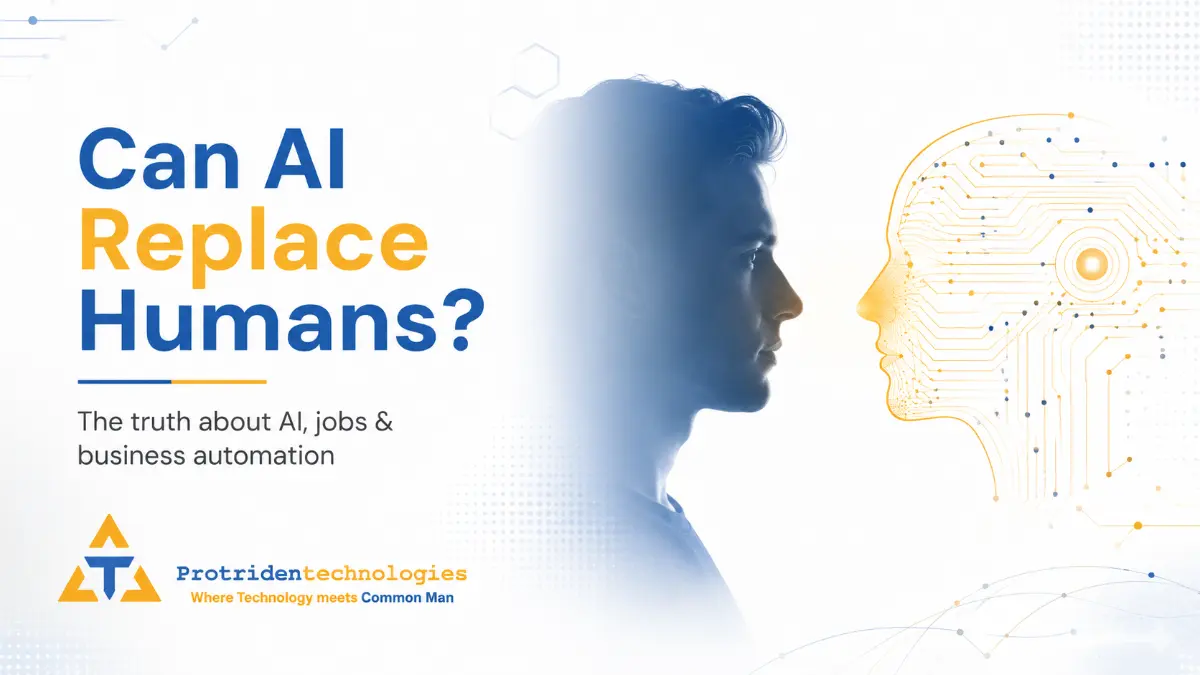
Your next employee may never ask for leave.
It may work throughout the night, analyse thousands of records in seconds, answer customers instantly and prepare reports before your morning meeting.
It may also confidently give you the wrong answer.
That employee is artificial intelligence.
AI can already write emails, create images, generate software code, analyse customer data, answer questions and automate repetitive business tasks.
This naturally creates fear.
Will AI replace employees?
Will developers, designers, marketers, accountants and customer-support teams become unnecessary?
Can artificial intelligence eventually replace human intelligence itself?
The honest answer is more interesting than a simple yes or no.
AI will replace some tasks. It will change many jobs. It may even reduce the need for certain repetitive roles.
But replacing human intelligence completely is a very different challenge.
AI is powerful because it can process information quickly. Humans are valuable because they understand meaning, emotion, responsibility, relationships and consequences.
The future may not be humans competing against AI.
It may belong to people and businesses that learn how to work with AI.
What Exactly Is Artificial Intelligence?
Artificial intelligence refers to computer systems designed to perform tasks that normally require human-like abilities.
These tasks can include:
- Understanding written or spoken language
- Recognising patterns
- Analysing large amounts of data
- Predicting possible outcomes
- Generating text, images, audio or software code
- Answering questions
- Recommending actions
- Automating routine decisions
Modern AI systems are trained using large amounts of data. They identify patterns in that data and use those patterns to generate outputs or predictions.
This is why AI can write an email, summarise a document or suggest a piece of code in seconds.
But generating an intelligent-looking answer is not the same as understanding the real-world situation behind it.
AI may recognise patterns in thousands of customer conversations.
A human employee may understand why one disappointed customer needs patience, reassurance and a personal response.
That difference matters.
Can AI Actually Think Like a Human?
AI can imitate parts of human communication and problem-solving remarkably well.
However, it does not think, feel or experience the world the same way a person does.
An AI system does not have:
- Personal experience
- Human emotions
- Moral responsibility
- Self-awareness
- Real relationships
- Cultural lived experience
- A personal understanding of consequences
AI can generate a compassionate message.
But it does not feel compassion.
AI can suggest a business strategy.
But it does not carry responsibility if that strategy damages the business.
AI can provide possible answers.
But someone still needs to decide whether those answers are correct, appropriate and safe.
The reference article from Calls9 also presents AI as a system that can perform certain tasks quickly while still requiring human creativity, judgment and oversight.
What Can AI Replace?
The better question may be:
Which tasks can AI replace?
AI is strongest when work is repetitive, structured, predictable and based on large amounts of information.
1. Repetitive administrative work
Many employees spend hours completing tasks that require time but little decision-making.
Examples include:
- Copying information between systems
- Sorting documents
- Preparing standard reports
- Updating spreadsheets
- Classifying customer enquiries
- Scheduling appointments
- Sending routine reminders
- Processing standard forms
AI and automation can handle many of these activities faster and more consistently.
This does not always mean removing the employee.
It can mean removing the most frustrating part of the employee’s job.
2. Basic customer-support requests
Customers often ask the same questions:
- Where is my order?
- What are your business hours?
- How do I reset my password?
- What is the status of my booking?
- Which service should I select?
An AI assistant can answer such questions instantly and operate outside normal working hours.
However, consider a customer who has been charged incorrectly, experienced repeated service failure or is emotionally upset.
That conversation requires more than information.
It requires listening, empathy, authority and judgment.
AI can handle the common question.
A human should handle the important relationship.
3. First-level data analysis
Businesses collect large amounts of information but often fail to use it.
AI can help identify:
- Sales trends
- Unusual transactions
- Customer behaviour patterns
- Inventory movement
- Frequently reported issues
- Marketing performance
- Potential leads
- Operational bottlenecks
This can help managers make faster decisions.
However, data does not always explain the full story.
Sales may be falling because of pricing, poor service, seasonality, new competition or changes in customer behaviour.
AI can highlight the pattern.
A business leader must understand the reason.
4. Content preparation
AI can assist with:
- Blog outlines
- Email drafts
- Social media ideas
- Product descriptions
- Meeting summaries
- Presentation structures
- Frequently asked questions
- Advertisement variations
This can save time, especially during the first stage of content creation.
But publishing AI-generated content without human review can create serious problems.
The content may be:
- Factually incorrect
- Repetitive
- Too generic
- Inconsistent with the brand
- Inappropriate for the audience
- Similar to existing content
- Missing important business context
AI can create a first draft.
Humans must create trust.
5. Routine software-development support
AI tools can help developers:
- Suggest code
- Explain errors
- Prepare documentation
- Generate basic tests
- Identify possible bugs
- Create reusable components
- Speed up research
This can make experienced developers more productive.
But building reliable software requires much more than producing code.
A professional development team must understand:
- The business problem
- User behaviour
- Security requirements
- Application architecture
- Performance needs
- Data privacy
- System integrations
- Scalability
- Testing
- Deployment
- Long-term maintenance
AI may generate code that looks correct.
A developer must confirm whether it is secure, efficient and appropriate for the product.
What Can AI Not Fully Replace?
Human judgment
Real business decisions are rarely black and white.
A manager may need to balance profit, customer trust, employee wellbeing, legal risk and long-term reputation.
AI can provide information and possible scenarios.
It cannot take genuine responsibility for the final decision.
Empathy
A chatbot can detect emotional words and respond politely.
But it does not truly understand disappointment, fear, trust, grief or motivation.
Human connection remains essential in areas such as:
- Healthcare
- Education
- Leadership
- Negotiation
- Counselling
- Customer recovery
- Team management
- Relationship-based selling
People do not always want the fastest response.
Sometimes they want to feel heard.
Creativity with purpose
AI can generate hundreds of ideas quickly.
But meaningful creativity is not only about producing something new.
It is about understanding:
- Why the idea matters
- Who it is for
- Which emotion it should create
- What cultural context surrounds it
- Whether it fits the brand
- Whether it solves the real problem
AI can assist a designer, writer or product strategist.
The human still decides what is worth creating.
Ethical responsibility
Suppose an AI system rejects a loan application, flags an employee, recommends a medical action or blocks a customer account.
Who is responsible when the system makes a mistake?
The software cannot apologise, accept legal responsibility or understand the personal consequences of its decision.
Businesses must maintain human accountability, especially when AI affects people’s rights, finances, health, employment or privacy.
Leadership
Leadership involves more than analysing performance data.
A strong leader builds trust, handles conflict, communicates direction, understands people and takes responsibility during uncertainty.
AI may support a leader with reports and recommendations.
It cannot become the source of genuine human trust.
Understanding unusual situations
AI works best when a situation resembles patterns it has already seen.
Real life is often messy.
Information may be incomplete. Customers may behave unexpectedly. Market conditions may change. Two similar situations may require completely different decisions.
Humans are often better at adapting when there is no clear rulebook.
Will AI Replace Jobs?
Some jobs will disappear.
Some new jobs will be created.
Most jobs will change.
That is what normally happens when businesses adopt major technologies.
Calculators changed accounting.
Computers changed office work.
The internet changed retail, communication and marketing.
Mobile applications changed transport, banking, food delivery and customer service.
AI is likely to create another major shift.
But it is more accurate to say that AI will automate parts of jobs before it replaces entire professions.
Consider these examples:
- AI prepares a report, but the manager explains what action to take.
- AI drafts a campaign, but the marketer shapes the message.
- AI suggests code, but the developer designs and secures the system.
- AI identifies a lead, but the salesperson builds the relationship.
- AI answers basic questions, but the support agent resolves difficult cases.
- AI creates a design direction, but the designer understands the customer.
The role changes because low-value tasks are reduced.
The human contribution becomes more focused on judgment, communication and problem-solving.
A More Important Risk: Humans Who Use AI
The biggest career risk may not be that AI replaces every person.
It may be that a person using AI becomes faster and more capable than someone performing the same work without it.
A developer using AI responsibly may complete routine work faster.
A marketer using AI may analyse more campaign variations.
A business owner using automation may receive reports instantly instead of waiting for manual updates.
An employee who understands AI may spend less time preparing information and more time making decisions.
This does not mean everyone should use AI blindly.
It means people should learn:
- What AI does well
- Where it makes mistakes
- How to verify its output
- How to protect confidential information
- When human review is essential
- How to apply it to a real business problem
The valuable skill is not simply using an AI tool.
It is knowing when to trust it—and when not to.
Human vs AI: Who Does What Better?
AI is better atHumans are better atProcessing large datasetsUnderstanding contextRepeating tasks consistentlyHandling unusual situationsFinding patterns quicklyExercising judgmentOperating continuouslyBuilding relationshipsGenerating multiple variationsCreating meaning and directionFollowing defined rulesMaking ethical decisionsProducing first draftsUnderstanding emotionAutomating routine workflowsTaking responsibility
The strongest result often comes from combining both sides.
Let AI handle volume.
Let humans handle value.
Should Businesses Use AI to Reduce Employees?
Businesses should be careful with this approach.
Replacing people may appear to offer immediate savings, but poorly planned automation can create:
- Lower service quality
- Frustrated customers
- Incorrect decisions
- Data-security risks
- Loss of internal knowledge
- Reduced employee trust
- Overdependence on third-party platforms
- Expensive corrections later
A better starting point is:
Do not ask which employee can be removed. Ask which unnecessary task can be removed.
An employee who spends three hours preparing the same report every week may not need to be replaced.
The reporting process needs to be improved.
A support team answering the same basic question hundreds of times may not need to be removed.
The repetitive enquiries need automation, while the team focuses on complex customer needs.
The purpose of technology should be to improve the system—not automatically eliminate the people within it.
Where AI Creates Real Business Value
AI is most useful when connected to a clearly defined business problem.
Customer enquiry management
AI can classify enquiries, answer common questions, capture contact information and assign leads to the correct team.
Sales support
AI can summarise conversations, identify potential leads, prepare follow-up drafts and organise customer information.
Inventory management
AI-assisted systems can identify unusual stock movement, predict possible shortages and notify decision-makers.
Reports and dashboards
AI can help convert business data into summaries, alerts and actionable insights.
Document processing
Businesses can use AI to extract and organise information from invoices, forms, applications or internal documents.
Internal knowledge assistance
An AI assistant can help employees find information from approved company documents, policies and process guides.
Workflow automation
AI can work with ERP systems, CRM platforms, mobile apps, admin panels and custom software to reduce repetitive operations.
The important point is that AI alone may not solve the problem.
It often needs to be integrated into the company’s existing software, data and workflows.
Five Questions to Ask Before Introducing AI
1. What exact problem are we solving?
“Everyone is using AI” is not a business problem.
A useful problem sounds like:
- Our team spends ten hours every week preparing reports.
- Customers wait too long for basic answers.
- Leads are not followed up consistently.
- Important documents are difficult to search.
- Staff repeatedly enter the same data into multiple systems.
Clear problems lead to useful solutions.
2. Is AI really necessary?
Some problems can be solved with simple automation.
For example, a fixed reminder, approval flow or invoice status update may not need advanced AI.
Using AI where a straightforward rule-based system would work can create unnecessary cost and complexity.
The right solution may be:
- Workflow automation
- An ERP system
- A dashboard
- A mobile application
- An admin panel
- A CRM
- A chatbot
- An AI-assisted custom platform
Technology should fit the problem.
3. What data will the AI access?
Businesses must understand:
- What information is being shared
- Where it is stored
- Who can access it
- Whether customer data is involved
- Whether confidential documents are protected
- Whether third-party tools retain the information
Sensitive business data should not be entered casually into public AI tools.
4. Who will review the output?
Human review should remain part of high-impact processes.
Businesses should clearly define:
- Who checks the AI output
- Who approves important actions
- How errors are reported
- When a case should move to a human
- Who remains responsible for the decision
Automation without accountability creates risk.
5. How will success be measured?
A business should not judge an AI project by how impressive it looks.
It should measure practical results such as:
- Time saved
- Reduction in errors
- Faster response time
- Better customer experience
- More organised information
- Improved lead follow-up
- Reduced repetitive workload
- Better reporting visibility
A useful AI system should create measurable operational value.
How Small Businesses Can Start Using AI
Small businesses do not need to automate everything at once.
Start with one repetitive problem.
Step 1: Observe
Identify work that happens repeatedly every day or every week.
Step 2: Calculate
Estimate how much employee time the process consumes and how often errors occur.
Step 3: Prioritise
Choose a process that is repetitive, measurable and relatively low-risk.
Step 4: Test
Create a small pilot instead of changing the entire organisation immediately.
Step 5: Review
Ask employees and customers whether the new process is actually better.
Step 6: Improve
Use real feedback to correct and expand the system.
A small, useful automation is more valuable than a large AI project that nobody trusts.
How Protriden Technologies Can Help
AI becomes valuable when it works with the real operations of a business.
Protriden Technologies helps startups, SMEs and business owners plan and build practical digital systems, including:
- AI-assisted workflows
- Custom software
- ERP solutions
- Admin panels and dashboards
- Mobile and web applications
- Customer-enquiry automation
- Business reporting systems
- CRM and workflow integrations
- Cloud infrastructure
- Secure API integrations
- Business process automation
The objective is not to force AI into every project.
The objective is to understand the business problem and recommend the right combination of people, software and automation.
Sometimes the right answer is AI.
Sometimes it is a simple dashboard.
Sometimes it is an ERP system that finally replaces scattered spreadsheets.
Good technology does not begin with a trend.
It begins with a real problem.
So, Can AI Replace Humans?
AI can replace tasks.
It can transform jobs.
It can make some roles smaller and create completely new ones.
But AI cannot fully replace human judgment, empathy, responsibility, creativity, leadership and real-world understanding.
The future will not simply be controlled by machines.
It will be shaped by the decisions humans make about those machines.
Businesses that use AI only to reduce costs may miss its greatest value.
Businesses that use AI to remove repetitive work, improve decisions and help employees perform better may build a stronger advantage.
The question is no longer:
“Can AI replace humans?”
The better question is:
“What could humans achieve if AI handled the work that should never have consumed their time?”
Frequently Asked Questions
Can artificial intelligence completely replace human intelligence?
No. AI can perform specific tasks quickly, but it does not possess the complete emotional, ethical, social and contextual intelligence humans use in real-life decisions.
Will AI replace employees?
AI may reduce the need for some repetitive roles, but most professions are more likely to change than disappear completely. Employees may increasingly focus on judgment, creativity, communication and problem-solving.
Which jobs are most at risk from AI?
Jobs containing highly repetitive, predictable and rule-based tasks are more exposed to automation. However, even these roles may evolve rather than disappear entirely.
Can AI replace software developers?
AI can support coding, testing, debugging and documentation. It cannot independently replace the full role of a professional developer who understands requirements, architecture, security, performance and product responsibility.
Can AI replace customer-support teams?
AI can handle common enquiries and collect basic information. Human support remains essential for complaints, emotional situations, unusual cases and relationship management.
Is AI suitable for small businesses?
Yes, when there is a clear use case. Small businesses can begin with enquiry handling, reporting, document processing, lead organisation or repetitive workflow automation.
Is automation the same as artificial intelligence?
No. Traditional automation follows predefined rules. AI can interpret information, detect patterns, generate content or make predictions. Many business systems combine both.
Can AI-generated information be wrong?
Yes. AI can produce incomplete, misleading or incorrect information. Important outputs should be verified by a knowledgeable person.
How can businesses use AI safely?
Businesses should protect confidential data, control access, maintain human review, test outputs, monitor performance and clearly assign responsibility for important decisions.
Where should a business begin with AI?
Begin with one repetitive and measurable business problem. Test a small solution before investing in large-scale implementation.
Do not begin by replacing people. Begin by removing repetitive work.
Protriden Technologies can help you identify where AI, automation, custom software or an ERP system could improve your operations.
Request a free business automation roadmap and discover what your business should automate first.