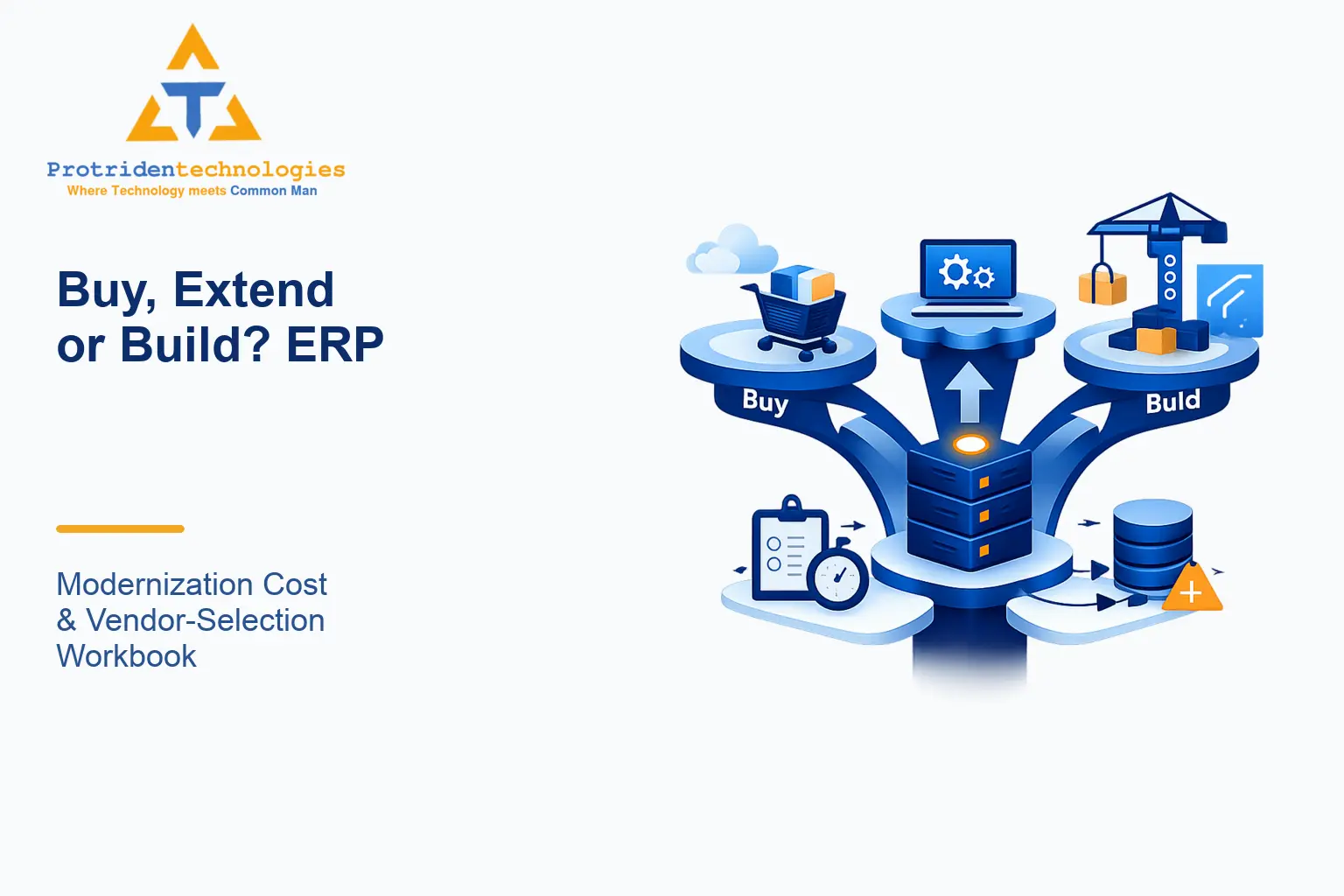
Growing companies face a hard decision when their legacy ERP hinders agility: buy a commercial platform, extend an off‑the‑shelf ERP, or build custom modules in-house. CFOs and CTOs need a clear cost-and-risk framework to compare total cost of ownership, migration effort and business continuity impact before committing scarce budget and engineering time.
This article provides a practical decision framework plus India‑specific cost buckets and a sample phased SOW to help mid‑market firms evaluate buy, extend or build choices for ERP modernization.
Use the workbook that accompanies this guide to estimate 3‑year costs, map non‑negotiable workflows, and score vendors against technical debt and extension capacity.
The guidance reflects common vendor-selection tradeoffs and buy‑then‑extend patterns that frequently suit enterprise ERP decisions.
Why This Topic Matters
ERP modernization is a strategic choice, not just a procurement exercise. It affects working capital, order-to-cash velocity, fulfillment accuracy and the ability to introduce new business models. Selecting the wrong path can lock an organization into higher long‑term maintenance costs, force process compromises, or create technical debt that becomes costly to unwind. Framing the decision around business outcomes and measurable cost buckets—rather than vendor proposals alone—reduces bias and keeps the focus on ROI and operational risk.
Buy, extend and build each map to different organizational strengths and constraints. Off‑the‑shelf platforms reduce time‑to‑value and transfer some operational risk to vendors, but they can impose process fit compromises. Building custom modules gives maximal control but requires sustained engineering capacity and governance. Buying and extending a platform combines both approaches and is often overlooked despite offering a middle path that balances pace, customization and vendor support.
- Modern ERP decisions shape finance, supply chain and compliance for years; plan with a 3-year TCO lens.
- Evaluate business‑critical workflows first: where the ERP must be unique, custom work may be justified.
- Consider vendor extension models early: many platforms are designed to be extended safely without deep core changes.
- Make migration and data quality costs first‑class inputs in vendor comparisons.
Research references: Build vs. Buy Software: A Decision Guide for ERP Software; Build vs Buy Software: Pros and Cons, Costs, and How to Decide (2026); ERP Systems: A Comprehensive Cost Breakdown and Analysis | Houseblend.
Common Mistakes Businesses Make
Teams commonly prioritize initial license or build estimates and underweight long‑tail costs like integration, data migration and ongoing customization. That creates surprises post‑go‑live when minor feature requests compound into large maintenance efforts. Another frequent error is treating the ERP as a one‑time project instead of a multi‑year product that needs roadmapping, API governance and support SLAs.
A third mistake is ignoring the buy‑then‑extend option. Procurement teams often see 'buy' as configuration only and 'build' as full custom development, missing opportunities to combine a stable core platform with targeted custom extensions that preserve vendor support.
- Comparing only upfront license or development quotes and ignoring 3‑year support, integration and upgrade costs.
- Assuming internal engineering capacity to build implies lower long‑term cost without validating maintenance runway.
- Failing to map non‑negotiable workflows, which forces expensive post‑implementation changes or workarounds.
- Overlooking extension frameworks or partner ecosystems that reduce custom development risk.
Practical Checklist / Steps
Use this checklist as a practical scoring and costing workflow. It organizes vendor selection, technical debt assessment and a phased build SOW so you can quantify tradeoffs between buy, extend and build. Apply each step to produce inputs for a 3‑year TCO worksheet.
- Map business-critical workflows: Document the 8–12 processes that directly affect revenue, margins or regulatory compliance. For each workflow, record current pain points, expected volume, and whether process uniqueness is a competitive differentiator. Label workflows as 'standardizable' or 'unique' to guide whether to buy or build.
- Run a legacy ERP technical‑debt audit: Assess data quality, custom code, undocumented integrations, and key single points of failure. Capture estimated hours to stabilize each issue and the business impact of downtime. This audit converts vague technical risk into actionable cost items for migration and for setting contingency budgets.
- Estimate 3‑year cost buckets: For each option—buy, extend, build—create line items for initial implementation, data migration, integrations, training, first‑year hypercare, ongoing support, upgrades, and contingency for change requests. Use conservative assumptions for scope creep and incremental license seats.
- Evaluate platform extension models: Request vendor documentation on APIs, extension SDKs, upgrade compatibility and partner marketplaces. Score vendors on how safely they support custom extensions without blocking core upgrades or invalidating warranties.
- Score vendors on non‑functional requirements: Include performance, security, regional compliance, backup and disaster recovery. Use weighted scoring to reflect the organization’s priorities and translate scores into vendor shortlist decisions.
- Draft a phased SOW for a hybrid approach: If buy‑then‑extend is viable, define Phase 1 as core platform deployment for standard processes, Phase 2 for data and integrations, and Phase 3 for custom extensions. Each phase should have acceptance criteria, rollback plans, and a change‑control process.
- Plan governance and support: Define long‑term product ownership, release cadence, and who manages third‑party integrations. Commit to a periodic technical debt review and an annual budget for extension and upgrades.
- Run a pilot and validate assumptions: Pilot critical workflows with a subset of users or a single region before full rollout. Use pilot results to recalibrate cost and timeline estimates, and to uncover migration data issues early.
Cost, Timeline, or Decision Factors
Key decision factors fall into cost, timeline, risk and strategic fit. Costs include initial implementation vs ongoing subscription or maintenance. Timeline considerations include how quickly the business needs capability improvements and the window available for migration and training. Risk factors include data migration complexity, single‑vendor lock‑in and the team’s ability to maintain custom code. Strategic fit evaluates whether the ERP is differentiating IP or commodity infrastructure for the business.
Because exact costs and timelines vary by scope, translate qualitative risks into contingency hours and budget line items. Compare options using a simple scorecard that weights business impact, expected TCO, and migration risk to produce an overall recommendation.
- Cost drivers: number of users, integration points, data cleansing needs, custom reports and regulatory compliance work.
- Timeline drivers: pilot duration, data readiness, stakeholder availability for testing and user training windows.
- Risk drivers: volume and variety of legacy data, undocumented integrations, and the vendor’s upgrade policy for customizations.
- Strategic drivers: whether ERP capabilities are core to customer value proposition or are enabling infrastructure.
Local Relevance: India, Karnataka, and Udupi
India’s mid‑market has a wide spectrum of ERP adoption and cloud readiness. Local considerations include multi‑GST compliance, regional language requirements for operations, and the maturity of local implementation partners. For companies based in Karnataka—particularly Udupi and Kundapura—access to regional development talent and cloud infrastructure makes phased modernization practical without relocating teams.
Procuring an international ERP may require local partner enablement for support and localization. Local teams should include compliance checks for state‑specific tax and labor rules, and ensure training materials and support processes are available in the operational languages used by shop floor and finance teams.
- Include GST reconciliation and e‑invoicing in migration scope and test these end‑to‑end during pilots.
- Budget for regional language support and shop‑floor interfaces if operations in Karnataka have non‑English users.
- Leverage nearby talent pools in Udupi and Kundapura for phased extension work and post‑go‑live support.
How Protriden Technologies Can Help
Protriden Technologies provides ERP modernization services from requirements and technical‑debt audits through phased custom development and cloud deployment. Our local presence in Kundapura, Udupi and Karnataka positions us to work with regional teams on localization, integration and post‑launch support. We combine implementation, API development and CI/CD deployment expertise to reduce runbooks and handoffs.
If you already have a legacy ERP, a diagnostic audit converts architectural issues into prioritized, budgeted remediation tasks suitable for procurement or engineering decisions. The cost workbook that accompanies this guide helps quantify tradeoffs between buy, extend and build so CFOs and CTOs can select an option aligned with business priorities.
- Technical‑debt audit for legacy ERP: data health, custom code inventory, and integration mapping.
- Phased SOW templates for buy‑then‑extend projects with acceptance criteria and rollback plans.
- Cloud deployment, monitoring and performance tuning on AWS and DigitalOcean.
- Ongoing maintenance, CI/CD pipelines and application security to reduce long‑term upkeep.
Final Thoughts
ERP modernization is a multi‑year decision that should be treated as product management for core operations rather than a one‑off IT project. Use a structured workbook to convert assumptions into numbers, score vendors against real non‑functional needs, and pilot before large‑scale rollouts. Buy‑then‑extend frequently unlocks the best tradeoff between speed and flexibility, but only when extension models and upgrade compatibility are validated early.
Make governance, backlog funding, and periodic technical debt reviews part of the plan so that the ERP remains an enabler of growth rather than a maintenance burden.
FAQs
How do I know if ERP is strategic enough to build custom?
Map your non‑negotiable workflows and estimate their impact on revenue, margins or regulatory compliance. If a workflow delivers unique competitive advantage and cannot be supported by vendor extension without heavy compromise, custom development may be justified. Use a 3‑year TCO comparison that includes ongoing maintenance before deciding.
What is buy‑then‑extend and when is it recommended?
Buy‑then‑extend means deploying a commercial ERP for standard processes while building bespoke extensions for unique needs. It is recommended when a platform covers most core functionality, when the vendor supports safe extension mechanisms, and when you want faster time‑to‑value with controlled customization risk.
How should I budget for data migration and cleanup?
Treat migration as a separate workstream with dedicated budget and timeline. Include data discovery, cleansing, transformation rules, reconciliation testing and pilot migration in estimates. Plan contingency for unexpected data quality issues and ensure rollback and validation steps are defined for cutover.
Can a small company realistically build and maintain a custom ERP?
Smaller firms can build targeted modules if they limit scope to essential differentiators and commit to ongoing maintenance. However, they must account for product management, security, backups and release management. For many, buying a platform and extending it selectively is a lower‑risk route.
What local compliance items should India‑based teams check during selection?
Ensure the chosen approach supports GST reconciliation, e‑invoicing where applicable, state‑level tax differences, and payroll rules. Verify that localization and reporting needs for Karnataka or other operational states can be met by the vendor or by planned extensions.
Download the ERP decision workbook and request a technical‑debt audit from Protriden to get a 3‑year cost comparison and a phased SOW tailored to your operations.
Explore our software development services or discuss your requirements with the Protriden Technologies team.