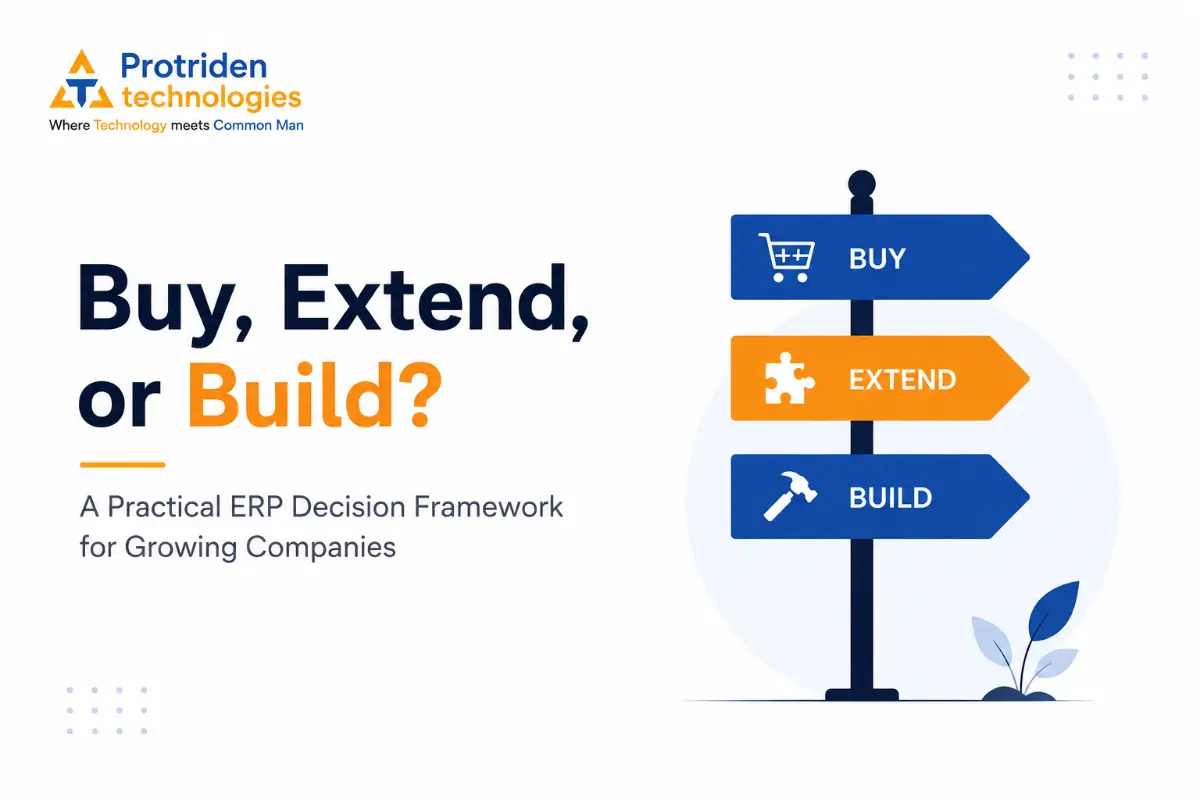
Growing companies face a recurring strategic question: should you buy an off-the-shelf ERP, extend a SaaS platform, or build a custom system? The right choice determines speed to value, operational control, long-term cost, and the degree of technical responsibility you accept.
This article presents a practical decision framework you can apply today. It draws on common build-vs-buy evaluation principles—focusing on outcomes, total cost over a multi-year horizon, operational fit, team capability, and governance—and translates them into concrete steps, trade-offs and implementation guidance for product and executive teams.
1. Start with outcomes: what strategic problem must ERP solve?
The first decision driver is not technology but outcomes. Define the business processes that must improve, the KPIs you expect to change, and the time window for results. Treat ERP as an operating system: some capabilities are commodity plumbing, while others are differentiators tied to your strategy or product.
Map your value chain at a granular level. Instead of asking whether you need an ERP broadly, list specific process flows—order-to-cash, procurement approvals, shop-floor scheduling, inventory replenishment—and identify which are core to your market differentiation. This approach helps you separate commodity needs that off-the-shelf products handle from specialized workflows that may justify custom work.
Practical steps: convene a cross-functional workshop (finance, operations, product, IT), produce a short outcomes statement for each process, and tag each as commodity, contextual or strategic. Use that tagging to guide whether you should buy a standard module, extend a vendor platform, or build a custom component.
2. Compare total cost and time-to-value, transparently
A realistic total cost assessment must include more than license or development fees. For both buy and build alternatives count implementation and migration, integrations, data cleansing, user training, ongoing maintenance, hosting and monitoring, and the opportunity cost of engineering time. Treat these as lifecycle costs rather than one-off line items.
Time-to-value is often the decisive factor for growing companies. Off-the-shelf SaaS ERPs generally deliver baseline functionality faster and with lower initial capital outlay, while custom builds take longer before they deliver measurable business benefits. Where speed matters, the buy-or-extend routes usually dominate.
Practical steps: create a multi-year cost model that captures recurring vendor fees, internal staff time, third-party integrators, and expected maintenance. Run two scenarios—best case and conservative case—for each option. Present both expected ROI and break-even timing to the business stakeholders so the board can weigh near-term needs against long-term upside.
3. Assess operational fit and the extend vs. replace decision
Fit is about how well a candidate system supports your daily processes without risky workarounds. Vendors often provide strong core capabilities but expect configuration rather than custom logic. If gaps are limited to a few areas, extending a vendor platform via APIs or custom modules keeps you on a supported path while preserving time-to-value.
A hybrid approach—buy the core and build only targeted extensions—reduces upfront risk, but ownership must be clear. Extensions create an operational dependency on both the vendor and your internal or contracted engineering team: upgrades, compatibility and testing become shared responsibilities.
Practical steps: document the functional gaps discovered in your outcome mapping, classify each gap by impact, and estimate effort to close it via configuration, extension, or replacement. Prioritize extensions that are encapsulated, use published APIs, and have clear upgrade paths to reduce technical debt.
4. Test build readiness and governance costs
If the analysis leans toward building, evaluate your organisation’s readiness honestly. Building an ERP is not only about initial development skills; it requires sustained product management, DevOps, security, compliance, testing and a maintenance budget for years. Underestimating these long-term responsibilities is a common source of failure.
Assess team capability across disciplines: backend engineering, data engineering, UX, operations and security. If gaps exist, factor in hiring, contracting and management overhead. Consider governance needs as well—especially if you plan to introduce AI-driven or automated decisioning features. Established risk frameworks recommend explicit governance around model performance, bias, and monitoring.
Practical steps: produce a capability checklist, estimate annual run-rate for product operations, and require a committed roadmap for maintenance. If you cannot commit the necessary ongoing resources, the extension or buy options are safer choices.
5. Decide with a matrix, pilot and exit plan
Turn qualitative conclusions into a quantitative decision by building a scoring matrix. Weight dimensions such as strategic fit, TCO, time-to-value, operational risk, and build readiness. Run candidate solutions through the same rubric to make transparent trade-offs visible to stakeholders.
Before full-scale rollout, validate the chosen path with a focused pilot or Minimum Viable Product that targets a high-value process. A pilot reduces uncertainty and surfaces hidden integration costs and user-adoption issues. If you choose to extend or build, use the pilot to validate APIs, upgrade behaviour and support processes with the vendor or engineering team.
Always include an exit and portability plan in contracts or architecture. For bought solutions, negotiate data export formats and sandbox access. For built solutions, design data exports, documented APIs and migration scripts so future changes in strategy are manageable.
There is no universal answer to buy, extend, or build. The correct decision depends on which processes are strategic, how quickly you need change, what your multi-year cost tolerance is, and whether your organisation can sustain long-term product and engineering ownership.
For many growing companies a pragmatic hybrid approach—buy the commoditized core and build narrowly for strategic differentiation—balances speed, cost and control. Use a structured rubric, test with a pilot, and make governance, maintenance and exit options explicit before committing.
If you need practical execution support—requirements mapping, integration design, or building safe, maintainable extensions—Protriden Technologies offers custom ERP development, cloud deployment and ongoing maintenance services to help implement the pathway you choose.
How Protriden Technologies Can Help
If you’re weighing ERP options, contact Protriden Technologies for a focused framework workshop and a pilot plan that matches your operational priorities.
Explore our software development services or discuss your requirements with the Protriden Technologies team.