
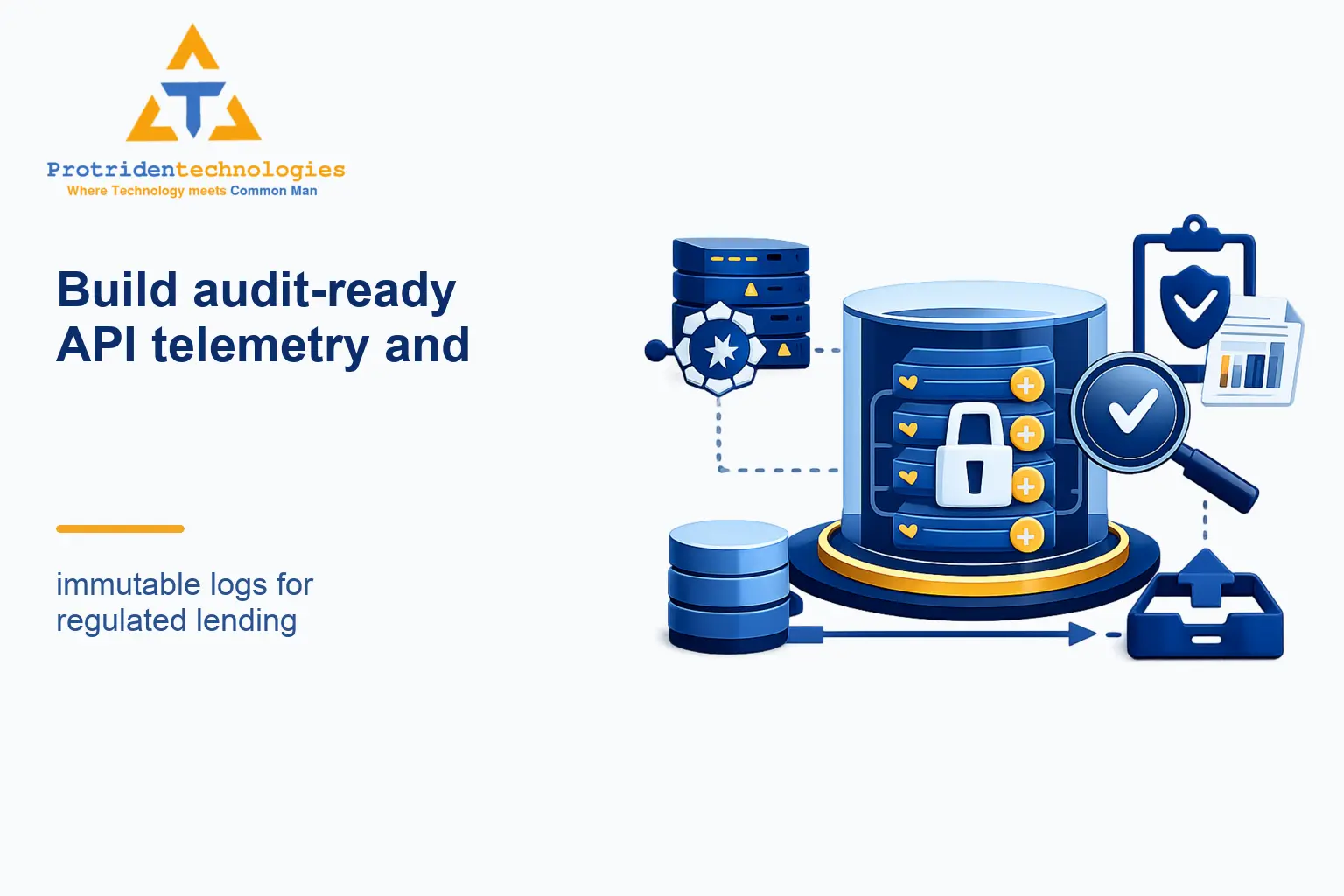
Regulated lenders increasingly face audit requests and incident investigations that require tamper-evident, searchable API logs. Many platforms rely on ad-hoc logs or ephemeral diagnostics that cannot prove what happened across services, slowing investigations and risking regulatory findings.
Engineering teams must produce evidence-grade telemetry that is immutable, discoverable and exportable under retention policies tuned for examiners and internal forensics. Building this correctly touches gateways, storage, search and access controls.
Specialist experience is often needed to design end-to-end pipelines that preserve integrity, enable fast queries for auditors, and integrate with compliance workflows without breaking production performance. This guide focuses on practical steps and decision factors for regulated lenders.
Why This Topic Matters
When lenders cannot produce reliable API-level evidence, audits and incident investigations take longer, remedial work grows costlier, and compliance risk rises. API telemetry is the single source of truth for interactions that touch credit decisions, identity checks and money flows; it needs immutability, retention and searchability to serve as defensible evidence.
Centralized, structured API telemetry makes response to examiner requests repeatable and reduces overhead when reproducing events across distributed services. It also supports fraud investigation and post-incident root-cause analysis by correlating caller identity, payloads, and downstream outcomes.
- Provides tamper-evident records necessary for audit and forensics
- Enables fast, precise searches across API calls and user identifiers
- Supports retention policies and lawful export for examiners or legal requests
- Reduces investigation time and operational cost through centralized observability (see sources S1, S4, S8)
Research references: The Role of API Gateways in Modern Mortgage Lending Platforms; The Vital Role of APIs in the Digital Lending Ecosystem; What Is API in Lending? Guide for Lenders | Vergent.
Common Mistakes Businesses Make
Teams often treat telemetry as operational noise rather than evidentiary material; they log only what helps debugging and not what an auditor would demand. Another frequent error is relying solely on application logs without an immutable storage or chain-of-custody mechanism.
Misconfiguring sampling, retention and access controls creates gaps: too aggressive sampling drops required records, while permissive access increases the risk of unauthorized modification or exposure. Finally, neglecting standardized schemas makes cross-service searches slow and error-prone.
- Logging only for dev/debug rather than audit readiness
- No immutability or verifiable chain-of-custody for stored logs
- Inconsistent event schemas that hinder search and correlation
- Unclear retention/export policies and lack of secure access controls
Practical Checklist / Steps
Use this checklist to validate an implementation plan for audit-ready API telemetry. Start at architecture and proceed through integrity, searchability, retention, access and compliance artifacts that auditors will request.
- Define the evidence scope and event schema: Specify which API requests, responses, headers, identifiers and decision outputs must be captured. Standardize a schema (timestamps, request IDs, principal IDs, operation, response codes, payload references) so queries return consistent results.
- Choose a gateway and collection points: Instrument the API gateway and service mesh to capture authoritative request/response metadata. Gateways provide a centralized choke point for consistent capture, rate limiting and initial enrichment before storage.
- Design immutable storage and chain-of-custody: Use append-only storage or write-once objects and store cryptographic hashes or signatures to detect tampering. Plan access logging for the storage itself so modifications or exports carry traceable audit trails.
- Implement secure, indexed search: Ship structured events to an indexed store that supports time-series and fielded search. Ensure indices preserve original events or references to immutable blobs; index only derived search fields to keep raw evidence intact.
- Set retention and export policies: Define retention periods aligned with regulatory or legal requirements and implement export formats for examiner requests (time-range exports, identifier-based bundles). Include metadata about retention start/end and legal holds.
- Enforce strong access controls and separation of duties: Restrict access to raw evidence, require multi-party approvals for exports, and use role-based access controls with MFA for auditor or investigator access. Maintain an approvals log for every export.
- Establish monitoring and alerting for telemetry health: Create alerts for missing telemetry flows, storage errors, or sampling anomalies. Regularly validate that a representative sample of calls can be reconstructed end-to-end for typical business actions.
- Document compliance artifacts and runbooks: Produce an evidence-handling runbook for auditors that explains collection points, schema, retention, immutability controls, and export procedures. Keep a change log for telemetry configurations and schema versions.
Cost, Timeline, or Decision Factors
Costs and timelines for audit-ready API telemetry vary by scope, existing infrastructure, and required controls. Key cost drivers are ingestion volume, retention duration, immutability mechanism, and effort to standardize schemas and access workflows. Timelines are affected by integration points, testing for forensic reproducibility, and organizational approvals for export and access controls.
Rather than fixed figures, evaluate projects by technical complexity (gateway changes, storage choices), operational impact (query performance, developer workflows) and compliance deliverables (runbooks, signed attestations). A staged pilot reduces risk and provides concrete data to estimate full rollout.
- Data volume and retention length determine storage and index costs
- Choice of immutability (append-only vs. cryptographic signing) affects implementation effort
- Number of integration points (API gateway, microservices, third-party IDV providers) adds integration time
- Searchability and UI for auditors increase development and UX effort
- Policies and legal review cycles influence organizational approval timelines
Local Relevance: India, Karnataka, and Udupi
Lenders operating in India should design telemetry with local compliance and examination practices in mind and maintain clear retention and export procedures. Protriden Technologies is based in Kundapura, Udupi, Karnataka, and offers local engineering and post-launch support to help teams in the region deploy and maintain audit-grade telemetry.
Indian examiners and evidence requests may require defensible export formats and secure handoffs; this amplifies the need for immutability, chain-of-custody metadata and documented runbooks. Working with a local partner can ease coordination for live audits and secure data transfers.
- Protriden Technologies provides onshore engineering support from Kundapura, Udupi, Karnataka
- Local operations simplify coordination for compliance reviews and evidence handoffs
- Design telemetry exports with secure transfer and approval workflows suited to Indian regulator expectations
How Protriden Technologies Can Help
Protriden Technologies can help lenders design, implement and validate audit-ready API telemetry without imposing vendor-specific lock-in. Our services span API architecture, deployment on cloud platforms, secure storage, observability dashboards and post-launch maintenance. We focus on delivering evidence artifacts and runbooks auditors expect.
We combine API engineering, application security, cloud monitoring and UI/UX to build searchable, immutable telemetry pipelines. For teams in Karnataka and nearby regions, Protriden offers local support for onboarding auditors, validating exports, and tuning retention and access workflows.
- Design standardized event schemas and gateway instrumentation
- Implement immutable storage patterns and cryptographic verification options
- Build indexed search and auditor-friendly export workflows
- Provide compliance documentation, runbooks and proof-of-concept pilots
- Offer cloud deployment, monitoring and ongoing support from Kundapura, Udupi, Karnataka
Final Thoughts
Audit-ready API telemetry is not purely a monitoring project; it is an evidence-management discipline that requires coordination across architecture, security, legal and operations. Prioritize defined schemas, immutable preservation and searchable indices so investigators and examiners can rely on your records.
Start with a bounded pilot that proves immutability, searchability and export workflows. Use the pilot’s metrics to make informed decisions about storage, retention and scaling. A pragmatic, staged approach lowers risk and delivers the compliance artefacts auditors need.
FAQs
What makes API telemetry “audit-ready”?
Audit-ready telemetry captures authoritative request and response metadata at defined collection points, preserves original events with tamper-evident controls, indexes derived fields for fast search, and includes documented retention and export procedures.
Do I need to log full payloads to be compliant?
Not always. Capture the elements auditors need (identifiers, request/response hashes, timestamps, decision outputs) and store full payloads only when required by regulation or forensic necessity. Use hashed references and secure blob storage to limit exposure while preserving evidence.
How can immutability be implemented without harming search performance?
Keep raw evidence in append-only or signed blobs and index only necessary derived fields to an optimized search store. This preserves an immutable source while enabling fast queries against indexed metadata rather than full payloads.
Will implementing audit-ready telemetry require replacing our API gateway?
Not necessarily. Many gateways and service meshes can be configured to emit consistent, enriched telemetry. The decision depends on current capabilities, required enrichment, and whether centralized capture at the gateway is feasible for your architecture.
How should we prepare for auditor export requests?
Define export formats and approval workflows in advance. Ensure exports include raw evidence or verifiable references, chain-of-custody metadata, schema documentation and an approvals log. Practice the export procedure with a dry run before live audits. You should also retain a change log for telemetry schema and configuration updates.
Request an API telemetry assessment from Protriden to scope a pilot that proves immutable capture, searchable exports and compliance artifacts for your audit needs.
Explore our software development services or discuss your requirements with the Protriden Technologies team.