
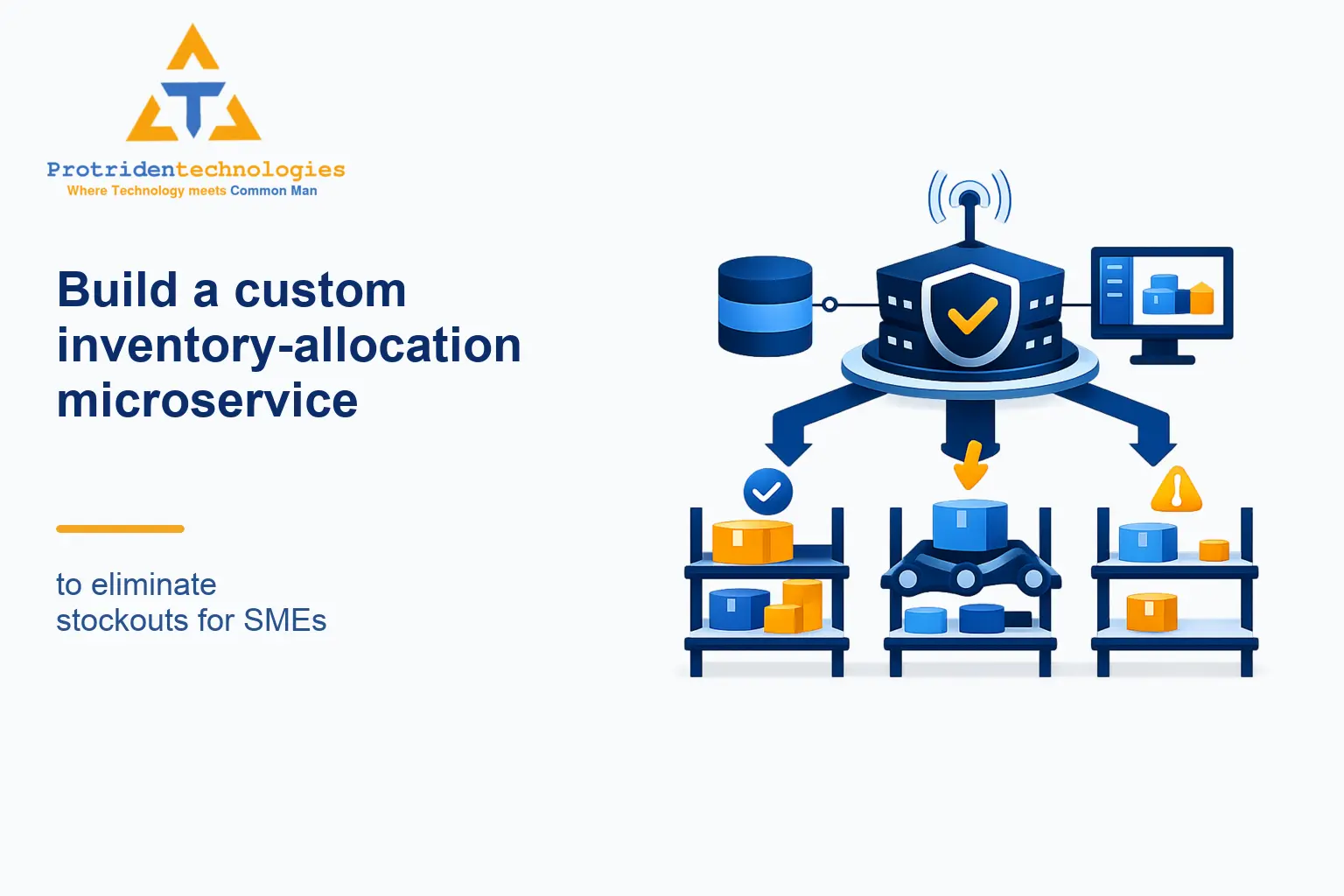
SME distributors, wholesalers and manufacturers routinely lose sales and tie up working capital because allocation decisions are manual, spreadsheets are inconsistent, and the ERP treats inventory as a single number rather than sellable stock per channel or location. The result: repeated stockouts for high-turn SKUs, overstock in low-demand items and delayed fulfilments that hurt customer retention.
A lightweight, focused inventory-allocation microservice can automate reservation, soft allocation and releases while integrating with legacy ERP and WMS, avoiding a full replatform.
SME teams need a phased approach: clarify allocation rules, validate with a small pilot, and introduce monitoring so the service reliably reduces missed orders without disrupting current operations.
Why This Topic Matters
Inventory allocation sits at the intersection of sales, procurement and fulfilment. Small errors cascade quickly: a promised-but-unavailable item costs a sale, while excess safety stock increases carrying costs. Microservices let teams isolate allocation logic, scale it independently and add visibility without rewriting the ERP core. Sources on microservice approaches and modular inventory services show this pattern is effective for targeted problems where full ERP replacement is impractical.
For SMEs, the business case is practical: reduce the frequency of stockouts, accelerate order-to-ship times and improve the accuracy of inbound replenishment decisions by using a dedicated allocation layer that speaks to existing systems.
- Isolates allocation logic so business rules can be changed without ERP customizations
- Supports soft reservations and sellable inventory calculations to avoid double-selling
- Enables event-driven updates and faster responses to demand spikes
- Scales independently during promotions or peak seasons without replatforming the ERP
Research references: Inventory Management System using Microservices: A Perfect Guide; Microservice: Setting Up the Inventory Management System | Coding Shuttle; Inventory Visibility Add-in overview - Supply Chain Management | Dynamics 365 | Microsoft Learn.
Common Mistakes Businesses Make
SMEs often assume the ERP already handles allocation adequately, only to discover it uses coarse inventory counts or lacks soft reservation semantics. Other common errors are over-scoping the project, trying to solve every inventory problem at once, or underestimating integration effort with connectors and data mappings.
Technical mistakes include tight coupling of the microservice to ERP schemas, no transactional compensation strategy for failed flows, and lack of real-time visibility for exceptions. Operational mistakes include insufficient stakeholder alignment on allocation priorities and missing KPIs to measure pilot success.
- Relying solely on the ERP without validating sellable inventory behavior
- Designing the microservice as a mini-ERP that duplicates core functionality
- Skipping compensation/event-driven rollback patterns for partial failures
- Failing to define clear allocation rules (channel priority, customer SLAs, expiry/FIFO)
- Deploying without dashboards, alerts and exception workflows for manual override
Practical Checklist / Steps
Use this checklist to scope a phased, fixed-scope pilot and a production rollout. Each step focuses on decision-useful outputs: testable rules, measurable KPIs and minimal invasiveness to existing ERP/WMS systems.
- Map current order-to-fulfilment flows: Document how orders move from sales channels into the ERP, how inventory is recorded, and where manual reconciliations happen. Identify touchpoints for the microservice to read/write reservations and inventory events.
- Define allocation objectives and KPIs: Agree measurable goals (for example: reduce missed shipments, improve order fill rate, shorten time-to-ship) and the KPIs you will track during the pilot and production.
- Specify allocation rules and exemptions: Capture rules such as channel priority, reserved stock for key customers, expiry handling, and per-location FIFO/LIFO. Keep rules scoped to what the pilot needs to prove value.
- Choose integration patterns: Decide between API-based synchronous calls, event-driven listeners, or a hybrid. Assess available ERP connectors, database access limitations and WMS APIs for real-time updates.
- Design for compensation and idempotency: Ensure the microservice uses idempotent operations and publishes compensation events to release or re-reserve inventory when downstream steps fail.
- Prepare a minimal dataset and environments: Select a representative set of SKUs, locations and customers for the pilot. Provision dev/test environments that mirror production interfaces where possible.
- Implement monitoring and exception workflows: Build dashboards for sellable inventory, reservation success/failure rates, and alerts for manual review. Define an operational runbook for exceptions.
- Run the fixed-scope pilot with controlled traffic: Deploy to a limited set of SKUs or channels, monitor KPIs, collect operational feedback and iterate rules before expanding scope.
Cost, Timeline, or Decision Factors
Cost and timeline for an inventory-allocation microservice vary by integration complexity, number of SKU/location combinations, and the need for near-real-time vs batched updates. An initial fixed-scope pilot typically focuses on a narrow set of SKUs and one or two integration points so the vendor can deliver measurable outcomes without a large upfront program.
Key decision factors include how the ERP exposes inventory and order data, whether a WMS is present, the maturity of existing data quality, and whether the deployment will be cloud-hosted or on-premises. These determine effort for connectors, data mapping, testing and monitoring.
- ERP and WMS integration complexity: APIs, batch files, database access or middleware required
- Number of SKUs, locations and sales channels to support in pilot and production
- Choice of synchronous vs event-driven architecture and the resulting SLAs
- Data quality and master-data reconciliation effort
- Operational readiness: staff to manage exceptions and maintain allocation rules
- Hosting and security requirements that affect deployment and monitoring work
Local Relevance: India, Karnataka, and Udupi
India's SME sector increasingly adopts modular cloud and microservice patterns to address specific operational bottlenecks without full ERP replacement. Protriden Technologies is based in Kundapura, Udupi, Karnataka and offers local delivery and support that understands regional supply-chain nuances, such as distributor networks, GST invoicing flows and logistics patterns in Karnataka.
Local partners can help accelerate integration with India-specific systems and compliance practices, and they can run on-the-ground workshops with warehouse and sales teams to ensure allocation rules reflect local realities.
- Local presence in Kundapura, Udupi, Karnataka enables on-site scoping, workshops and faster iterative feedback
- Familiarity with common ERP deployments and Indian tax/shipment documentation flows reduces friction during integration
- Regional knowledge helps prioritize channels and customers critical to SME revenue in Karnataka and nearby markets
How Protriden Technologies Can Help
Protriden Technologies provides end-to-end custom development, ERP integration, cloud deployment and post-launch monitoring. For inventory-allocation microservices they can scope a fixed-scope pilot, build connectors to ERP/WMS, implement allocation and compensation logic, and deliver dashboards and runbooks for operations.
Their local base in Kundapura, Udupi, Karnataka allows Protriden to run discovery workshops on-site and provide follow-on support tailored to SME operations and regional constraints.
- Scoping workshops to define allocation rules, KPIs and pilot boundaries
- Custom API or event-driven connectors to legacy ERPs and WMS
- Microservice development, Docker/CI-CD and cloud deployment on AWS or other providers
- Monitoring dashboards, alerting and operational runbooks
- Post-pilot extension to wider SKU sets and production rollouts
Final Thoughts
A narrowly scoped inventory-allocation microservice is a practical way for SMEs to reduce stockouts and improve fulfilment without replacing their ERP. The right pilot is conservative in scope, measurable in outcomes and engineered for safe integration with existing systems.
Decisions should balance technical risk (integration, data quality) and operational readiness (clear rules, exception handling). Use the pilot to de-risk a larger rollout and ensure allocation logic becomes a dependable layer that supports growth.
FAQs
How is an allocation microservice different from ERP inventory functionality?
An allocation microservice isolates reservation and allocation logic so rules can be changed independently. Many ERPs record on-hand quantities but lack soft reservation semantics or flexible channel-based allocation; a microservice can calculate sellable inventory, manage soft holds and publish events to downstream systems without altering ERP core behavior.
Will a microservice require changing our ERP?
Not usually. The goal is to integrate via supported APIs, message queues or controlled data extracts. Some ERP customizations might be needed for edge cases, but a good approach minimizes changes by using external connectors and compensation patterns to keep ERP as the source of record.
How long does a typical fixed-scope pilot take?
Pilot duration depends on ERP access, number of integrations, and rule complexity. Pilots are often designed for a short, measurable window—commonly weeks rather than months—to validate behavior on a subset of SKUs and channels. Exact timelines should be estimated after the discovery phase.
What operational changes will my team face?
Expect new dashboards, exception queues and a small set of manual override procedures. Teams will need to validate allocation rules, review flagged exceptions and trust the sellable inventory numbers. Training and a runbook for manual interventions are essential for smooth adoption.
How do you handle partial failures between order, allocation and fulfilment?
Use idempotent operations and compensation events: when a downstream step fails, the microservice publishes a release or rollback event to restore inventory. Designing clear retry windows, idempotency keys and human-review workflows for unmatched failures reduces risk of lost or double reservations.
Request a fixed-scope pilot estimate to integrate an inventory-allocation microservice with your ERP; we’ll scope a short pilot, define KPIs and deliver a deployment plan tailored to your operations.
Explore our software development services or discuss your requirements with the Protriden Technologies team.