
Digital marketing can help a business attract attention, generate enquiries, build trust, and reach customers beyond its immediate location.
But spending money on SEO, social media, content creation, or advertising does not automatically produce results.
Many businesses begin marketing before preparing the foundation required to convert attention into customers.
They start posting regularly, running advertisements, hiring an SEO agency, or promoting offers without clearly defining:
- Who they want to reach
- What they want customers to do
- Why customers should choose them
- Whether their website is ready
- How enquiries will be tracked
- Who will respond to leads
- How success will be measured
As a result, the business may receive traffic, likes, views, or clicks without generating meaningful enquiries.
Digital marketing cannot fix an unclear offer, a confusing website, slow customer response, or a business that is not ready to handle leads.
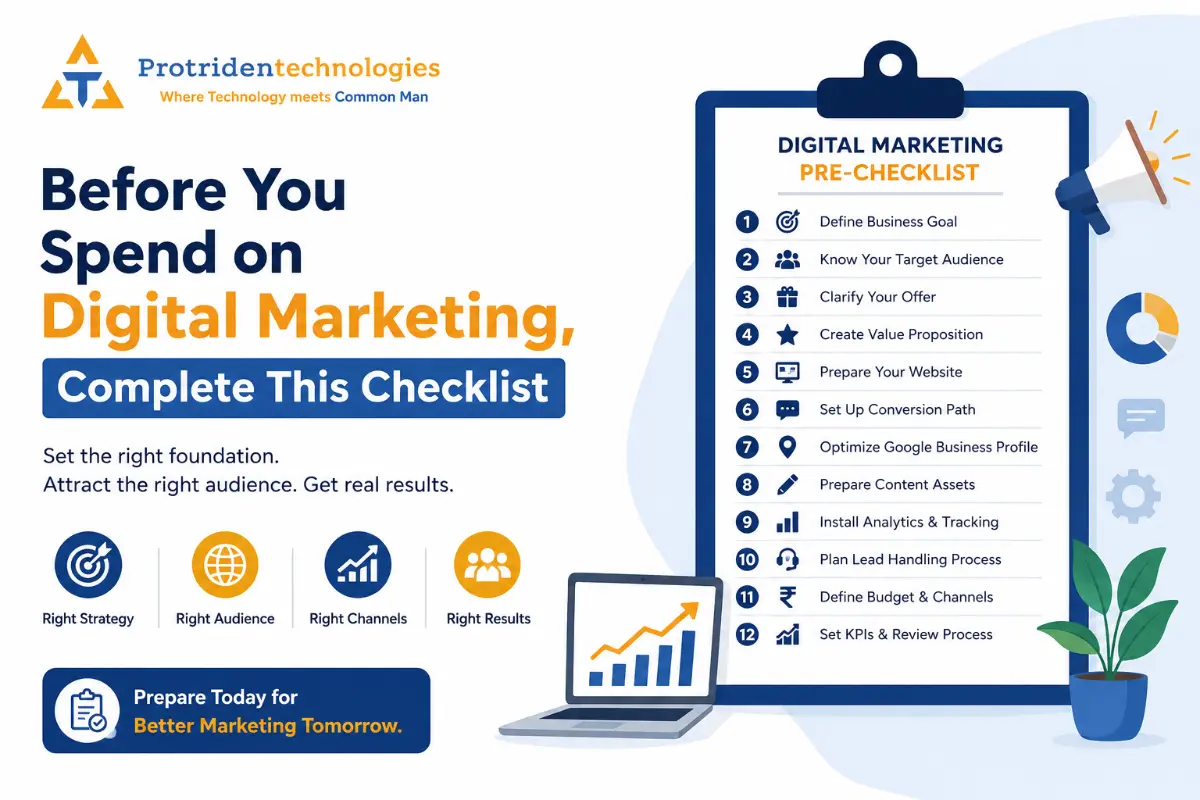
Before spending money, complete this digital marketing readiness checklist.
1. Define One Clear Business Goal
Do not begin digital marketing with a broad goal such as:
We want more business.
Decide what specific result you want your marketing activities to produce.
Your goal may be to:
- Generate quotation requests
- Receive more phone calls
- Increase WhatsApp enquiries
- Book appointments
- Sell products online
- Increase store visits
- Generate software project enquiries
- Build awareness in a new location
- Promote a new service
- Increase repeat purchases
- Collect qualified leads for a sales team
Different goals require different strategies.
For example, a local clinic seeking appointment bookings may focus on Google Business Profile, local SEO, service pages, reviews, and booking CTAs.
A startup launching a B2B software product may need founder-led LinkedIn content, educational blogs, landing pages, email capture, and product demonstrations.
An ecommerce business may require product-page optimization, conversion tracking, abandoned-cart follow-ups, SEO, social content, and paid campaigns.
What to prepare
Write one primary marketing goal for the next 90 days.
Example:
Generate qualified enquiries from business owners in Udupi and Mangalore who need website development or SEO services.
A focused goal makes channel selection, content planning, and measurement easier.
2. Identify Your Target Audience
Trying to reach everyone usually leads to weak messaging.
Define the customer most likely to need and purchase your product or service.
Your target-audience profile should include:
- Customer type
- Industry
- Location
- Business size
- Main problem
- Buying motivation
- Common objections
- Preferred communication channel
- Person involved in the buying decision
For example, Protriden Technologies may create different campaigns for:
- Startup founders planning an MVP
- Local businesses that need a lead-generating website
- SMEs managing operations through Excel
- App owners facing server-cost or performance issues
- Businesses that need SEO and better online visibility
Each audience has different problems.
A startup founder may be concerned about product scope, technology, development cost, and launch time.
A local business owner may be more concerned about Google visibility, website enquiries, WhatsApp leads, and customer trust.
What to prepare
Create a simple audience statement:
We help [specific audience] solve [specific problem] through [service or solution].
Example:
We help local service businesses improve online visibility and generate enquiries through conversion-focused websites, local SEO, and digital marketing.
3. Clarify Your Offer
Digital marketing becomes difficult when customers cannot understand what the business is offering.
Avoid promoting broad statements such as:
- We provide the best service.
- We offer complete solutions.
- We help every type of business.
- Contact us for all digital needs.
A strong offer clearly explains:
- What the service is
- Who it is for
- What problem it solves
- What is included
- What the customer should do next
For example:
Weak offer:
We provide digital marketing services.
Clearer offer:
We help local businesses improve Google visibility, strengthen their website, and generate more enquiries through SEO, Google Business Profile, and practical content marketing.
You may also create an entry-level offer that reduces the risk of contacting your business.
Examples include:
- Free website audit
- Free SEO visibility check
- Free app idea consultation
- Free server cost audit
- Free digital marketing readiness check
- Free business automation roadmap
What to prepare
Define:
- Your main service
- Your target customer
- Your primary business outcome
- Your entry-level offer
- Your main call to action
4. Create a Clear Value Proposition
Your value proposition should answer one important customer question:
Why should I choose your business?
It should not rely only on claims such as “high quality,” “affordable,” or “best service.” These phrases are widely used and rarely create meaningful differentiation.
A stronger value proposition may be based on:
- Industry experience
- Local understanding
- Technical capability
- End-to-end service
- Faster communication
- Clear process
- Ongoing support
- Business-focused recommendations
- Security and reliability
- Relevant project experience
For Protriden Technologies, the value proposition can focus on helping businesses move from ideas or manual processes to practical digital systems.
A suitable message could be:
Protriden Technologies helps startups and businesses plan, build, launch, and maintain practical digital systems that reduce manual work, improve customer experience, and support growth.
What to prepare
Write:
- One primary value proposition
- Three reasons customers can trust you
- One clear explanation of how your approach is different
5. Make Sure Your Website Is Ready
Marketing can bring visitors to your website.
But the website must help those visitors understand the business and take the next step.
Before promoting your website, check whether it clearly answers:
- What does the business offer?
- Who does it help?
- Which problem does it solve?
- Why should customers trust it?
- How can customers contact the business?
- What should the visitor do next?
Your website should also be:
- Mobile-friendly
- Fast-loading
- Secure
- Easy to navigate
- Professionally designed
- Search-engine friendly
- Clear about service areas
- Connected to analytics
- Easy to update
Every important service should ideally have a dedicated page.
For example, a software company offering websites, mobile apps, ERP development, cloud services, and SEO should not explain every service through one short homepage section.
Dedicated service pages give potential customers more clarity and provide stronger opportunities for search visibility.
Website readiness checklist
Confirm that your website has:
- Clear homepage messaging
- Individual service pages
- Strong contact options
- WhatsApp or enquiry CTA
- Contact form
- Trust elements
- Portfolio or case studies
- FAQ section
- Privacy policy
- Mobile optimization
- Analytics
- Proper page titles and descriptions
6. Prepare a Conversion Path
Traffic alone does not create business results.
Visitors need a clear path from interest to action.
A conversion path may be:
Google search → service page → case study → enquiry form → discovery call
Or:
LinkedIn post → blog article → free consultation CTA → form submission
Or:
Instagram Reel → profile → website → WhatsApp enquiry
Decide what action customers should take after viewing your content.
Possible actions include:
- Call
- Send a WhatsApp message
- Submit a form
- Book a consultation
- Request an audit
- Purchase a product
- Schedule an appointment
- Download a guide
- Join an email list
Do not present too many competing CTAs on the same page.
A service page should normally have one main action and, where useful, one secondary action.
What to prepare
Define:
- Primary CTA
- Secondary CTA
- Landing page
- Required form fields
- Confirmation message
- Follow-up process
7. Set Up Google Business Profile and Local Visibility
For businesses serving customers in a specific location, Google Business Profile is an important part of digital marketing readiness.
It can help customers discover the business through Google Search and Maps.
Before starting local marketing, verify that your profile includes:
- Correct business name
- Business category
- Address
- Service areas
- Opening hours
- Website link
- Phone number
- Service details
- Business description
- Relevant photos
- Customer reviews
- Regular updates
Your business name, address, phone number, and website information should remain consistent across the website, Google Business Profile, social media profiles, and local directories.
For Protriden Technologies, local campaigns may target businesses in Kundapura, Udupi, Manipal, Mangalore, and other Karnataka locations.
What to prepare
- Complete Google Business Profile
- Add current services
- Upload professional photos
- Request genuine client reviews
- Reply to existing reviews
- Publish regular educational and service updates
8. Prepare Your Brand Messaging and Visual Identity
Customers should be able to recognize your business across the website, social media, advertisements, and marketing materials.
Before creating content, prepare basic brand guidelines.
These may include:
- Logo files
- Brand colours
- Fonts
- Image style
- Writing tone
- Tagline
- Company introduction
- Service descriptions
- CTA language
- Social media templates
Your brand does not need to look overly corporate.
It needs to be clear, consistent, and credible.
A local business can use a simple visual identity while still appearing professional.
Protriden’s content, for example, should use a practical and technology-focused visual style with blue and yellow brand accents, clear layouts, and easy-to-understand messaging.
What to prepare
Create approved versions of:
- Short company introduction
- Long company description
- Service descriptions
- Social media bio
- Logo
- Colour palette
- Post templates
- CTA statements
9. Prepare Useful Content Assets
Digital marketing requires more than promotional posts.
Before launching campaigns, collect or create useful content assets.
These may include:
- Service explanations
- Customer FAQs
- Product photos
- Team photos
- Office photos
- Project screenshots
- Case studies
- Client reviews
- Demo videos
- Before-and-after examples
- Educational blog articles
- Short-form videos
- Downloadable checklists
Your content should answer questions customers ask before buying.
For a software development company, useful topics may include:
- How much does app development cost?
- What should an MVP include?
- Why does an application need an admin panel?
- How should a founder choose a software company?
- How can businesses reduce cloud costs?
- When should a company move from Excel to ERP?
- How long does software development take?
- What support is needed after launch?
Helping customers understand these topics builds trust before a sales discussion begins.
What to prepare
Build a small content library containing:
- Ten common customer questions
- Five educational posts
- Three service posts
- One company-trust post
- One project or capability post
- One lead-magnet promotion
10. Install Analytics and Conversion Tracking
Do not spend on digital marketing without deciding how results will be measured.
Basic tracking should help you understand:
- How visitors reached the website
- Which pages they viewed
- Which campaigns generated clicks
- How many people submitted forms
- How many clicked WhatsApp
- How many called the business
- Which content generated enquiries
- Which leads became customers
Depending on your marketing channels, you may need:
- Google Analytics
- Google Search Console
- Google Tag Manager
- Meta Pixel
- LinkedIn Insight Tag
- Google Ads conversion tracking
- Call tracking
- Form tracking
- UTM parameters
- CRM or lead sheet
You do not need every tool on the first day.
But you need enough tracking to connect marketing activity to business results.
Important metrics
Track:
- Website visits
- Search impressions
- Website clicks
- Form submissions
- WhatsApp clicks
- Calls
- Consultation bookings
- Cost per lead
- Qualified leads
- Proposals sent
- Closed customers
Views and likes may support awareness, but they should not be the only measures of success.
11. Prepare Your Lead-Handling Process
Marketing may generate enquiries, but poor follow-up can waste those opportunities.
Before launching a campaign, decide:
- Who will receive enquiries?
- Who will reply?
- How quickly should they reply?
- What information should be collected?
- How will leads be qualified?
- Where will lead details be stored?
- When will follow-ups happen?
- Who will update the lead status?
A basic lead record may contain:
- Date
- Name
- Company
- Phone number
- Location
- Source
- Service required
- Budget range
- Timeline
- Status
- Follow-up date
- Notes
Response quality also matters.
Avoid sending only:
Please call us.
Instead, acknowledge the enquiry, ask relevant questions, and guide the prospect to the next step.
Example response
Thank you for contacting Protriden Technologies. To understand your requirement, could you share the type of product or service you need, the target users, expected launch timeline, and approximate budget range? We can then recommend the most practical next step.
What to prepare
- Lead-response template
- Qualification questions
- Follow-up schedule
- Lead-tracking system
- Discovery-call process
12. Define Your Budget, Channels, and KPIs
Do not divide a small marketing budget across every available platform.
Select channels based on where your target audience searches, spends time, and makes decisions.
For example:
Local service businesses may prioritize:
- Google Business Profile
- Local SEO
- Website optimization
- Customer reviews
- Google Ads
B2B companies may prioritize:
- SEO blogs
- Founder-led content
- Email outreach
- Case studies
- Google Search
Ecommerce businesses may prioritize:
- Product SEO
- Meta advertising
- Google Shopping
- Email marketing
- Retargeting
Define separate budgets for:
- Website improvements
- Content production
- SEO
- Paid campaigns
- Design
- Video creation
- Marketing tools
- Lead management
Also define the KPIs you will review weekly or monthly.
Recommended KPIs
- Website clicks
- Search impressions
- Google Business Profile actions
- Form submissions
- WhatsApp clicks
- Calls
- Social media reach
- Saves and shares
- Qualified enquiries
- Discovery calls
- Proposals
- Closed business
A campaign should be improved based on business data, not personal preference.
Common Mistakes Businesses Make Before Starting Digital Marketing
Starting without a clear offer
Customers cannot respond to a service they do not understand.
Promoting a weak website
Marketing increases traffic, but a confusing website loses that traffic.
Targeting everyone
Broad audiences usually create generic messages and low-quality leads.
Posting without a strategy
Random posts may keep a profile active but may not build trust or generate enquiries.
Running ads without tracking
Without conversion tracking, the business cannot tell which campaign generated valuable actions.
Ignoring follow-ups
Even good leads may disappear when replies are delayed or unclear.
Measuring only followers and likes
Visibility matters, but qualified leads and sales matter more.
Stopping too early
SEO, content marketing, and organic social growth require consistent execution and regular improvement.
Digital Marketing Readiness Checklist
Before launching your campaign, confirm that you have:
- One clear business goal
- A defined target audience
- A clear offer
- A strong value proposition
- A conversion-ready website
- Clear calls to action
- A complete Google Business Profile
- Consistent branding
- Useful content assets
- Analytics and conversion tracking
- A lead-response process
- Defined channels, budget, and KPIs
When these foundations are ready, digital marketing has a better chance of generating meaningful business results.
How Protriden Technologies Can Help
Protriden Technologies helps startups, local businesses, SMEs, and growing companies prepare and execute practical digital marketing systems.
Depending on the business requirement, support can include:
- Website development
- Landing-page development
- Website audits
- SEO
- Local SEO
- Google Business Profile guidance
- Content planning
- Social media marketing
- Lead-generation campaigns
- Analytics setup
- Conversion tracking
- Business automation
- Lead-management systems
The objective is not only to increase traffic or social media activity.
The objective is to help the business build a clear digital foundation that can attract, capture, and manage customer enquiries.
Final Takeaway
Digital marketing should not begin with an advertisement.
It should begin with preparation.
Before spending money, make sure your business has:
- A clear goal
- A defined customer
- A relevant offer
- A trustworthy website
- A conversion path
- Proper tracking
- Useful content
- A reliable follow-up system
When the foundation is strong, SEO, social media, content, and paid advertising can work together more effectively.
When the foundation is weak, even a large marketing budget may produce clicks without customers.
Frequently Asked Questions
What should a business prepare before starting digital marketing?
A business should define its goal, target audience, offer, value proposition, website, conversion path, content assets, analytics, lead-handling process, budget, channels, and KPIs.
Does a business need a website before starting digital marketing?
A website is strongly recommended for most businesses because it provides a central place to explain services, build trust, capture enquiries, and track conversions. Some local campaigns may begin with Google Business Profile or social media, but a professional website usually strengthens long-term marketing.
Which digital marketing channel should a small business start with?
The best channel depends on the customer and business goal. Local businesses may begin with Google Business Profile, local SEO, and a strong website. B2B companies may prioritize LinkedIn and SEO content. Ecommerce businesses may need product SEO, social media, email, and paid campaigns.
How much should a business spend on digital marketing?
The budget depends on the market, competition, services, location, content requirements, and selected channels. Businesses should first prepare the marketing foundation and then assign a realistic test budget with clear measurement.
How can a business measure digital marketing success?
Track website clicks, enquiries, WhatsApp clicks, calls, form submissions, qualified leads, proposals, customer acquisition cost, and closed business. Reach and engagement can support awareness, but they should not be the only KPIs.
Why do digital marketing campaigns fail?
Campaigns often fail because of unclear targeting, weak offers, poor websites, missing tracking, inconsistent content, slow lead follow-up, unrealistic expectations, or selecting channels that do not match the audience.
Is digital marketing useful for local businesses?
Yes. Local businesses can use Google Business Profile, local SEO, customer reviews, location-based service pages, social media, and targeted advertising to improve discovery and generate enquiries.
Is Your Business Ready for Digital Marketing?
Before investing in SEO, content, social media, or paid advertising, make sure your website, offer, tracking, and lead process are ready.
Request a free digital marketing readiness check from Protriden Technologies.
We can review:
- Your website
- Service messaging
- Google visibility
- Calls to action
- Basic SEO setup
- Conversion tracking
- Content readiness
- Enquiry process
Request a Free SEO Visibility Check