
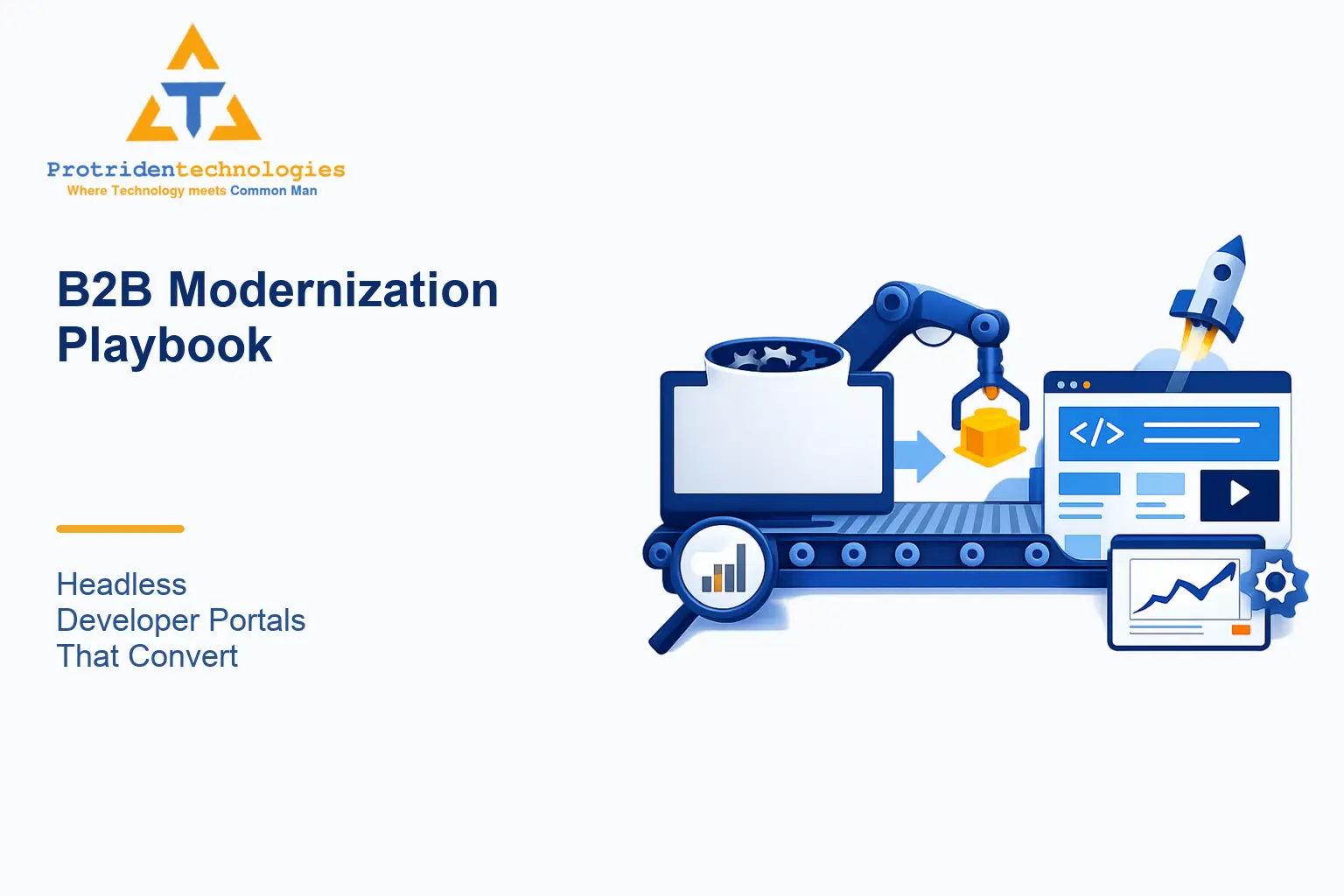
Developer-facing B2B sites often underperform as conversion tools. Companies find partner leads and technical buyers dropping off because documentation is outdated, search traffic has fallen, onboarding flows are fragmented, and engineering teams struggle to update content in monolithic CMSs. The result: lost partner deals and longer sales cycles.
Technical buyers expect fast, searchable docs, runnable examples, clear API reference and a predictable onboarding path. Modern headless architectures help, but teams need a staged plan to migrate without breaking traffic or developer trust.
Marketers and product owners must balance SEO remediation, content architecture and DX (developer experience) while minimizing disruption to integrations and partner workflows.
This playbook helps procurement and product teams choose a staged engagement: audit, headless CMS proof-of-concept, portal build and focused SEO remediation to restore organic partner leads.
Why This Topic Matters
Developer portals are not marketing microsites; they are sales infrastructure. Technical buyers evaluate APIs and integrations through documentation, SDKs and sample apps. If those pages are hard to find, outdated or slow to render, partners delay or abandon proof-of-concept work.
Headless CMS and component-driven frontends separate content from presentation, enabling engineering teams to iterate on SDK samples, interactive docs, and portal UX without hazardous monolith deployments. That separation accelerates updates and reduces friction for technical decision-makers.
Search visibility and structured docs are critical. Recovering organic traffic after algorithm changes requires consistent content architecture, schema, and performance improvements tied to developer intent, not just generic marketing copy.
- Developer docs and API reference are primary buying signals for technical evaluators.
- Headless architectures enable independent deployment of docs and UI, reducing release risk.
- SEO remediation must prioritize developer intent, structured data and page performance to restore organic partner leads.
Research references: B2B Web Portal Development: Features, Process, Costs & Case Studies; B2B Web Portal Development Guide | Ramotion Agency.
Common Mistakes Businesses Make
Treating a developer portal as a marketing brochure. Teams replicate product pages and gloss over API reference, interactive examples, and versioned docs that developers actually use.
Big-bang migrations without a proof-of-concept. Moving dozens or hundreds of technical pages into a new platform without validating render patterns, schema, and search index behavior risks traffic and partner disruption.
Overlooking measurability and handoff. Failing to instrument conversion funnels, observation of technical content usage, and developer feedback loops prevents iterative improvement after launch.
- Publishing docs in a monolithic CMS that requires engineering sprints for every content change.
- Migrating content without preserving URLs, structured schema, or redirects and losing organic traffic.
- Prioritizing flashy UX over runnability: interactive code sandboxes and samples must be runnable and versioned.
Practical Checklist / Steps
Use a staged, evidence-driven approach: audit, small proof-of-concept, prioritized migration and post-launch remediation. Each step delivers a measurable outcome and reduces risk.
Checklist items below map to outputs you can require in vendor contracts or retainers: audit report, POC demo, migration backlog, SEO remediation plan, and telemetry dashboard.
- Audit technical content and traffic sources: Inventory developer-facing pages (API reference, tutorials, SDKs, changelogs), map URLs and organic traffic; identify pages driving partner leads and pages with high drop-off. Include crawlability, render times and structured-data gaps.
- Define developer conversion metrics: Agree on measurable outcomes such as time-to-first-success (run sample), API keys requested, partner signup completions and organic sessions to documentation pages. Instrument events and baseline current performance before any migration.
- Proof-of-concept with headless CMS: Build a small POC of critical flows: an API reference page with OpenAPI-driven rendering, a tutorial with runnable code, and a version selector. Validate content editing UX for product writers and the deployment pipeline for engineers.
- Content architecture and URL preservation plan: Design content models (reference, how-to, SDK, changelog) and map canonical URLs. Prepare redirects and canonical tags for any URL changes to protect search equity and developer bookmarks.
- Developer UX and onboarding flow design: Prioritize discoverability of Getting Started, quick-start code snippets, and SDK setup. Design a clear partner onboarding funnel with checkpoints, sample apps, and frictionless credentialing.
- SEO remediation and structured data: Apply schema where appropriate (FAQ, software application, breadcrumb) and ensure OpenAPI/Swagger is exposed for search indexing. Audit meta content for developer intent and improve page performance.
- Incremental migration and staging: Migrate content in batches that match traffic and conversion priority. Use the POC deployment pattern to verify rendering, monitoring and search index behavior before moving additional pages.
- Launch monitoring and iterative optimization: Monitor organic traffic, API-key requests, session flows and error telemetry. Run targeted A/B tests on onboarding copy, sample placement and code sandbox defaults to improve technical buyer conversion.
Cost, Timeline, or Decision Factors
Budget and timeline depend on content volume, integration complexity and compliance needs. A minimum viable portal migration often begins with a POC that proves the headless pattern for critical developer journeys and can be delivered faster than a full rewrite.
Typical enterprise B2B portal MVP timelines and cost bands vary with scope. Research shows MVP timelines commonly range from four to nine months, with cost varying by integration depth and platform choices. Exact figures require scoping a content inventory, integrations and security requirements.
Choose a vendor engagement model that aligns incentives: a staged fixed-scope audit and POC, followed by prioritized delivery sprints and a retention plan for SEO remediation and post-launch support.
- Content volume: number of reference pages, tutorials, SDK docs and languages.
- Integration complexity: single sign-on, analytics, developer console, billing APIs and CDNs.
- Regulatory and compliance needs: data residency, logging, security reviews or ISO requirements.
- Team readiness: availability of product writers, engineers for API-first content and DevOps for CI/CD.
Local Relevance: India, Karnataka, and Udupi
If you are operating in India, partnering with a local or regional agency can reduce coordination friction during discovery and handoff. Protriden Technologies operates from Kundapura in Udupi, Karnataka, enabling local on-site collaboration for regional clients and familiarization with Indian partner ecosystems.
For Karnataka-based teams, proximity to Indian developer talent pools and shared working hours simplifies workshops, content handoffs and iterative quality assurance rounds during migration stages.
- Protriden Technologies is located in Kundapura, Udupi, Karnataka, India.
- Local on-site workshops and post-launch support can be arranged to suit regional clients and stakeholders.
How Protriden Technologies Can Help
Protriden Technologies offers services aligned to each stage of the modernization playbook: content and SEO audits, headless CMS proof-of-concept, developer portal builds, cloud deployment and post-launch support. Work can be scoped as a fixed-scope audit + POC followed by delivery sprints and retained SEO remediation.
Protriden’s practice includes responsive website and custom web application development, UI/UX and backend APIs, cloud deployment and monitoring, CI/CD automation, and local SEO and content support that together cover the technical and discovery needs of developer-portal modernization.
- Content architecture audit and documentation inventory with prioritized remediation backlog.
- Headless CMS proof-of-concept and frontend pattern library for API reference and tutorials.
- Developer portal builds: UI/UX, backend APIs, admin panels and runnable code samples.
- Cloud deployment, performance monitoring, Docker/CI-CD and post-launch maintenance.
- Local SEO and content support to restore and improve developer-focused organic traffic.
Final Thoughts
Modernizing a developer portal is both a technical migration and a product redesign. The most successful projects minimize risk by proving core flows with a POC, protecting search equity through intentional URL and schema handling, and aligning teams around measurable developer conversion metrics.
Plan for staged deliverables that produce value early: a documentation audit that shows which pages to fix first, a headless POC that proves editing and rendering, and prioritized migrations focused on high-value partner journeys.
Choose a delivery partner who can bridge product, engineering and SEO disciplines and offer post-launch remediation and measurement. That combination preserves organic leads while improving technical buyer conversion over time.
FAQs
How quickly can we see traffic recovery after migrating developer docs?
Recovery timing depends on migration approach, URL preservation, schema implementation and search indexing. If you preserve canonical URLs or cleanly redirect them, implement structured data and ensure pages are performant, you can usually observe stabilization of organic traffic within weeks to a few months. Exact timing requires monitoring and iterative remediation.
Do we need a headless CMS for a developer portal?
A headless CMS is not mandatory but it provides operational benefits: it separates content from presentation, enables componentized docs, and allows product teams to update tutorials and guides without full deployments. Evaluate a POC to confirm it meets your editing, versioning and rendering needs.
What are the biggest SEO risks during migration?
Losing URLs, failing to implement redirects, dropping structured data, and introducing slower page rendering are the main risks. An audit and a migration plan that preserves canonical signals and validates search behavior in stages will reduce those risks.
How should we prioritize pages for migration?
Prioritize pages by conversion impact: Getting Started guides, API reference pages that trigger SDK or API key requests, and tutorials that close deals. Use analytics to rank pages by developer traffic and conversion signals, and migrate high-value pages first under the POC pattern.
What level of vendor involvement is typical post-launch?
Post-launch work commonly includes SEO remediation, fixing edge-case render issues, adding structured data, monitoring funnels and running iterative UX experiments. Vendors typically offer retained support plans covering monitoring, content updates, and performance improvements.
If you’re evaluating agencies for a staged modernization—audit, headless POC and prioritized portal build—contact Protriden Technologies for a scoped discovery that maps content, traffic and developer conversion outcomes.
Explore our software development services or discuss your requirements with the Protriden Technologies team.