
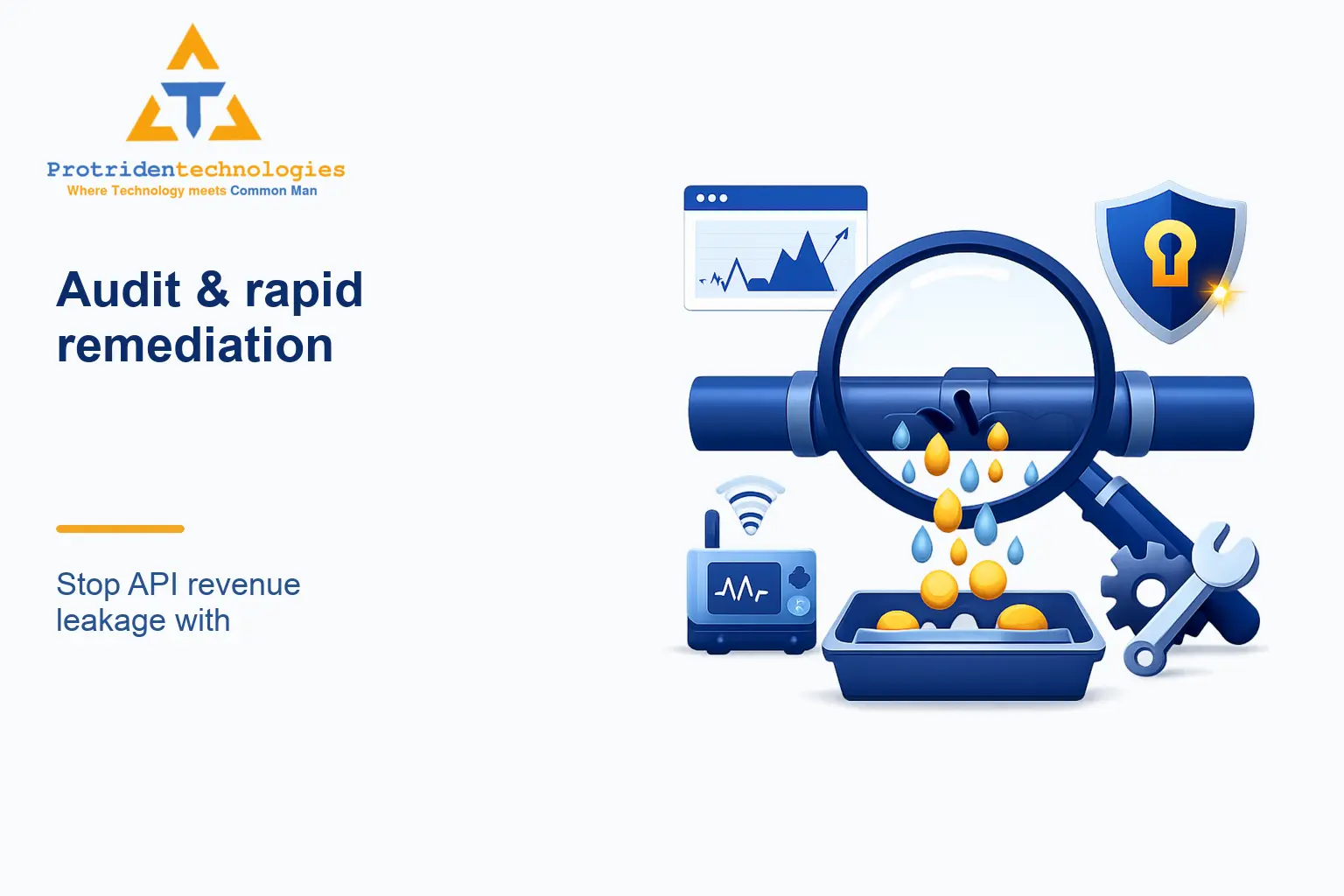
Sudden usage spikes, billing gaps or customer complaints often mean API usage is slipping past billing controls. Stolen API keys, unmetered endpoints and missing telemetry let abusive traffic and integration errors generate unbilled or misbilled usage that erodes revenue and damages trust.
A focused external audit can identify secret exposure, telemetry blind spots and billing reconciliation failures faster than internal firefighting. This article explains an audit-led remediation approach and a short pilot maintenance program that prioritizes fixes and reduces future leakage risk.
Read on for why this matters, common mistakes engineering teams make, a practical checklist to run an audit, decision factors that affect cost and timelines, local relevance in India and Karnataka, and how Protriden Technologies can help.
Why This Topic Matters
API revenue leakage is material because small, continuous losses compound and because abused or miscounted usage undermines pricing, forecasting and customer relationships. Industry guidance recommends frequent, automated audits aligned to billing frequency rather than annual checks to avoid months of unnoticed loss (see sources).
Beyond direct revenue loss, leakage signals gaps in controls that invite larger operational failures: stolen keys can lead to runaway third-party costs, shadow APIs can expose data, and missing telemetry prevents rapid detection and root-cause analysis. A program that combines secrets management, telemetry and maintenance reduces both immediate loss and systemic risk.
- Leakage often starts with exposed secrets or weak credential policies that let third parties use paid APIs undetected.
- Incomplete or absent telemetry — missing usage dimensions, no correlation with billing identifiers, or aggregated metrics only — makes reconciliation and incident triage slow or impossible.
- Regular audits aligned to billing cycles reduce the window during which abuse can cause material loss.
- Remediation must prioritize fixes that reduce recurring impact and enable short feedback loops to prove the fix actually stopped leakage.
Research references: How to Identify and Avoid Revenue Leakage in 2026; API Audit Checklist 2026 | Secure Your APIs, Ensure Compliance & Stop Breaches; SaaS Revenue Leakage Audit: 7 Steps and Cause Codes | MxM; What Is Revenue Leakage? How To Prevent It?.
Common Mistakes Businesses Make
Teams often focus on perimeter security while neglecting usage-level controls. That looks like strong network rules but no per-key telemetry, coarse usage aggregation, or no automated alerts for unusual rate patterns. These gaps let abuse persist even when traditional security scans report green.
Another frequent error is treating billing reconciliation as a finance-only problem. If telemetry lacks the identifiers finance needs to reconcile usage and invoices, the reconciliation will miss unbilled consumption.
Many organizations also defer secrets hygiene — long-lived API keys, lack of rotation, or hard-coded credentials in client apps. That increases the attack surface and delays detection of compromise.
- Relying on aggregate metrics instead of per-key or per-customer telemetry.
- Only doing annual or ad-hoc leakage checks that miss months of cumulative loss.
- Separating security, billing and engineering ownership so no team is accountable for end-to-end usage accuracy.
- Assuming cloud-provider metrics are sufficient without validating the billing dimensions used by invoicing systems.
Practical Checklist / Steps
Run this checklist as the basis for a 1–3 week diagnostic audit. The goal is to produce a prioritized remediation ticket list plus an evidence-backed pilot plan that proves the fixes.
- Inventory and discovery: Enumerate public and internal APIs, clients, and credential issuers. Find shadow and undocumented endpoints using traffic analysis, service meshes, API gateways and static code scans.
- Secrets and credential audit: Locate all API keys and long-lived tokens, including those embedded in mobile apps or scripts. Check rotation policies, issuer logs, and expiration. Mark high-risk credentials for immediate rotation or revocation.
- Telemetry gap analysis: Compare telemetry fields to billing identifiers: do you have per-key, per-customer, per-endpoint usage? Validate timestamps, dimensions and aggregation windows so finance can reconcile invoices to raw usage events.
- Anomaly detection and alerting: Deploy or enable realtime alerts for volume, rate and pattern anomalies per key and per endpoint. Define thresholds and runbooks for rapid containment (e.g., rate-limiting, temporary key suspension).
- Billing reconciliation test: Reconcile a recent billing cycle using telemetry exports and billing data. Record unmatched usage items and assign cause codes (e.g., unmetered endpoint, missing customer tag, internal test traffic).
- Prioritize remediation tickets: Rank fixes by recurring revenue impact, ease of implementation and detection latency reduction. Create a 4-week pilot that targets the top tickets and includes verification steps.
- Post-remediation verification: After fixes, rerun reconciliation and anomaly-detection tests. Produce before/after metrics such as reduction in unmatched usage and time-to-detect for new anomalies.
Cost, Timeline, or Decision Factors
Cost and timeline for an audit-plus-pilot program depend on scope (number of APIs, public vs internal), current telemetry maturity, secrets hygiene, and required integration with billing systems and finance exports. A compact public-API audit can be faster than a full enterprise audit that includes internal services and legacy integrations.
Decisions about remediation sequencing should weigh recurring impact versus quick wins. Prioritize fixes that remove ongoing leakage, enable better detection, and unblock accurate billing reconciliation.
- Scope: More endpoints and integrations increase effort for discovery and reconciliation.
- Telemetry maturity: If per-key metrics already exist, time-to-value shortens; if telemetry needs redesign, timelines extend.
- Secrets complexity: Widespread long-lived credentials require more coordination for rotation and client updates.
- Billing data access: Direct access to billing exports speeds reconciliation; if not available, additional integration effort is required.
Local Relevance: India, Karnataka, and Udupi
India’s SaaS and API-driven ecosystem has high growth and frequent cloud adoption, which makes rapid detection of API abuse an operational priority. Local legal and commercial nuances — for example, how contracts define billable units and dispute processes — influence audit scope and remediation decisions.
Protriden Technologies is based in Kundapura, Udupi, Karnataka. Working with a local partner can reduce coordination friction for Indian customers and provide regional context for vendor invoices, compliance expectations and on-ground support needs.
- Karnataka is a major technology hub; local teams understand common Indian cloud billing patterns and domestic vendor relationships.
- Local presence helps align the audit cadence with Indian finance cycles and dispute-resolution practices.
- On-site or nearby support in Udupi and Kundapura can accelerate stakeholder interviews and credential rotation work when client-side approvals are needed.
How Protriden Technologies Can Help
Protriden Technologies offers an audit-first approach: a diagnostic that discovers secrets exposures, maps telemetry to billing identifiers and produces a prioritized remediation roadmap. The output is a focused set of tickets and a 4-week pilot plan that delivers measurable verification steps.
Our services combine UI/UX, backend APIs, cloud monitoring and maintenance. For teams that lack dedicated telemetry engineers or need an independent assessment, Protriden can run the diagnostic, implement fixes for highest-impact items, and hand off a maintenance SLA that keeps detection and rotation processes active.
- Deliverables include an evidence-backed audit report, remediation tickets prioritized by recurring impact, and a 4-week pilot proposal.
- Hands-on support options: credential rotation assistance, telemetry field redesign, anomaly alert tuning and billing export integration.
- Maintenance options: periodic audits, on-call incident support for suspicious usage spikes, and SLAs for telemetry and secrets hygiene checks.
Final Thoughts
API revenue leakage is often fixable with a short, focused audit that targets secrets exposure, telemetry gaps and reconciliation blind spots. The most reliable programs combine immediate remediation for recurring losses with a maintenance discipline that prevents recurrence.
Choosing the right scope and prioritization matters: aim first for fixes that reduce recurring loss and enable fast detection, then invest in broader telemetry and process improvements. An external partner can accelerate discovery and deliver a practical pilot that proves the approach.
FAQs
How long does an audit typically take?
Audit duration depends on scope: a focused public-API audit is faster, while a full enterprise audit covering internal services and many integrations takes longer. Rather than fixed dates, estimate based on number of APIs, telemetry maturity and required billing integrations.
Will an audit identify stolen API keys in mobile apps or public repos?
Yes—discovery activities include scanning for hard-coded keys, analyzing client-side distribution, and reviewing issuer logs. The audit flags exposed credentials and recommends rotation and compensating controls, but remediation often requires coordinated client updates.
Can you guarantee recovered revenue?
No. While audits and remediation reduce leakage risk and can uncover unbilled usage, guaranteed recovery depends on contract terms, billing histories and customer dispute processes. The audit provides prioritized evidence to support recovery actions and prevent future loss.
How do you verify that remediation worked?
Verification combines billing reconciliation (before/after unmatched usage), telemetry tests (synthetic transactions and anomaly detection), and a defined observation window. The pilot plan includes measurable verification steps tailored to each remediation ticket.
What ongoing program is needed to prevent recurrence?
A maintenance program should include periodic audits aligned with billing cadence, automated alerts for per-key anomalies, credential rotation policies and a reactive SLA for suspicious spikes. Frequency and SLAs depend on business risk and billing complexity.
Request an API telemetry audit to get a prioritized remediation report and a 4-week pilot proposal.
Explore our software development services or discuss your requirements with the Protriden Technologies team.