Mid‑market CTOs must choose cloud vendors for AI projects but face unclear GPU SLAs, unpredictable GPU cost spikes, and data‑residency constraints that can delay delivery or burst budgets during pilot-to-production transitions. Making the wrong selection can inflate total cost of ownership and complicate compliance.
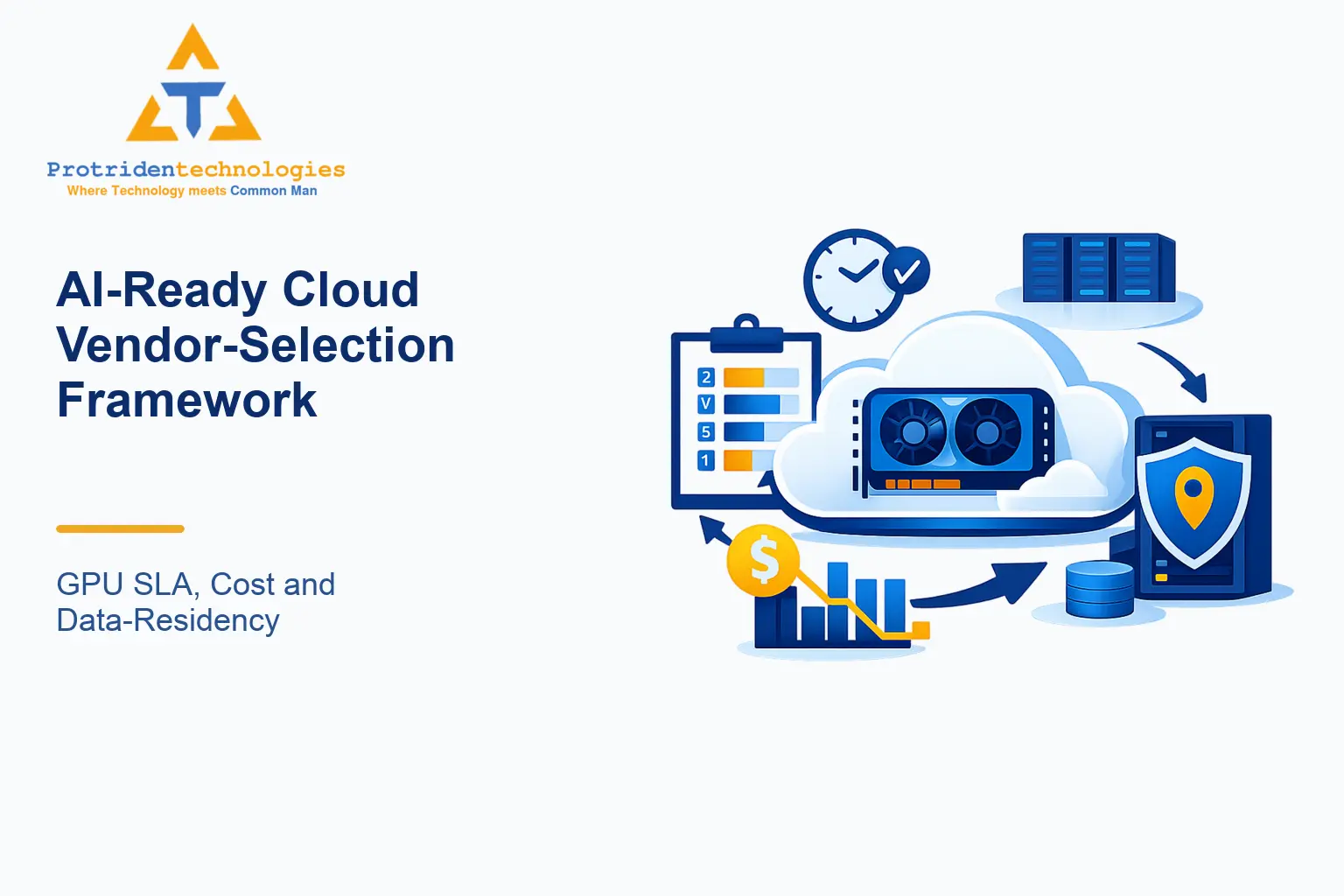
This article provides a practical decision framework and a downloadable vendor scorecard focused on GPU SLAs, cost drivers and data‑residency checks so teams can shortlist vendors faster and with fewer surprises.
The checklist is vendor-agnostic and oriented to mid‑market constraints: limited procurement cycles, constrained engineering capacity and the need to balance latency, compliance and FinOps discipline during AI rollout.
Why This Topic Matters
AI workloads change the procurement calculus: GPU capacity, placement, cooling and network connectivity matter as much as VM SKU names. Cloud adoption frameworks for AI highlight the need to isolate AI infrastructure, choose appropriate connectivity to on‑prem sources and manage administrative access to reduce risk while enabling performance.
Hidden operational and licensing costs can overwhelm anticipated cloud spend. A procurement approach that treats GPU hours as the only cost will understate licensing, model access, data transfer, storage IO and engineering time to integrate vendor tooling.
Data residency and auditability are now checklist items in several guidelines and advisory frameworks. Organisations must validate where data and logs are stored, how role‑based access is enforced, and whether the vendor provides the written evidence needed by privacy officers before production deployment.
- AI cloud choices must balance performance (GPU type, network, storage IO) with governance (data residency, logging and access control).
- TCO for AI includes model licensing, observability, integration effort and variable GPU availability—beyond per‑hour rent.
- A structured vendor scorecard reduces negotiation time and surfaces operational risk earlier.
Research references: AI Ready - Cloud Adoption Framework | Microsoft Learn; AI vendor selection and management framework | Xenoss Blog; Ud.
Common Mistakes Businesses Make
Teams often evaluate providers by headline VM SKUs and on‑demand GPU prices alone, ignoring GPU availability SLAs, preemption behaviour, or the operational support needed to maintain sustained throughput for training or inference.
Procurement processes can miss recurring hidden costs: model hosting fees, dedicated interconnects, egress charges for large datasets, persistent storage IOPS, and vendor tool licensing. Underestimating these creates budget shock during scale‑up.
Failing to verify data residency, audit logging, and contractual proof of encryption and role‑based access can force late rework or even block deployment in regulated jurisdictions.
- Relying solely on spot or preemptible GPU pricing without a fallback plan for sustained workloads.
- Skipping a pilot that tests real data and realistic load—accepting vendor test results on vendor‑selected datasets.
- Assuming identical operational support across providers; response times and troubleshooting ownership vary.
Practical Checklist / Steps
Use this practical checklist during vendor discovery and procurement workshops. Each step links to a concrete deliverable you can score on a vendor scorecard: documentation evidence, test results or contract clauses.
Scorecard sections map to three decision pillars: performance & availability, cost & FinOps, and governance & data residency.
- Define target workloads and critical success metrics: Document representative training and inference flows, maximum dataset sizes, peak concurrency, acceptable latency, and error budgets. Include real sample payloads and I/O patterns so pilots exercise realistic storage and network behaviour.
- Request GPU SLA and availability details: Ask vendors for documented GPU availability SLAs, preemption/eviction policies, average provisioning time for specific GPU types, and published incident response times for GPU infrastructure.
- Validate end‑to‑end performance in a short pilot: Design a time‑boxed pilot that runs your workload on each vendor with the same dataset and pipeline. Collect GPU utilization, training time, IOPS, network throughput, and failure modes. Treat pilot as a test of integration effort as much as raw speed.
- Map total cost of ownership categories: Capture direct GPU hours and instance costs plus model licensing, data egress, storage IO, dedicated interconnects, monitoring, and expected engineering hours for deployment and runbook creation. Use ranges to reflect uncertainty.
- Check contractual proofs for data residency and controls: Request written evidence that data, backups and logs remain in the required jurisdiction, plus details on encryption at rest and in transit, role‑based access, audit logging, and vendor commitments for compliance needs.
- Score operational support and escalation model: Verify support SLAs, escalation paths, and whether the vendor will troubleshoot GPU-level issues. Confirm what constitutes vendor vs customer responsibility for multi‑tenant GPU failures.
- Assess exit strategy and data portability: Confirm how to export models, datasets, and metadata. Check any proprietary hooks or managed services that create vendor lock‑in and evaluate the migration effort needed to move to another provider.
- Run a cost sensitivity and availability stress test: Simulate doubling usage, sudden price shifts, or reduced GPU availability to see how costs and delivery timelines change. Flag scenarios that breach budget or SLA tolerances.
Cost, Timeline, or Decision Factors
Selecting a vendor is a multi‑criteria decision: not a single metric. Prioritise which outcomes matter—lowest cost today, predictable long‑term spend, strict data residency, or fastest time‑to‑market—and weight your scorecard accordingly.
Expect tradeoffs: the lowest headline GPU rate can come with higher hidden costs or weaker governance; the most compliant vendor may require higher integration effort or regional availability constraints.
- Business priority: regulatory compliance and data residency vs performance and cost optimization.
- Workload profile: training‑heavy projects need sustained availability; inference at scale needs lower latency and different GPU provisioning.
- Operational maturity: vendors with managed AI services reduce engineering time but increase managed‑service lock‑in and potential recurring fees.
- FinOps sensitivity: assess how variable GPU pricing or spot volatility affects monthly budgets and procurement flexibility.
Local Relevance: India, Karnataka, and Udupi
In India, data‑residency and privacy guidance have become part of procurement checklists—organisations must be able to show where personal and sensitive data is stored and how access is controlled. Verify vendor evidence that data and backups for Indian workloads remain in approved locations and that audit logs can be exported for review.
For teams in Karnataka, Udupi and Kundapura, regional connectivity and available cloud regions matter. Lower latency to nearby cloud regions or edge points of presence reduces inference latency and can improve cost efficiency for interactive applications.
Local vendors or regional cloud partners sometimes offer tailored commercial terms or presence that simplifies compliance checks. Evaluating regional presence, local support availability, and whether the vendor's regional infrastructure meets your residency needs is essential for India deployments.
- Confirm whether the vendor’s Indian cloud regions or local partners keep data and backups within the country and can provide contractual proof.
- Assess network paths between office/edge sites in Kundapura/Udupi and the chosen cloud region; plan for dedicated connect if latency or throughput is critical.
- Include local support and escalation capability in scoring—onshore support can reduce troubleshooting time for production incidents.
How Protriden Technologies Can Help
Protriden Technologies helps mid‑market teams run vendor selection pilots and build the migration shortlist. We combine infrastructure deployment experience on AWS and DigitalOcean with application integration, Docker/CI‑CD, observability and post‑launch support to validate vendor choices against your real workloads.
We provide a scorecard workshop to quantify GPU SLA, TCO and data‑residency risk, and can run short pilots to gather the performance and cost metrics needed for procurement decisions. Our local presence in Kundapura (Udupi district, Karnataka) supports India‑specific compliance and connectivity planning.
- Run vendor scorecard workshops and supply a downloadable, customisable vendor comparison matrix.
- Execute short pilots on representative workloads using Docker, CI/CD pipelines and monitoring to collect real performance and cost data.
- Advise on cloud region selection, data residency controls and integration with existing application stacks and ERPs.
- Support migration scoping, runbook creation and post‑launch monitoring to reduce operational surprises.
Final Thoughts
Choosing an AI cloud vendor is a strategic decision that blends performance, cost discipline, and governance. Use a scorecard approach, insist on evidence during pilots, and treat data residency checks and exit plans as non‑negotiable.
A short, structured procurement process that includes realistic pilots and a documented TCO will reduce surprises and give you negotiating leverage. If you need a starting point, use the downloadable scorecard and run a two‑week pilot to validate assumptions before signing multi‑month contracts.
FAQs
What is a GPU SLA and why does it matter?
A GPU SLA describes availability, provisioning and incident response expectations for GPU infrastructure. It matters because preemption, long provisioning times or frequent maintenance on GPU instances can delay training and increase costs, affecting the reliability of AI pipelines.
Can I rely on spot/preemptible GPUs to reduce cost?
Spot or preemptible GPUs can lower short‑term costs but introduce eviction risk and variability. Use them for non‑critical, checkpointed workloads and design fallback strategies for sustained training or latency‑sensitive inference to avoid production disruptions.
How should I evaluate data residency claims from vendors?
Ask for written proof of where primary data, backups and logs are stored, details on encryption and role‑based access, and the ability to export audit logs. Validate these during a pilot and confirm contractual clauses that meet your compliance requirements.
What hidden costs should my scorecard capture?
Capture model hosting or inference fees, monitoring and observability costs, storage IOPS and egress charges, dedicated interconnect fees, and estimated engineering hours for integration and runbook development—these often exceed headline GPU charges.
How long does a reliable pilot take?
A reliable pilot should be time‑boxed but realistic: typically one to four weeks depending on data volume and test coverage. The goal is to collect performance and cost metrics under representative load, not to fully productionise the pipeline.
Download the vendor scorecard and book a short scoping workshop with Protriden to quantify GPU SLA, TCO and data‑residency risk for your AI workloads.
Explore our software development services or discuss your requirements with the Protriden Technologies team.